Emerging 2026 Product Trends and the Supply Chain Factors Behind Them
The world of product demand never stops changing. As we move into 2026, importers and logistics teams face a shifting landscape where the products driving growth look different from just a few years ago. Automation, clean energy, and digital infrastructure are pulling freight volumes in new directions. At the same time, tighter regulations on carbon and packaging are reshaping how goods move and how much it costs to bring them across borders.
This post gives you a clear picture of what’s trending in 2026, why demand is rising, the key risks you need to watch, and how to prepare your supply chain to handle it all. We’ll walk through ten product categories split between business-to-business and consumer markets, then show you the logistics moves that separate smooth operations from costly delays.
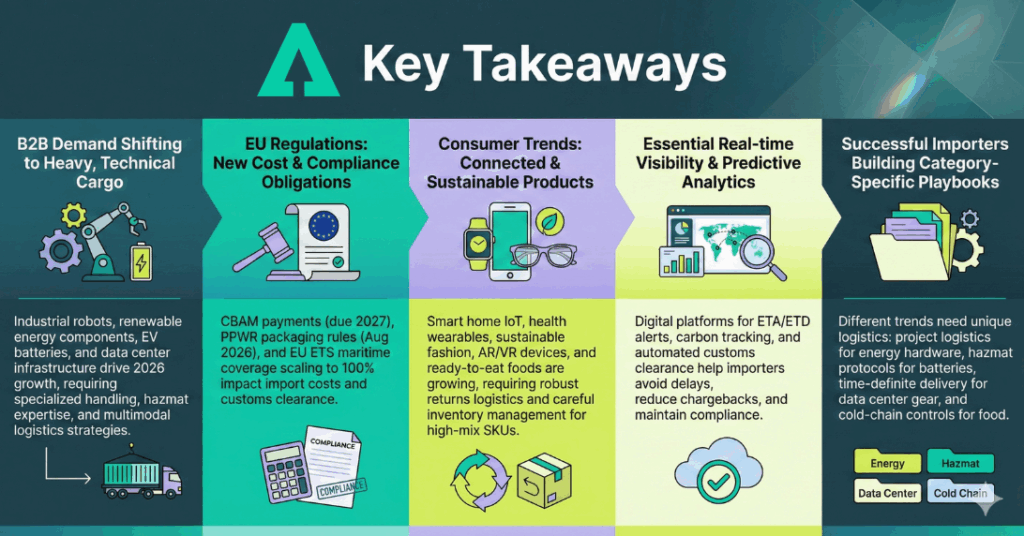
Key Takeaways
- B2B demand is shifting toward heavy, technical cargo: Industrial robots, renewable energy components, EV batteries, and data center infrastructure are driving 2026 growth, requiring specialized handling, hazmat expertise, and multimodal logistics strategies.
- EU regulations create new cost and compliance obligations: CBAM payments for 2026 imports (due 2027), PPWR packaging rules effective August 12, 2026, and EU ETS maritime coverage scaling to 100% will directly impact import costs and customs clearance.
- Consumer trends favor connected devices and sustainable products: Smart home IoT, health wearables, sustainable fashion, AR/VR devices, and ready-to-eat foods are growing, requiring robust returns logistics and careful inventory management for high-mix SKUs.
- Real-time visibility and predictive analytics are now essential: Digital platforms that provide ETA/ETD alerts, track carbon emissions, and automate customs clearance help importers avoid delays, reduce chargebacks, and maintain compliance.
- Successful importers are building category-specific playbooks: Different product trends require different logistics approaches—project logistics for energy hardware, hazmat protocols for batteries, time-definite delivery for data center gear, and cold-chain controls for food.
2026 Supply Chain Snapshot
Before diving into specific products and trends, let’s look at the big picture shaping 2026 planning.
Demand remains strong in several pockets despite broader economic uncertainty. Energy infrastructure, factory automation, data centers, and select consumer electronics continue to attract investment and drive freight volumes. Companies are responding by pushing harder on digital visibility and using artificial intelligence to sharpen demand forecasts, track shipments in real time, and catch exceptions before they become chargebacks.
On the regulatory front, the pressure is building. The EU Carbon Border Adjustment Mechanism transitions from reporting-only to payment obligations starting January 1, 2026, with the first declaration for 2026 imports due September 30, 2027. The EU Packaging and Packaging Waste Regulation applies from August 12, 2026, requiring importers to hold declarations of conformity for packaging that meets strict material efficiency and recyclability standards. And shipping costs tied to carbon keep climbing as the EU Emissions Trading System for maritime transport scales from 70% coverage for 2025 emissions to 100% for 2026 emissions, with allowances surrendered in 2027.
These aren’t vague future targets anymore. They’re active compliance obligations that hit your cost structure and customs clearance in 2026. Smart importers are mapping their tier-two and tier-three suppliers now, adding visibility tools to catch delays early, and building playbooks for each high-growth product category.
B2B Trends – 5 Products & Industries to Watch
Business-to-business demand in 2026 tilts toward heavy, technical, and often oversized cargo. Expect specialized handling, hazmat classifications, and longer lead times for many of these categories. The smart move is to build buffer stock for critical items and secure dual routing options before peak season hits.
1 Industrial automation & robotics
Factory floors worldwide are adding more robots. Global industrial robot installations reached 542,000 units in 2024, with forecasts showing growth to 575,000 units in 2025. Asia accounted for 74% of new deployments in 2024, with Europe at 16% and the Americas at 9%. China alone represents more than half of global demand, but Europe and North America are expanding too as labor costs rise and precision requirements tighten.
The electronics cycle is rebounding, and collaborative robots are moving into small and mid-sized manufacturers that couldn’t justify automation before. For logistics teams, this means precision packing, export crating for sensitive servo motors and controllers, and managing spare parts flows that can’t afford customs delays. Articulated robots and SCARA units dominate installations, but mobile robots for warehouse automation are growing fast.
2 Renewable-energy hardware (PV, wind components)
Solar PV is projected to account for around 80% of global renewable capacity expansion over the next five years, with nearly 600 GW of capacity additions expected in 2025. Utility-scale projects drive the bulk of this growth, but distributed solar on commercial rooftops and industrial sites is climbing too. Wind energy adds another layer, with onshore turbines expanding in emerging markets and offshore installations ramping up in China and Europe.
Logistics for renewable hardware is multimodal and site-specific. Solar modules ship in volume containers, but inverters, mounting systems, and balance-of-system components require careful sequencing to avoid costly site delays. Wind components like blades and tower sections need specialized transport, port staging, and sometimes road permits for oversized loads. Lead times stretch to months, so planning around production schedules and weather windows is critical.
3 EV components and battery systems
Automotive lithium-ion battery demand surged by approximately 65% from 330 GWh in 2021 to 550 GWh in 2022, driven primarily by growth in electric passenger car sales. That trajectory continues through 2026 as automakers push more electric models to market and battery pack sizes grow to support longer ranges.
Cells, modules, battery management systems, and charging equipment all move under hazmat rules. Lithium-ion batteries fall under dangerous goods class 9, which means specific packing instructions, labeling requirements, and carrier restrictions. Some shipping lanes have limited capacity for hazmat cargo, so expect lane risk and the need to switch modes or routes mid-transit. Temperature controls matter too, especially for cells in storage or in-transit longer than planned. It’s important to build contingency into your transport plan and make sure your freight forwarder has hazmat expertise.
4 Data-center & AI infrastructure (racks, power, liquid cooling)
Artificial intelligence workloads are driving a data-center build-out that shows no signs of slowing. Servers, power distribution units, cooling systems, and rack infrastructure are all in high demand. Liquid cooling solutions, which handle the heat from dense AI chip clusters, are a particular hot spot as traditional air cooling hits its limits.
Much of this gear is heavy, fragile, and time-sensitive. A delayed server shipment can push back a facility commissioning by weeks, so importers are paying premiums for time-definite freight and using real-time tracking to rebook fast if a vessel or flight gets delayed. Lead times for specialized power gear can stretch past six months, making early Purchase Order placement and staged inventory essential.
5 Sustainable packaging & materials
From August 12, 2026, packaging placed on the EU market must comply with strict rules on material and space efficiency. That’s pushing demand for recycled plastics, fiber-based alternatives, and right-sized packaging formats that cut empty space and reduce transport emissions.
Importers sourcing packaging materials face new documentation requirements. Manufacturers and importers must keep technical documentation demonstrating packaging compliance with design, recyclability, and substance restrictions, along with an EU Declaration of Conformity. Get those documents sorted with your suppliers now, because customs can ask for them and delays cost money. Sourcing recycled content reliably also takes time, so dual-source your packaging suppliers and test alternatives before you’re forced to switch mid-year.
B2C Trends – 5 Products & Industries to Watch
Consumer-facing products in 2026 show strong growth in connected devices, health tech, and sustainable fashion. Logistics strategies need to balance air freight for fast launches with ocean for steady replenishment, and plan for returns at scale since many of these categories see high return rates.
1 Smart-home & consumer IoT
Connected devices keep expanding. Smart speakers, security cameras, sensors, and app-controlled appliances are moving beyond early adopters into mainstream homes. The product mix is diverse, SKUs multiply quickly, and accessories like sensors or batteries add complexity to fulfillment.
Expect high-mix, small-parcel shipments and tight reverse logistics flows. Returns can hit double digits in consumer electronics, so you need grading and refurbishment processes that get working units back to sellable inventory fast. Tariff classification matters too, as some connected devices fall under different HS codes than their offline equivalents, which can shift duty rates or trigger additional compliance checks.
2 Health wearables & at-home diagnostics
Wrist-worn fitness trackers, smart glasses with health sensors, hearables that monitor biometrics, and at-home test kits all saw strong shipment growth in 2024 and 2025. That momentum carries into 2026 as consumers prioritize health monitoring and convenience.
Some SKUs need compliance checks beyond standard consumer electronics. At-home diagnostic kits may require serial tracking for recalls, and any device making health claims can trigger regulatory review. Plan for returns grading that separates devices by condition and, where needed, temperature-controlled storage for test kits that lose accuracy if exposed to heat. Lead times for health-focused electronics can be longer due to quality checks, so buffer inventory accordingly.
3 Sustainable fashion & traceable textiles
Buyers and regulators are pushing fashion brands to prove origin and impact. The EU is working on Digital Product Passports for textiles, which will require detailed supply chain data, material composition, and environmental footprint for garments sold in Europe. While the full rollout extends past 2026, brands are starting to align supplier documentation now.
For logistics teams, this means tighter coordination with textile mills and cut-and-sew factories to capture data at each stage. You’ll need digital records of fiber sources, dyeing processes, and finishing treatments. Traceability also helps with customs under programs like the US Uyghur Forced Labor Prevention Act, where proving your cotton didn’t come from restricted regions avoids costly shipment holds.
4 AR/VR devices and smart glasses
Immersive hardware and AI-powered smart glasses are bouncing back. After a few slower years, augmented reality headsets and mixed-reality glasses are seeing renewed interest driven by improved software, lighter form factors, and new use cases in gaming, remote work, and navigation.
Launches drive sharp demand spikes, so air freight and expedited ocean are common. Returns and warranty swaps run high in early batches as users test fit and functionality, so reverse logistics must be smooth. Fragile optics and electronics mean packaging needs to protect during international transit and last-mile delivery. Plan for product localization too, as some markets require different power adapters, language packs, or compliance labels.
5 Ready-to-eat and convenience foods (non-alcohol)
Busy lifestyles and growing cross-border e-commerce are lifting demand for shelf-stable and chilled ready-to-eat items. Meal kits, snack packs, and specialty foods that travel well are moving across borders more than ever.
Cold-chain quality assurance is essential if you’re shipping chilled items. Shelf-life controls matter for all foods, so track production dates closely and use first-expired-first-out inventory rules. Rapid relabeling for local regulations is another must, as nutrition labels, allergen warnings, and ingredient lists vary by country. Build that flexibility into your fulfillment setup so you’re not stuck with unsellable inventory when a rule changes.
2026 Enablers & Risks: What Will Make or Break Execution
Let’s cut to the short list of levers and blockers that decide whether your 2026 supply chain runs smoothly or stumbles.
Real-time visibility and predictive alerts are no longer nice-to-have features. They’re competitive necessities. Systems that flag delays, predict dwell at congested ports, and auto-rebook freight save money and keep customers happy. Invest in platforms that integrate with carriers and customs brokers so you see exceptions early and act before they turn into chargebacks or lost sales.
Carbon and compliance obligations are hitting costs directly in 2026. CBAM requires importers to purchase certificates for embedded emissions in covered goods, with the first payments due in 2027 for 2026 imports. EU ETS for shipping scales to 100% coverage for 2026 emissions, which means every ton of CO₂ from your ocean freight into Europe costs real money. And PPWR packaging rules apply from August 12, 2026, so non-compliant packaging can get stopped at customs.
The solution isn’t just compliance paperwork. It’s building carbon tracking into your freight decisions, working with suppliers to lower embedded emissions where possible, and choosing packaging that meets EU standards before you ship. Companies that treat this as a cost to manage will do better than those scrambling to fix problems after the fact.
Capacity strategy rounds out the must-dos. Multimodal mixes hedge against single-mode disruptions. Buffer stocks for long-lead items keep production lines running when a shipment is late. Flexible routings around geopolitical hotspots or port congestion let you pivot fast. These moves cost a bit more upfront but pay off when things go sideways.
Importer Action Plan (High-level Checklist)
Here are some of the steps your team can run now to get ahead of 2026 trends and risks.
- Map tier-two and tier-three suppliers and lanes. Knowing only your direct supplier isn’t enough. Understand where raw materials and components come from so you can spot risks early and add alternate sources in each region. This also helps with CBAM and traceability requirements, where proving origin matters.
- Tighten PO-to-fulfillment control. Use estimated time of arrival and estimated time of departure alerts to rebook freight fast when delays hit. Set up triggers that automatically notify your team when a shipment falls behind schedule, so you can switch to air or a faster vessel before it’s too late.
- Standardize product data to support PPWR, Digital Product Passports, and retailer EDI needs. Clean, structured data about materials, weights, dimensions, and compliance attributes speeds customs clearance and reduces errors. Build this into your product master data now, not when a customs officer asks for it.
- Build a returns and refurbishment loop for consumer tech and apparel. High return rates in these categories mean you need efficient grading, testing, and resale processes. Work with logistics partners who can handle returns in-market and get working units back into inventory quickly.
- Create playbooks per trend. Energy hardware needs project logistics expertise. Batteries require hazmat handling. Data-center gear demands time-definite delivery. Food needs cold-chain controls. Having a documented playbook for each category prevents mistakes and speeds onboarding for new team members or partners.
Quick Recap & KPIs to Watch
Let’s wrap with a one-page summary and the metrics that show if you’re winning.
Trends Recap
On the B2B side, industrial automation and robotics, renewable-energy hardware, EV components and batteries, data-center and AI infrastructure, and sustainable packaging materials are all seeing strong demand growth in 2026.
On the B2C side, smart-home and consumer IoT, health wearables and at-home diagnostics, sustainable fashion and traceable textiles, AR/VR devices and smart glasses, and ready-to-eat convenience foods are the categories to watch.
KPIs that matter
Port dwell time tells you if cargo is sitting too long at terminals. Forecast error shows how accurate your demand predictions are. On-time in-full delivery tracks whether shipments arrive when and how they should. Damage and claim rates reveal packaging and handling quality. CO₂ per shipment measures your carbon efficiency. The percentage of auto-cleared customs entries shows how clean your documentation is. Return-to-resale rate tells you how fast you’re getting returns back to sellable inventory.
Track these weekly or monthly, depending on volume. When a KPI slips, dig into the root cause fast and fix it before it becomes a pattern.
Partner with a Trusted Supply Chain Expert
The 2026 landscape demands more than traditional freight forwarding. You need a logistics partner who understands digital visibility, complex compliance, and global scalability.
Unicargo combines smart technology with deep supply chain expertise to help businesses navigate these challenges. Our digital platform gives you real-time tracking, automated customs clearance, and end-to-end visibility so you catch problems early and keep shipments moving. We handle the full range of logistics services including international shipping, e-commerce fulfillment & global warehousing, PO management, and trade compliance, all backed by regional offices across three continents.
Whether you’re scaling renewable energy hardware shipments, managing hazmat requirements for battery logistics, or ensuring your packaging meets EU standards, Unicargo’s tailored solutions adapt to your needs. Our platform integrates with your systems to streamline booking, monitor carbon emissions, and provide the data you need for CBAM, PPWR, and other regulatory obligations.
Ready to build a supply chain that handles 2026’s trends and regulations with confidence? Contact Unicargo today to learn how we can support your growth.
Frequently Asked Questions (FAQ)
Q1: What is CBAM and how will it affect my 2026 imports into the EU?
A: The Carbon Border Adjustment Mechanism (CBAM) is an EU regulation that puts a carbon price on certain imports to prevent carbon leakage. Starting January 1, 2026, importers must purchase CBAM certificates for embedded emissions in covered goods (iron & steel, aluminum, cement, fertilizers, hydrogen, and electricity). The first declaration for 2026 imports is due September 30, 2027. You’ll need accurate emissions data from your suppliers to calculate obligations and may face higher costs if you rely on default emission values instead of actual supplier data.
Q2: What are the new EU packaging requirements coming in 2026?
A: The EU Packaging and Packaging Waste Regulation (PPWR) applies from August 12, 2026. All packaging placed on the EU market must comply with strict material efficiency, recyclability, and space-efficiency requirements. Importers must hold a declaration of conformity for each packaging type and maintain technical documentation proving compliance. PFAS substances in food packaging above specified thresholds will be prohibited. Start working with your packaging suppliers now to ensure compliance, as non-conforming packaging can be stopped at customs.
Q3: How is the EU ETS affecting shipping costs in 2026?
A: The EU Emissions Trading System for maritime transport scales to 100% coverage for 2026 emissions (surrendered in 2027), up from 70% for 2025 emissions. This means shipping companies must purchase allowances for every ton of CO₂ emitted on EU-related voyages. With EUA prices projected between €60-150 per ton in 2026, ocean freight costs to Europe will increase significantly. Most carriers are passing these costs to shippers through surcharges, so budget for higher freight rates and consider route optimization to reduce emissions.
Q4: What logistics challenges should I expect when importing EV batteries and components?
A: EV batteries fall under dangerous goods class 9 (lithium-ion hazmat), requiring specific packing instructions, labeling, and carrier restrictions. Key challenges include: limited carrier capacity for hazmat on certain lanes, potential mode switching requirements mid-transit, temperature control needs during storage and transport, and longer customs clearance times due to additional documentation. Work with freight forwarders who have hazmat expertise, build buffer inventory for long lead times (often 3-6 months), and establish dual routing options to manage lane risk.
Q5: How can I prepare my supply chain for these 2026 trends and regulations?
A: Start by mapping your tier-2 and tier-3 suppliers to understand where materials originate and identify alternate sources. Implement real-time visibility tools with ETA/ETD alerts so you can rebook quickly when delays occur. Standardize your product data to support PPWR, CBAM reporting, and Digital Product Passport requirements. Create category-specific logistics playbooks (hazmat protocols for batteries, project logistics for renewable energy hardware, cold-chain for food, etc.). Finally, partner with a logistics provider who offers integrated compliance expertise, digital visibility, and global reach to handle the complexity.