Importing Electronics to the USA: Complete Compliance Checklist
Bringing electronics into the United States involves more than finding a reliable supplier and booking freight. Every shipment must clear multiple regulatory hurdles, and a single documentation gap can trigger costly holds, fines, or outright seizures. Whether you’re importing Bluetooth headphones, smart home devices, or children’s tablets, understanding which agencies apply to your products is the foundation of a smooth import process.
This compliance checklist breaks down the specific requirements for electronics importers. You’ll learn how to quickly identify which regulations apply to your products, what documentation you need for each agency, and exactly what to send your customs broker or freight forwarder to minimize delays. By the end, you’ll have a reusable framework you can apply to every SKU in your catalog.
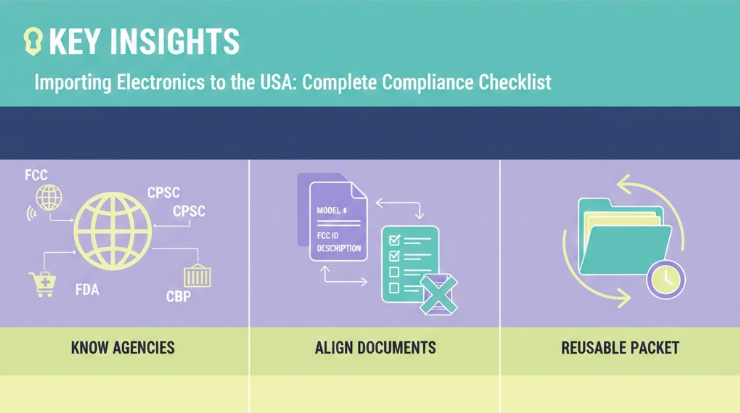
Key Takeaways
- Know which agencies apply to your products: FCC for wireless devices, CPSC for consumer goods (especially children’s items), FDA only if you make health claims, and CBP for every shipment.
- Documentation mismatches cause most delays: Ensure model numbers, FCC identifiers, and product descriptions align perfectly across your commercial invoice, packing list, and compliance documents.
- Build a reusable packet for each SKU: Gather all documentation before your first order, then verify nothing has changed with each reorder to streamline clearance.
Start Here: Electronics Import Triage (Which Rules Apply?)
Before diving into paperwork, you need to determine which U.S. agencies have jurisdiction over your specific products. Not every electronic device triggers the same requirements, and over-preparing for the wrong agency wastes time while under-preparing for the right one causes delays.
The Quick Decision Framework
Run through these four questions for each product you plan to import:
Does it contain wireless, RF, or transmitting capabilities? If your device uses WiFi, Bluetooth, cellular connectivity, RFID, NFC, or any radio frequency technology, the Federal Communications Commission likely has requirements. This applies to everything from wireless earbuds to smart thermostats.
Is it designed for, marketed to, or primarily used by children? Products intended for children under 12 face additional scrutiny from the Consumer Product Safety Commission. Age grading and marketing language matter here – if your packaging shows children or your Amazon listing targets young users, CPSC rules likely apply.
Does the product make health, medical, or diagnostic claims? Fitness trackers, sleep monitors, and similar devices can fall under Food and Drug Administration oversight if marketing language crosses into medical territory. Claims about diagnosing, treating, or monitoring health conditions raise FDA flags.
Does it include batteries or chargers? While not agency-specific, battery-powered electronics and included charging equipment require additional documentation discipline. Lithium battery shipping regulations and safety documentation should be prepared early.
Mapping Common Products to Agencies
Consider a Bluetooth speaker. It transmits radio frequencies, so FCC requirements apply. If marketed for general consumers but not specifically for children, CPSC involvement is minimal. No health claims means FDA stays out of the picture.
Now consider a children’s tablet with WiFi. This product triggers FCC requirements due to wireless capability AND CPSC requirements due to the children’s market focus. The compliance burden doubles.
A fitness tracker with heart rate monitoring sits in trickier territory. FCC applies if it uses Bluetooth. FDA potentially applies if marketing claims the device helps users monitor cardiovascular health. The language on your packaging and listings determines whether FDA oversight kicks in.
Pre-Importation Preparations: Get These Right Before You Ship
Before your electronics leave the factory floor, complete these foundational steps. Missing any of them creates problems that are far more expensive to fix once cargo is in transit.
- Identify the Correct HTS Code: Determine the 10-digit Harmonized Tariff Schedule code for each SKU. This code drives your duty rates, determines which Partner Government Agencies have jurisdiction, and affects your risk exposure. For electronics, classification can be tricky – a device with multiple functions might classify differently depending on its primary purpose. Document your reasoning and consider requesting a binding ruling from CBP if there’s any ambiguity.
- Obtain a Customs Bond: CBP requires a bond to guarantee payment of duties, taxes, and fees. Choose between a single-entry bond for occasional shipments or a continuous bond if you import regularly. Most commercial electronics importers benefit from a continuous bond, which covers all entries during a 12-month period.
- Determine and Mark Country of Origin: Every product must be permanently, legibly, and conspicuously marked with its country of origin (e.g., “Made in China”). This isn’t optional – failure to comply can trigger a 10% marking duty under 19 U.S.C. § 1304, redelivery demands, or seizure. Verify your supplier’s marking before shipment, not after arrival.
- Identify Partner Government Agencies (PGAs): Electronics may fall under multiple agency jurisdictions beyond CBP. Run through the triage questions from the previous section to identify whether FCC, CPSC, FDA, or other agencies apply. Determine required licenses, certifications, or pre-clearance filings before booking freight.
8 Most Common Electronics Import Mistakes
- Valuation errors – Unreported assists, tooling, or royalties
- HTS misclassification – Wrong code means wrong duty rate and PGA triggers
- Country of origin marking failures – Missing or illegible markings
- Wood packaging non-compliance – Missing ISPM-15 stamps
- Inconsistent documentation – Invoice doesn’t match packing list or bill of lading
- Late security filings – ISF 10+2 submitted after deadline
- Ignoring PGA requirements – Shipping without required agency clearances
- No compliance program – Reactive instead of systematic approach
Let’s dive into the agency-specific requirements that help you avoid these pitfalls-starting with CBP, which applies to every electronics shipment.
CBP Essentials Checklist for Electronics (The Non-Negotiables)
Regardless of which agencies regulate your specific electronics, every import must satisfy Customs and Border Protection requirements. CBP examines your shipment’s documentation for accuracy and consistency. Discrepancies between documents are among the most common causes of electronics holds.
Commercial Invoice Requirements
Your commercial invoice serves as the primary document for customs clearance. For electronics, CBP expects specific details that general importers sometimes overlook.
Every invoice should include the exact model number for each product. Generic descriptions like “electronic device” or “consumer electronics” invite scrutiny. Instead, use precise language: “Wireless Bluetooth Earbuds Model XB-400” tells customs exactly what they’re processing.
Include clear product descriptions that match how you’ve classified the item. Quantities must be accurate per unit, not just per carton. Unit values should reflect the actual transaction value, including any agreed discounts. Don’t forget to specify Incoterms (FOB, CIF, etc.) that establish when ownership and risk transfer.
Packing List Consistency
Your packing list must align perfectly with your commercial invoice. Carton counts, gross weights, and net weights should match across documents. A common problem occurs when suppliers update packing without notifying the importer – suddenly your invoice says 100 cartons but your packing list shows 98.
According to CBP’s informed compliance publication on reasonable care, importers must exercise reasonable care to ensure entry documentation is accurate and complete. Discrepancies between documents suggest a lack of reasonable care and can trigger examinations.
HTS Classification Challenges
Electronics create unique Harmonized Tariff Schedule classification challenges. Multifunction devices don’t always fit neatly into a single category. A smartphone case with a built-in battery pack could classify as a phone accessory or as a battery, each with different duty rates.
Kits and bundles require careful consideration. If you’re importing earbuds packaged with a charging case and carrying pouch, you need to determine whether these constitute a set classified together or separate items requiring individual classification.
The U.S. International Trade Commission’s HTS database is the authoritative source for tariff classifications. For complex electronics, consider requesting a binding ruling from CBP before your first large shipment.
Valuation Accuracy
Transaction value – what you actually paid for the goods – forms the basis for duty calculations. However, electronics importers sometimes stumble on valuation consistency. If you negotiated volume discounts, promotional pricing, or payment terms that affect the true cost, these must be accurately reflected.
Related party transactions (importing from a supplier you own or have significant control over) face additional valuation scrutiny. CBP wants assurance that your declared values reflect arm’s length pricing.
Pro Tip: The “Reasonable Care” Standard
Under 19 U.S.C. § 1484, CBP holds you – the importer of record – responsible for exercising “reasonable care” when declaring classification, value, origin, and admissibility. You can use a customs broker, but you cannot delegate this responsibility. Best practice: document the rationale for every decision and retain files for five years per 19 CFR part 163.
FCC Checklist (If It Has Wireless, RF, or a Transmitter)
The Federal Communications Commission regulates devices that emit radio frequency energy. Most modern electronics fall into this category – if it connects wirelessly to anything, FCC likely has requirements.
Determining Your Equipment Authorization Type
FCC classifies devices into different authorization categories. Intentional radiators – devices designed to emit RF energy like WiFi routers or Bluetooth speakers – require the most rigorous review. Unintentional radiators that incidentally emit RF energy during operation have simpler requirements.
Check whether your product needs certification (most wireless devices), Supplier’s Declaration of Conformity (many digital devices), or simply verification (basic electronics). The FCC’s equipment authorization page provides guidance on determining which path applies.
Collecting FCC Documentation
For certified devices, you need the FCC ID – a unique identifier assigned during the certification process. This ID should appear on the product label and in accompanying documentation. If your product uses certified modules (a common approach where the wireless components were pre-certified by the module manufacturer), collect the module’s FCC ID and supporting grant documentation.
Test reports demonstrate that the device meets FCC emission limits. While you don’t typically need to submit full test reports with your import entry, having them accessible prevents delays if CBP requests verification. Many importers keep summary documents that reference the full reports.
Labeling requirements specify where and how the FCC ID must appear on products and packaging. User manuals should include required FCC statements. If your device uses a certified module, the manual still needs appropriate disclosure language.
Watching for Supplier Changes
A significant compliance risk for electronics importers involves undisclosed supplier changes to wireless components. Your supplier might swap radio modules or antennas to reduce costs or address component shortages without informing you. Suddenly, your documentation references hardware that’s no longer in the product.
Establish clear communication protocols with suppliers requiring notification of any component changes affecting RF performance. Periodic verification testing of samples can catch undisclosed changes before they become customs problems.
CPSC Checklist (If It’s Consumer-Facing – Especially for Kids)
The Consumer Product Safety Commission oversees consumer product safety, with particularly stringent requirements for children’s products. Electronics importers often underestimate CPSC relevance because they think of it as applying mainly to toys, but any consumer-facing electronic device has CPSC implications.
Determining Children’s Product Status
The critical question: is your product a “children’s product” under CPSC definitions? A children’s product is designed or intended primarily for children 12 years or younger. This determination isn’t just about age recommendations on packaging – it considers marketing, subject matter, and how the product is actually used.
An educational tablet with cartoon characters in marketing materials, even without explicit age labeling, likely qualifies as a children’s product. A gaming headset marketed with images of children using it might cross the threshold. The CPSC’s business education guidance provides detailed criteria for making this determination.
Children’s Product Requirements
Children’s products face additional requirements beyond general consumer goods. Testing by CPSC-accepted laboratories confirms compliance with applicable children’s product safety rules. Lead content limits, small parts testing, and other requirements apply depending on the product type.
A Children’s Product Certificate must accompany children’s products, certifying that the product complies with all applicable children’s product safety rules. This certificate isn’t submitted to customs but must be provided to retailers and available upon CPSC request.
Tracking labels enable identification of the product’s manufacturer and specific production run. If a recall becomes necessary, tracking labels allow targeting of affected units rather than the entire product line.
General Consumer Electronics Requirements
Even electronics not classified as children’s products must meet basic safety requirements. Products should not present unreasonable risks of fire, electrical shock, or other hazards. Documentation demonstrating safety testing and compliance with relevant voluntary standards (like UL certifications) supports your import position.
Warnings and instructions must be clear, conspicuous, and in English. For electronics, this includes proper use instructions, hazard warnings, and any age recommendations. Ensure your packaging, instruction inserts, and online listings present consistent warning language.
FDA Checklist (Only If You Make Medical/Health Claims)
Many electronics importers assume FDA requirements don’t apply to them – and in many cases, they’re right. However, the line between consumer wellness device and regulated medical device depends largely on how you market and describe your product.
Understanding FDA Jurisdiction Triggers
FDA regulates devices intended for diagnosis, treatment, cure, mitigation, or prevention of disease or conditions. A fitness tracker that simply displays heart rate data operates as a general wellness device outside FDA oversight. The same tracker marketed as helping users “monitor for cardiac irregularities” or “detect potential heart conditions” crosses into FDA territory.
The distinction lies in intended use, determined primarily by marketing claims. According to FDA guidance on general wellness products, products intended only for general wellness that present low risk typically don’t require FDA premarket review.
Conducting a Claims Audit
Before importing wearables, health monitors, or any electronics with sensor capabilities, audit every claim across all materials. This includes packaging, instruction manuals, product inserts, website descriptions, Amazon listings, and social media marketing.
Look for language suggesting the product diagnoses conditions, monitors health markers for clinical purposes, or provides therapeutic benefits. Replace problematic language with wellness-focused alternatives. “Helps you track your fitness journey” differs significantly from “monitors your cardiovascular health.”
Aligning Customs Descriptions
Your customs description should match your intended-use positioning. If you’ve carefully positioned a fitness wearable as a general wellness device, don’t describe it to customs as a “health monitoring device” or “medical-grade sensor.” Consistency across marketing and customs documentation prevents confusion and potential holds.
For borderline products, maintain a basic evidence file documenting why your product falls outside FDA device classification. Test data, regulatory analysis, and legal opinions can support your position if questions arise.
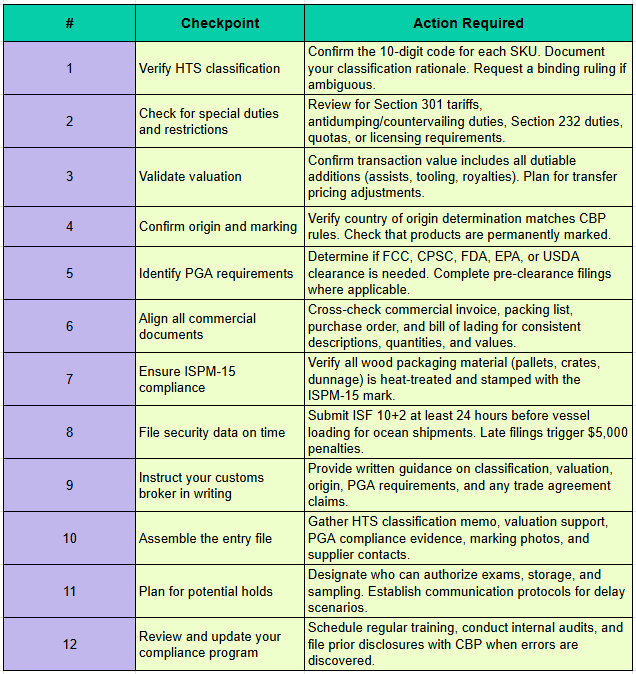
12-Point Pre-Shipment Compliance Checklist
Use this operational checklist before every electronics shipment leaves port. Print it, share it with your team, and verify each point is addressed.
What to Send Your Broker/Forwarder (Electronics-Ready Packet)
The documents you provide your customs broker or freight forwarder directly impact how smoothly your electronics clear customs. Incomplete or inconsistent information forces multiple rounds of questions, delaying your shipment while competitors move their products to market.
Essential Documentation Packet
- Product Identification Materials: Include SKU numbers, model numbers, and clear photos of the actual product, labels, and packaging. Photos should show brand markings, model identifiers, country of origin labels, and any compliance markings (FCC ID placement, CE marks, etc.).
- Wireless Documentation (if applicable): Provide FCC IDs for all wireless devices and modules, along with grant documents or references to test reports. If products use certified modules from third-party manufacturers, include module identification and the module manufacturer’s FCC documentation.
- Compliance Documentation: Gather user manuals showing required compliance statements, warning labels, and safety information. Include any test reports, certificates (CPSC Children’s Product Certificate, UL certificates), or compliance summaries you have available.
- Commercial Documentation: Draft commercial invoices and packing lists using consistent product descriptions that match how items are classified. Ensure model numbers, quantities, and values align across all documents.
- Historical Context: If you’ve experienced prior holds, examinations, or classification disputes on these products, share that history with your broker. Previous CBP decisions (especially binding rulings) provide valuable context for current entries.
Building Relationships Through Preparation
Freight forwarders and customs brokers become more effective partners when you provide organized, complete documentation upfront. Rather than reactive information requests, they can proactively address potential issues before your cargo arrives at port.
Consider creating a standard electronics import packet template for your team. Each new SKU gets its own file with all relevant documentation gathered before the first PO is placed with your supplier. Reorders then require only verification that nothing has changed rather than starting from scratch.
Post-Importation: Don’t Forget These Ongoing Requirements
Compliance doesn’t end when your cargo clears customs. CBP expects importers to maintain documentation and address issues that surface after entry.
- Five-Year Recordkeeping Requirement: By law, you must retain all import-related records for at least five years from the date of entry. This includes commercial invoices, contracts, product specifications, HTS classification memos, valuation support, PGA filings, ruling letters, lab reports, and all broker communications. Organized records aren’t just good practice-they’re your defense if CBP audits your entries.
- Monitor Your ACE Portal: The Automated Commercial Environment (ACE) portal allows you to track entries, duty payments, flags, and liquidations in real time. Active monitoring helps you spot errors before they escalate into enforcement issues.
- Use Prior Disclosure When Errors Are Found: If you discover past errors or violations, a properly filed prior disclosure can significantly reduce penalties. CBP views self-reporting far more favorably than discovering problems during an audit. Work with your customs broker or trade attorney to file disclosures correctly.
- Conduct Regular Compliance Audits: Schedule quarterly or annual reviews of your import operations. Compare entry data against your classification memos, valuation records, and PGA documentation. Identify patterns of errors and address root causes through training or process improvements.
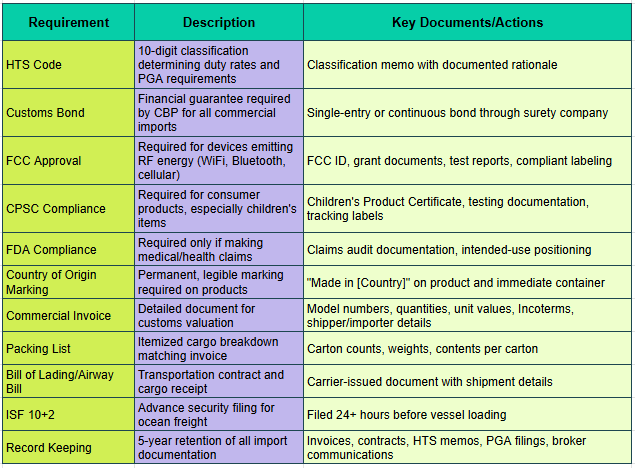
Electronics Import Compliance: Quick-Reference Summary
Use this table as a fast reference when preparing shipments or training team members.
How Unicargo Helps Electronics Importers Reduce Delays
Electronics imports carry inherent complexity – multiple agencies, detailed documentation requirements, and products that often defy simple classification. For importers without dedicated compliance staff, keeping everything aligned across international shipments creates ongoing challenges.
Unicargo’s approach combines digital freight forwarding technology with hands-on logistics expertise specifically relevant to electronics importers.
Pre-Shipment Documentation Review
Before your cargo leaves the origin country, Unicargo’s team can review your SKU documentation for consistency issues. Model numbers that don’t match across documents, missing wireless identifiers, or classification questions get addressed before your shipment is in transit – when corrections are inconvenient at best and expensive at worst.
This pre-shipment sanity check catches the documentation gaps that commonly delay electronics entries at U.S. ports.
Centralized Documentation Management
Unicargo’s digital platform provides a centralized location for the documentation your customs entries require. Rather than hunting through email threads and shared drives to assemble your broker packet, maintain organized records accessible to everyone involved in your import operations.
For electronics importers managing multiple SKUs across multiple shipments, this documentation discipline prevents the inconsistencies that trigger CBP scrutiny.
Visibility Throughout the Import Process
Electronics supply chains often involve multiple parties across multiple countries. Unicargo’s platform provides milestone tracking and exception alerts across international moves, so you know when potential issues arise rather than discovering problems when cargo is already held at port.
If you’re looking to streamline your electronics import process with both technology and human expertise, reach out to Unicargo’s team to discuss how a dedicated logistics partner can help organize compliant shipments from the start.
Conclusion: Turn Compliance Into a Reusable SKU Checklist
Importing electronics to the USA successfully comes down to preparation and consistency. The regulations from CBP, FCC, CPSC, and FDA aren’t going away, but you can systematize your approach to handle them efficiently.
Start with triage before placing each purchase order. Run through the agency decision framework to identify which requirements apply to your specific products. Don’t assume – verify wireless capabilities, review marketing language for children’s implications, and audit health-related claims.
Build standardized documentation packets for each SKU. Gather FCC identifiers, product photos, compliance certificates, and commercial documents into organized files. When your broker or forwarder can access complete, consistent information, they clear your goods faster.
Add a quick pre-shipment audit to your reorder process. Verify that nothing has changed with your supplier’s production – same components, same packaging, same labeling. Undisclosed changes are among the most common sources of electronics import problems.
Following this structured approach transforms electronics compliance from a recurring headache into a routine process. Each compliant shipment builds your track record with CBP and reduces the likelihood of future examinations. Over time, your operations benefit from predictable timelines and avoided penalties – exactly what efficient electronics importing requires.
Frequently Asked Questions
Do all electronics require FCC certification to import into the USA?
Not all electronics require FCC certification, but most do require some form of FCC compliance. Devices that intentionally transmit radio frequencies (WiFi, Bluetooth, cellular) typically need full FCC certification with an assigned FCC ID. Digital devices that unintentionally emit RF energy may qualify for Supplier’s Declaration of Conformity instead. Basic electronics with minimal emissions might only need verification. Check the FCC equipment authorization guidelines to determine which path applies to your specific products.
What happens if my electronics shipment gets held at customs?
When CBP holds an electronics shipment, they typically request additional documentation or clarification. Common reasons include missing or inconsistent paperwork, questions about HTS classification, or requests for proof of FCC compliance. You’ll receive a notice specifying what’s needed. Response time matters – delays in providing requested information extend your hold. Having organized documentation readily available allows your customs broker to respond quickly and minimize storage fees and delays.
How do I know if my product is considered a “children’s product” under CPSC rules?
CPSC defines a children’s product as one designed or intended primarily for children 12 years or younger. This determination considers multiple factors: the product’s subject matter and theme, packaging and marketing materials, age recommendations, and how the product is commonly used. If your packaging features cartoon characters, your marketing shows children using the product, or your product is sold in toy sections of retailers, it likely qualifies as a children’s product regardless of whether you explicitly label it with an age range.
Can I import electronics without a customs broker?
Technically, you can self-file customs entries for shipments valued under $2,500 using CBP’s informal entry process. However, for commercial electronics imports, working with a licensed customs broker is strongly recommended. Brokers understand HTS classification nuances, maintain bonds required for formal entries, and can respond quickly when CBP raises questions. The cost of a broker is typically far less than the cost of delays, penalties, or seized goods resulting from filing errors.
What documentation do I need for electronics with lithium batteries?
Lithium battery shipments require specific documentation for both transportation safety and customs compliance. You’ll need a Material Safety Data Sheet (MSDS) or Safety Data Sheet (SDS) for the batteries, documentation showing batteries meet UN 38.3 testing requirements, and proper shipping declarations. Packaging must include lithium battery handling labels. Your freight forwarder needs this information to book cargo correctly, as lithium batteries face shipping restrictions on certain carriers and routes.
How long does customs clearance typically take for electronics?
Standard electronics clearance takes one to five business days when documentation is complete, and no issues arise. However, shipments flagged for examination can take two to four weeks or longer. First-time importers, new products, and shipments with documentation discrepancies face higher examination rates. Building a track record of compliant entries with consistent documentation reduces examination likelihood over time and leads to more predictable clearance timelines.
Do I need different documentation for each SKU I import?
Yes, each unique SKU should have its own documentation packet. Different products may have different FCC identifiers, fall under different HTS classifications, or trigger different agency requirements. A wireless speaker and a wired speaker from the same supplier require different compliance documentation even though they’re similar products. Creating SKU-specific packets takes initial effort but dramatically simplifies reorders and reduces the risk of using wrong documentation for a shipment.
Need help with your next shipment? Consult with our compliance experts to avoid surprises.
Get A Quote, and our team will reach back and assist you with your compliance needs (click below)