Top 20 HS Code Mistakes That Cost Importers Thousands in 2026
Most importers assume HS code errors happen to beginners. They don’t. Some of the most experienced SMB importers in the US are quietly overpaying duties, triggering CBP penalties, and watching shipments get held at the border – all because of classification mistakes hiding in plain sight on their commercial invoices.
HS code misclassification is not a rare, edge-case problem. It’s one of the most common – and most expensive – compliance failures in US import operations. The consequences range from annoying (overpaid duties you’ll never recover) to serious (CBP audits reaching back five years, antidumping exposure, and, in extreme cases, goods seizure).
This post breaks down the 20 most common HS code mistakes importers make in 2026 – with real examples of what goes wrong and exactly how to fix each one. By the end, you’ll have a clear picture of where your own classification process might be leaking money, and what to do about it.
Key Insights / TL;DR
- HS code misclassification is the #1 cause of unexpected duty bills and CBP penalties for US importers.
- Using your supplier’s Chinese HS code directly – without converting to the US 10-digit HTS – is the single most common mistake.
- A wrong code doesn’t just mean overpaying. It can trigger antidumping duties, UFLPA holds, or outright seizure.
- Many classification errors are silent: goods clear customs, but CBP can audit and assess back-duties up to five years later.
- Mistakes #1–5 are the most expensive; mistakes #6–20 are the most common day-to-day.
- The fix for most errors is the same: use a licensed customs broker or freight forwarder with active classification support.
Why HS Code Errors Are More Expensive Than You Think
The difference between a minor mistake and a costly one
Not all classification errors are created equal. Using a code that’s one digit off from the correct tariff chapter might cost you a few hundred dollars in overpaid duties. But misclassifying a product into the wrong chapter – especially one that carries a high Section 301 tariff rate, an antidumping order, or a Partner Government Agency (PGA) flag – can cost tens of thousands on a single shipment.
The dollar impact of a classification error depends on three things: the duty rate difference between the wrong code and the right one, the value and volume of your shipment, and whether the code you’ve used triggers any additional regulatory consequences. In 2026, with layered tariffs on Chinese-origin goods still active, even a small classification error on high-volume imports compounds quickly across multiple shipments. If you want to learn more about how to import from China to the USA in 2026 check out the guide.
What CBP can do when they catch a misclassification
US Customs and Border Protection has broad enforcement powers when it comes to classification errors. In straightforward cases, they’ll issue a duty demand – you pay the difference plus interest. In more serious cases, where CBP believes the misclassification was deliberate to avoid duties, you’re looking at civil penalties under 19 USC 1592, which can reach the full value of the merchandise. Even for unintentional errors, CBP can audit your import history going back five years and assess back-duties across every affected entry.
The important thing to understand is that CBP doesn’t need to catch you at the port. Post-entry audits, importer compliance programs, and Trade Compliance Improvement Plans are all in active use. An error you made in 2022 can come back in 2026.
The Top 20 HS Code Mistakes – And How to Avoid Each One
Group 1: The Big-Money Mistakes (1–5)
Mistake #1: Using your supplier’s Chinese HS code instead of the US HTS code
This is the most expensive mistake on this list, and it’s remarkably common. Chinese suppliers classify their products under China’s HS system, which shares the same 6-digit international root as the US HTS – but diverges at digits 7 and beyond. The US extends to a 10-digit statistical suffix with its own duty rates, antidumping notes, and Section 301 add-ons that have no equivalent in China’s system.
Real example: A furniture importer copies the 8-digit Chinese HS code from their supplier’s packing list onto the US entry. The Chinese code maps to a general furniture subheading. The correct US 10-digit HTS code, however, falls under a subheading subject to a 25% Section 301 tariff. The importer clears customs at the lower rate, CBP audits 18 months later, and the back-duty bill on six shipments is $83,000.
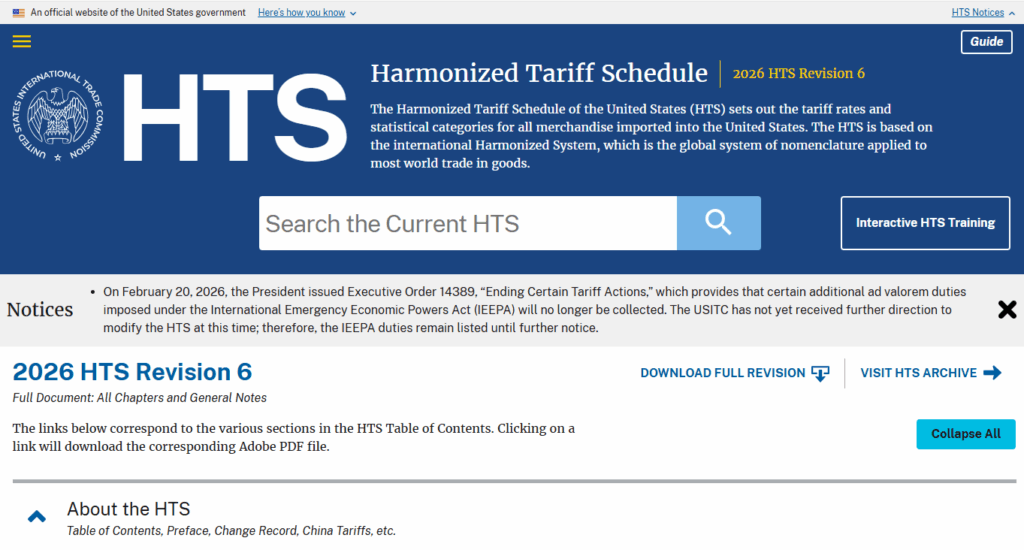
Fix: Always convert your supplier’s code to the US HTS using hts.usitc.gov. Start with the 6-digit HS root, then classify down to the full 10 digits yourself – or with your broker.
Mistake #2: Ignoring the 10-digit statistical suffix
Many importers stop at 8 digits and assume they’re done. In US customs practice, digits 9 and 10 are the statistical suffix – and while they don’t always change the duty rate, they can trigger different Section 301 Chapter 99 add-ons, PGA flags, and statistical reporting obligations that affect your compliance record.
Fix: Always classify to the full 10-digit level. Never submit an entry with an incomplete code.
Mistake #3: Missing Chapter 99 Section 301 tariff add-ons
Section 301 tariffs on Chinese-origin goods are applied as a separate Chapter 99 code on top of the base HTS classification. Many importers correctly identify their 10-digit HTS code but fail to check whether a corresponding Chapter 99 code applies – and as a result, they either underpay (triggering a CBP demand later) or overpay (for products with active exclusions).
Real example: An industrial machinery importer classifies their product correctly under HTS 8479.89.9599. They pay the base 0% MFN duty. What they miss is that this HTS code also requires a Chapter 99 overlay code carrying a 25% Section 301 tariff. On a $200,000 shipment, that’s $50,000 in unpaid duties – discovered in a CBP audit 14 months later.
Fix: After identifying your 10-digit HTS code, always cross-reference the USTR’s Section 301 product lists and check Chapter 99 on the USITC HTS portal. Your customs broker should do this as standard practice.
Mistake #4: Misclassifying goods to get a lower duty rate – and why it backfires
Some importers knowingly (or with a nudge from their supplier) choose a code with a lower duty rate when the correct classification would carry a higher one. This is customs fraud. It’s also, in practice, one of the most common reasons for CBP civil penalty cases.
The reason it backfires so reliably: CBP has extensive data on what goods are typically classified under what codes, and importers who consistently use the same low-duty codes for products that competitors classify differently get flagged for examination. And once you’re on CBP’s radar, your entire import history becomes subject to review.
Fix: Don’t do it. If you believe the correct code is unfairly burdensome, the legal route is to apply for a binding ruling or engage a trade attorney to argue for a different classification. That process has a track record of success – fraud doesn’t.
Mistake #5: Failing to update codes after product changes
A product you classified correctly two years ago may no longer be correctly classified today – either because your manufacturer changed materials or components, because the HTS itself was updated, or because tariff actions have reclassified how certain goods are treated.
Fix: Build a quarterly HTS review into your operations. Any time a supplier updates a product spec, treat it as a classification trigger – don’t assume the old code still applies.
Group 2: Documentation & Description Mistakes (6–10)
Mistake #6: Vague or generic product descriptions on commercial invoices
CBP expects commercial invoices to contain detailed, specific product descriptions that support the classification. Generic descriptions like “spare parts,” “household goods,” or “accessories” give CBP nothing to verify against your HTS code – and create immediate grounds for examination or a request for additional documentation.
Fix: Descriptions should state material composition, function, and end use. Instead of “metal parts,” write “stainless steel mounting brackets for industrial conveyor systems.” It takes 10 seconds and saves days at the port.
Mistake #7: Classifying by material instead of function
The Harmonized System classifies most goods by their primary function or use, not by what they’re made of. A common mistake is to look at a product – say, a plastic enclosure – and classify it under the plastics chapters (39) when the correct code is under the machinery chapter (84) because it’s a component for a specific piece of equipment.
Fix: When in doubt, read the chapter notes and section notes in the HTS. They contain clear guidance on classification hierarchy. General Rule of Interpretation 1 tells you to always start with heading text and notes before looking at subheadings.
Mistake #8: Using an outdated HS code that was reclassified in 2022 or 2024
The World Customs Organization updates the Harmonized System every five years. The 2022 revision introduced significant changes across chemicals, electronics, and medical devices. If your HTS master list hasn’t been reviewed since 2021, some of your codes may simply no longer exist – or may now map to a completely different duty rate.
Fix: Cross-check all codes against the current HTS edition on usitc.gov. If a code returns no result or a “deleted” notation, it needs to be reclassified immediately.
Mistake #9: Letting your supplier choose the HS code without verification
Suppliers are helpful, but their job is to sell you a product – not to optimize your US customs compliance. A supplier’s suggested HS code is a starting point, not a final answer. It may be based on their local system, on what they’ve seen other buyers use, or simply on a best guess.
Fix: Treat supplier-provided codes as research input only. Always verify independently using the US HTS and your broker. If there’s a discrepancy, resolve it before the first shipment – not after CBP flags it.
Mistake #10: Not accounting for sets or composite goods
When you import a product that consists of multiple components – for example, a promotional gift set, a machine sold with its accessories, or a kit sold as a unit – classification becomes more complex. GRI 3 governs the classification of sets and composite goods, and the rules don’t always produce the result importers expect.
Fix: Any time you’re importing goods that ship together as a set or kit, flag it for your broker. Don’t assume each component keeps its own code or that the set follows the classification of its most recognizable part.
Group 3: Compliance & Regulatory Mistakes (11–15)
Mistake #11: Missing PGA flags tied to specific HTS codes
Certain HTS codes trigger automatic Partner Government Agency review – FDA for medical devices and food contact materials, EPA for chemicals, CPSC for children’s products, and others. If your code triggers a PGA flag and you haven’t prepared the required documentation, your shipment stops at the port until the agency clears it. That clearance can take days or weeks.
Fix: As part of your US customs clearance process, check the “Special Program Indicator” and “PGA Message Set” fields for your HTS codes. Your broker should flag these proactively. If they don’t, ask.
Mistake #12: Incorrect country of origin leading to the wrong tariff column
Country of origin determines which tariff column applies and whether goods are subject to Section 301, antidumping orders, or other trade measures. Errors in country of origin – especially for goods manufactured across multiple countries – can result in applying the wrong duty rate entirely.
Fix: Understand the “substantial transformation” standard that determines US origin rules. If your goods involve materials or processing from multiple countries, work with your broker or a trade attorney to confirm origin before you classify.
Mistake #13: Ignoring antidumping and countervailing duty (ADD/CVD) exposure
Antidumping and countervailing duty orders are separate from the base HTS duty and from Section 301 tariffs. They apply to specific products from specific countries at rates that are set by the Department of Commerce and can range from a few percent to several hundred percent. Many importers don’t check ADD/CVD exposure at all – and discover it when CBP issues a demand for the full additional duty amount.
Fix: Check the USITC’s antidumping and CVD order database for every new product you import. Your customs broker should do this as a standard step in classification review.
Mistake #14: Misclassifying to avoid UFLPA scrutiny
Since the Uyghur Forced Labor Prevention Act took effect, CBP has significantly increased scrutiny of goods that could originate from or involve processing in Xinjiang. Some importers attempt to classify goods under codes that attract less attention – or adjust descriptions to obscure origin. This is both ineffective (CBP’s targeting is sophisticated) and illegal.
Fix: The right response to UFLPA exposure is supplier documentation and traceability – not classification manipulation. If your supply chain has Xinjiang risk, work with your freight forwarder on a proper compliance and documentation strategy. See our guide to importing from China in 2026 for the full compliance framework.
Mistake #15: Not checking for applicable trade agreement preferences (e.g., USMCA)
Some importers are so focused on China-origin tariff exposure that they overlook duty-saving opportunities on other trade lanes. USMCA, for example, provides preferential duty rates on qualifying goods from Mexico and Canada – but only if you file the correct preference claim and have the supporting documentation at entry.
Fix: If any of your goods could qualify for preferential treatment under a US free trade agreement, make sure your broker is claiming the preference at entry. Don’t leave legitimate savings on the table.
Group 4: Process & Systems Mistakes (16–20)
Mistake #16: Having no HTS master list for your SKUs
Without a documented HTS master list, classification decisions get made ad hoc – by whoever is processing the entry at any given moment. That leads to inconsistency across entries, which is itself a red flag for CBP auditors. Worse, it means there’s no single place to catch a wrong code before it costs you.
Fix: Build and maintain a master HTS matrix that lists every SKU you import, its 10-digit HTS code, any applicable Chapter 99 overlay codes, PGA flags, and the last date the classification was reviewed. Review it quarterly.
Mistake #17: Reusing old entries without reviewing for rate changes
A common shortcut when filing a new entry is to copy the classification from a previous entry for the same product. The problem is that tariff rates, Section 301 exclusion status, and Chapter 99 codes all change – sometimes with very little notice. Copying an old entry imports its errors as well as its correct details.
Fix: Use historical entries as a reference, not as a template. Confirm that every code and rate is current before filing a new entry.
Mistake #18: Not requesting a binding ruling for borderline products
When a product sits on the boundary between two classifications – and those classifications carry significantly different duty rates – the right move is to request a binding ruling from CBP before you import. A binding ruling gives you legal certainty: CBP is obligated to honor the classification it issued. Without one, you’re exposed.
Many importers avoid binding rulings because they think the process is slow or complicated. In practice, rulings typically take 30 days for routine requests and create protection that’s worth the wait on any high-volume or high-value import.
Fix: If you’re uncertain about a classification and the duty rate difference is meaningful, request a binding ruling. Your customs broker can help you prepare the submission.
Mistake #19: Assuming your freight forwarder handles classification – without confirming
Freight forwarders and customs brokers vary significantly in how much classification support they provide. Some actively manage your HTS codes, flag rate changes, and recommend audits. Others simply use whatever code appears on your commercial invoice and process the entry. The importer is always legally responsible for correct classification – not the broker.
Fix: Have an explicit conversation with your freight forwarder about classification responsibilities. Get clarity on who is reviewing your codes, how often, and what process exists to flag discrepancies. If the answer is vague, that’s a problem worth solving before it becomes expensive.
Mistake #20: Failing to do a periodic classification audit
Classification is not a set-it-and-forget-it task. Product specs change, tariff schedules update, trade measures are added and removed, and your own product range evolves. Importers who don’t conduct regular audits of their HTS codes accumulate errors quietly – until a CBP audit makes them visible all at once.
Fix: Schedule a formal classification audit at least once a year. For high-volume or high-value imports, twice a year is better. The audit should cover your full SKU list, not just the products you’ve recently added.
How to Do a Quick HS Code Self-Audit (5-Step Checklist)
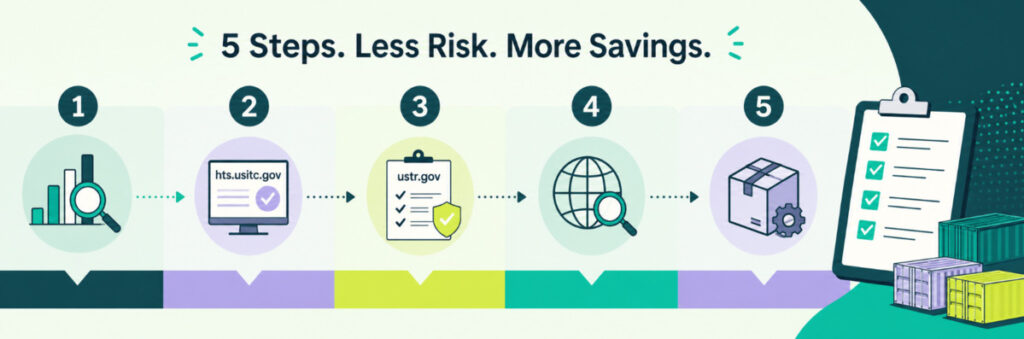
You don’t need a full trade compliance team to do a meaningful classification review. Here’s a practical five-step process you can run with your current broker:
- Pull your top 20 SKUs by import value – these represent the majority of your duty exposure. Start here, not with your full product catalog.
- Verify each 10-digit HTS code on hts.usitc.gov – confirm it’s current, active, and maps to the correct product description. Flag any codes that return no result or a revised notation.
- Cross-check each code against the Section 301 product lists on ustr.gov – confirm whether a Chapter 99 overlay applies, and if so, whether any active exclusion covers your product.
- Check each code for ADD/CVD orders on the USITC database. This takes five minutes per code and can save you from a very unpleasant surprise.
- Review product specs for any recent changes – material substitutions, new components, or updated supplier configurations that may have changed the classification basis.
If this process turns up discrepancies, address them with your broker before your next shipment. For any borderline classifications, consider a binding ruling.
When to Get a Binding Ruling from CBP
A binding ruling is a written determination from CBP that tells you how your specific product must be classified. Once issued, CBP is legally bound to honor it – as long as the facts of the importation match what was described in the ruling request. If they don’t, the ruling is void.
You should request a binding ruling when:
- Your product falls on the boundary between two chapters, and those chapters carry meaningfully different duty rates.
- You’re importing a new product category for the first time and classification is not clear-cut.
- Your product has been classified in different ways by different brokers or across different shipments.
- You’re planning a high-volume or high-value import program and want legal certainty before committing.
- You’re importing regulated goods (medical devices, chemicals, food contact materials) where classification also triggers PGA requirements.
Ruling requests are submitted through CBP’s online portal. For routine requests, expect a response in approximately 30 days. Your customs broker can help prepare the submission – and in complex cases, a trade attorney is worth the investment.
Frequently Asked Questions (FAQ)
What happens if I use the wrong HS code on a US import?
The consequences depend on the nature and scale of the error. At minimum, CBP may issue a duty demand for the underpaid amount plus interest. For repeated or significant errors, CBP can assess civil penalties under 19 USC 1592, ranging from the unpaid duties to the full value of the merchandise. In cases of deliberate fraud, criminal liability is also possible.
Can I correct an HS code after my goods have already cleared customs?
Yes. You can file a post-summary correction (PSC) within 270 days of the entry summary date, or a protest within 180 days of CBP’s liquidation of the entry. If you’ve overpaid duties due to an incorrect code, a PSC or protest is the mechanism for recovering the difference. If you’ve underpaid, a prior disclosure to CBP – before they find it – can significantly reduce potential penalties.
How far back can CBP audit my HS codes?
CBP can audit import entries for up to five years from the date of entry. This means a classification error made in 2021 can still result in a duty demand and penalties in 2026. This is why periodic internal audits are so important – you want to find and correct errors before CBP does.
Is it my responsibility or my freight forwarder’s to get the HS code right?
It is always the importer’s legal responsibility. Your customs broker or freight forwarder may assist with classification, but they are acting as your agent — not as the responsible party. CBP holds the importer of record accountable for the accuracy of all entry documentation, including HTS classification. Make sure you understand what classification services your broker actually provides, rather than assuming they handle everything.
What’s the difference between an HS code and an HTS code?
The HS (Harmonized System) is the international 6-digit product classification system maintained by the World Customs Organization and used by over 200 countries. The HTS (Harmonized Tariff Schedule) is the US-specific extension of that system, which adds digits 7 through 10 to capture US-specific duty rates, statistical categories, and tariff provisions. When importing into the US, you always need the full 10-digit HTS code – not just the 6-digit HS root.
How do I know if my product needs a Chapter 99 add-on for Section 301 tariffs?
After classifying your product under its base 10-digit HTS code, you need to cross-reference the USTR’s Section 301 product lists and the Chapter 99 HTS subchapters. CBP’s ACE system automatically checks for applicable Chapter 99 codes at entry, but it’s your responsibility to file the correct code. Your customs broker should check for this as standard practice on any Chinese-origin import. If they don’t, ask them to.
What’s a binding ruling, and when should I request one?
A binding ruling is a formal written determination from CBP confirming how a specific product must be classified under the US HTS. Once issued, it’s legally binding on CBP – they must apply the classification in the ruling to your product as long as the facts match. You should request one any time classification is genuinely uncertain, and the duty rate difference between possible codes is material. Requests are submitted through CBP’s online ruling request portal and typically take about 30 days.
How often should I review my HS codes?
At minimum, once a year. For high-volume or high-value imports, twice a year. You should also trigger an immediate review any time a supplier changes product specs, any time you add a new product to your import catalog, and any time there’s a significant trade policy change – like a new tariff action or HTS schedule update – that could affect your classification. Building this into your operations calendar is far less expensive than discovering errors in a CBP audit.
Stop Paying More Than You Owe
HS code errors are expensive, but they’re fixable. Unicargo’s customs and compliance team works with Global Importers to audit classifications, catch Section 301 and ADD/CVD exposure before it becomes a problem, and make sure every entry is filed correctly the first time.
Ready to quote the next shipment with the right code/s? Click below