Importing Toys to the USA: Compliance Guide + Step-by-Step Checklist
If you’re importing toys to the USA, getting the shipping right is only half the battle. The real challenge is making sure every product meets U.S. safety requirements before it reaches the border. Between mandatory third-party testing, Children’s Product Certificates, tracking labels, and customs documentation, the process can trip up even experienced importers.
This guide walks you through every stage of importing toys into the United States, from understanding what counts as a “children’s product” under federal law to clearing customs without delays. At the end, you’ll find a phased checklist you can copy directly into your operations.
TL;DR (Key Takeaways)
- Any toy designed or intended primarily for children 12 and under is a “children’s product” under U.S. law, subject to mandatory third-party testing, a Children’s Product Certificate (CPC), and tracking labels.
- The Consumer Product Safety Commission (CPSC) enforces product safety rules, while Customs and Border Protection (CBP) handles border entry. You must satisfy both to sell legally.
- Every toy must be tested at a CPSC-accepted laboratory and comply with ASTM F963-23, the current mandatory toy safety standard, effective since April 20, 2024.
- Misclassification, missing CPCs, and inconsistent invoices are the most common reasons toy shipments get detained at the border.
- A phased compliance checklist (pre-manufacturing through post-arrival) keeps your documentation airtight and your shipments moving.
What Makes Toy Imports Different in the U.S.
Toys are not treated like standard consumer goods at the U.S. border. Because they’re used by children, they fall into one of the most heavily regulated import categories. The Consumer Product Safety Improvement Act of 2008 (CPSIA) created a framework of mandatory testing, certification, and labeling that applies to every toy entering U.S. commerce, regardless of whether it’s sold through Amazon, Walmart, a retail store, or a personal website.
The practical difference between importing, say, kitchen utensils and importing toys is significant. Kitchen utensils generally need a commercial invoice, proper HTS classification, and standard customs paperwork. Toys need all of that plus third-party lab testing, a Children’s Product Certificate, permanent tracking labels, and compliance with specific safety standards that vary by toy type, material, and intended age group.
Consider a seller importing a line of wooden stacking blocks from a factory in Zhejiang, China. The freight process itself, booking ocean containers, arranging transport, filing customs entry, looks the same as importing any other product. But if that seller hasn’t arranged third-party testing at a CPSC-accepted lab, issued a CPC, and verified that every package has a compliant tracking label, the shipment can be detained at the port. The goods are physically there, but they’re not legally cleared.
Key Definitions You Must Get Right (Toy vs. Children’s Product)
The regulatory definition that drives everything is “children’s product.” Under the CPSIA and CPSC’s implementing regulations, a children’s product is a consumer product designed or intended primarily for children 12 years of age or younger. The CPSC looks at four factors to determine this: the manufacturer’s stated intent, how the product is marketed and packaged, whether consumers commonly recognize it as a children’s item, and the product’s suitability based on age-appropriate features.
This definition matters because it determines your testing and certification obligations. A set of educational wooden blocks marketed for ages 3 and up is clearly a children’s product. But what about a novelty desk toy sold to adults that happens to look appealing to kids? If the CPSC determines it’s likely to attract children based on its design, color scheme, or retail placement, it can still be classified as a children’s product, regardless of what the label says.
Special categories worth noting include educational toys (often subject to the same rules as play toys), plush toys (which face specific flammability and small-parts testing), battery-operated toys (which must meet battery accessibility requirements), and ride-on toys (which have additional stability and marking requirements under ASTM F963).
Who Enforces What: Agencies You’ll Encounter
Two federal agencies play the primary roles in toy imports, and understanding where their responsibilities split helps you prepare the right documentation for the right audience.
The Consumer Product Safety Commission (CPSC) is responsible for product safety. It sets and enforces the safety standards your toys must meet, manages the list of accepted testing laboratories, reviews Children’s Product Certificates, and has the authority to order recalls, detain shipments, and assess civil penalties. According to Eurofins, the CPSC can levy civil penalties of up to $120,000 per violation, capped at over $17 million for a related series of violations.
Customs and Border Protection (CBP) handles the border entry process. CBP reviews your shipping documents (commercial invoice, packing list, bill of lading), verifies HTS classification, assesses duties, and can physically inspect shipments. CBP also works with the CPSC to flag non-compliant imports. If a shipment is selected for examination and the compliance documents are missing or inconsistent, CBP can place a hold that racks up storage fees daily.
A customs broker files your entry paperwork with CBP and helps navigate classification and duty questions. A freight forwarder manages the physical movement of goods and coordinates logistics. Neither one, however, is responsible for your product’s safety compliance. That obligation rests squarely on the importer of record.
Core U.S. Toy Compliance Requirements
Before any toy can legally enter U.S. commerce, it must satisfy a baseline set of safety, testing, and documentation requirements. These apply broadly to all toys classified as children’s products, though the specific standards vary based on the product’s material, features, and intended age group.
The foundational safety rule for toys is ASTM F963, which the CPSIA made mandatory. The current version, ASTM F963-23, took effect on April 20, 2024, after the CPSC unanimously approved it in January 2024. This comprehensive standard addresses mechanical hazards, flammability, chemical composition (including lead and phthalates), battery accessibility, projectile safety, and dozens of other risk categories. As the importer, it’s your responsibility to identify which sections of ASTM F963 apply to your specific product.
Beyond ASTM F963, children’s products must also comply with other applicable rules, such as the lead paint ban (16 CFR 1303), lead content limits, phthalate restrictions, and the small parts regulation (16 CFR 1501). Compliance differs by material. A plastic toy may need phthalate testing. A wooden toy needs lead-in-substrate testing. A plush toy with a fabric component faces flammability requirements. A battery-operated toy triggers battery compartment accessibility tests.
CPSIA + Safety Testing: What Must Be Tested (and When)
Third-party testing is non-negotiable for children’s products. Under the CPSIA, every toy intended for children 12 and under must be tested by a CPSC-accepted laboratory before it can be sold or distributed in the United States. This requirement applies even to small-quantity imports and online-only sales.
“Third-party testing” means you cannot test the product yourself or rely on your factory’s in-house quality checks. The testing must be performed by a lab that has been specifically accepted by the CPSC to test against the relevant children’s product safety rules. The CPSC maintains a searchable database of accepted labs on its website.
Timing matters. The ideal workflow is to test during pre-production (using production-representative samples) or during early production. Testing after goods are loaded on a container means that if something fails, you’re stuck with a compliant-looking product sitting in a port. Re-testing is required whenever there is a material change: a new dye or coating, a different plastic resin, a switch in component suppliers, or a change in the manufacturing process. Using an old test report for a product that has been materially altered is one of the most common compliance mistakes importers make.
Children’s Product Certificate (CPC): The Document That Makes or Breaks Clearance
The Children’s Product Certificate is the formal document in which the importer (or domestic manufacturer) certifies that their product complies with all applicable children’s product safety rules. It is not optional. Every shipment of children’s products into the United States must be accompanied by a valid CPC, and it must be available to CBP and the CPSC upon request.
According to the CPSC’s CPC guidance, a CPC must include the following information: identification of the product covered, a citation of each CPSC children’s product safety rule with which the product complies, identification of the importer or domestic manufacturer certifying compliance, contact information for the person maintaining test records, the date and place of manufacture, the date and place of testing, and identification of the CPSC-accepted laboratory that performed the testing.
A critical point: the importer of record is responsible for issuing the CPC, not the overseas factory. Even if your Chinese supplier provides a CPC, it is legally your obligation as the U.S. importer to verify it and issue your own. A foreign manufacturer’s certificate alone does not satisfy the requirement.
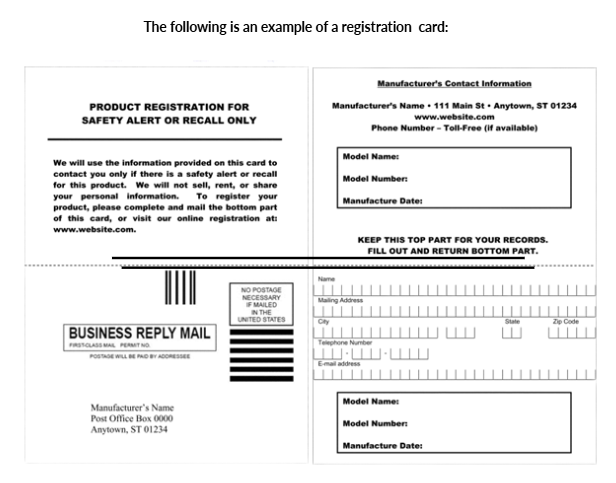
If your product qualifies as a “durable infant or toddler product,” such as a ride-on toy, infant activity center, or rocking/bouncing seat intended for children under 5, there’s an additional documentation requirement: you must include a postage-paid product registration card with each unit. Under 16 CFR Part 1130, this card must be permanently attached to the product, follow specific size and formatting requirements (at least 3.5 × 5 inches, two-section perforated design with a business reply mail portion), and include an option for consumers to register online. The card must include your company name, contact information, model name/number, and manufacture date. Its purpose is to enable direct consumer notification in the event of a recall. Non-compliant or missing registration cards can result in the shipment being refused entry at the border.
Best practices for CPC management include linking each certificate to specific test reports and SKUs, maintaining digital copies in a centralized compliance folder, and having a “fast-response packet” ready for inspections. If CBP or the CPSC requests your CPC and you can’t produce it quickly, the shipment stays on hold while storage fees accumulate.
Tracking Labels: Traceability Requirements Importers Overlook
Under Section 14(a)(5) of the CPSA, all children’s products must bear permanent distinguishing marks, commonly called “tracking labels,” on both the product and its packaging (to the extent practicable). These labels allow a specific unit to be traced back to its manufacturer, production date, production facility, and batch or lot.
The required information includes the name of the manufacturer or importer, the location and date of production, detailed information about the manufacturing process (such as a batch or lot number), and any other information that helps identify the specific source of the product. This information doesn’t have to be on a single sticker; it can be spread across existing markings on the product, as long as the full set of information is ascertainable.
Where tracking labels get tricky for importers is in multi-factory and private-label scenarios. If you source the same toy from two different factories, each factory’s output needs distinct tracking information. If you private-label a product, the tracking label must reference your company as the importer of record. And importantly, tracking labels must be permanent. Adhesive stickers on the product itself don’t qualify (though they may be acceptable on disposable packaging). For the product, think printed, engraved, or otherwise permanently affixed.
Packaging & Labeling Workflow: Make Compliance Part of Artwork Approval
Labeling mistakes are among the most preventable compliance failures in toy imports, yet they happen constantly because packaging design teams and compliance teams often work in separate workflows. By the time the compliance team reviews packaging, thousands of units may already be printed or packed.
The solution is simple but powerful: build compliance checks directly into the packaging artwork approval process. Treat labeling requirements as a mandatory checkpoint before finalizing any packaging file or sending artwork to print.
A practical packaging compliance checklist should verify the following elements:
Age grading labels
The intended age range must be clearly displayed and aligned with the product’s safety testing and design. Age grading is not merely a marketing choice – it determines which safety rules apply. A toy labeled “Ages 3+” may trigger different testing and warning requirements than one labeled “Ages 6+.”
Required warning statements
Certain product features require mandatory warnings under U.S. regulations. The most common example is the small parts choking hazard warning required for toys intended for children ages 3–6 that contain small parts. The wording, font size, and placement of these warnings are regulated and should follow the format required by 16 CFR 1500.19.
Other warnings may apply depending on the toy type, such as:
- Battery hazard warnings for toys using button or coin cell batteries
- Balloon warnings for latex balloons
- Projectile toy warnings for certain launching toys
- Magnet warnings for toys containing accessible magnets
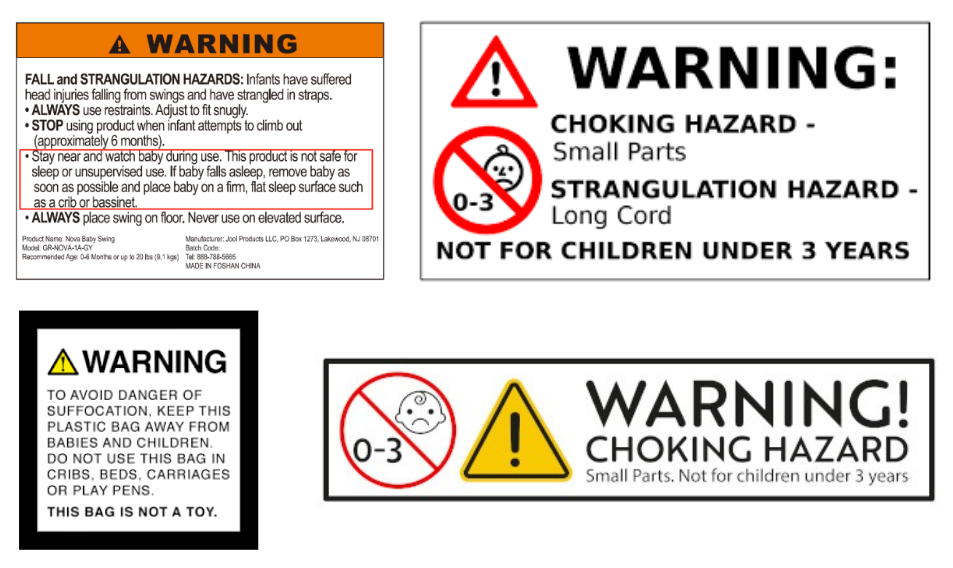
The above are examples of labels/stickers for different use cases. Make sure to double-check with your forwarder or import manager which ones you need according to your product classification.
Manufacturer or importer identification
Packaging must clearly identify the manufacturer or the U.S. importer responsible for the product. This typically includes the company name and contact information, allowing regulators or consumers to trace the responsible party if safety concerns arise.
Country of origin marking
Under U.S. customs rules, the product or packaging must include the country of origin (for example, “Made in China”). This marking must be legible, permanent, and placed in a conspicuous location. Incorrect or missing origin marking is one of the most common issues discovered during CBP inspections.
Tracking label information
Children’s products must include traceability information linking the product to its production history. Tracking labels typically include:
- Manufacturer or importer name
- Production date (month and year)
- Production facility identification
- Batch or lot number
This information allows regulators and importers to identify specific production runs if safety issues arise.
Placement and durability of labels
Label placement matters. Some information must appear on the product itself, while other elements may appear on the packaging. Tracking labels must be permanent where practicable – meaning printed, molded, engraved, or otherwise integrated into the product rather than attached via removable stickers.
Version control for packaging files
Packaging artwork should be version-controlled the same way engineering drawings are. Every artwork revision should be tied to a specific production run or lot. This makes it possible to identify which packaging version was used if questions arise during an inspection or recall investigation.
Marketing claims that affect compliance
Marketing language can unintentionally change a product’s regulatory classification. For example, describing a toy as “great for toddlers” or “designed for early learning” could lead regulators to classify the product for a younger age group than intended. That classification may trigger stricter testing requirements or additional warning labels.
Before finalizing packaging, review the claims made on the box alongside the product’s official age grading and test reports.
For a deeper look at common toy labeling requirements and real-world examples of compliant warning labels and tracking marks, see our detailed guide:
Everything You Need to Know About Importing Toys Into the USA.
Small Parts, Magnets, and Batteries: High-Risk Features That Trigger Extra Scrutiny
Certain toy features draw disproportionate regulatory attention because of their documented injury risk, particularly for young children.
Small parts are the most common concern. Under 16 CFR 1501, toys intended for children under 3 may not contain small parts (or generate small parts after normal use and reasonably foreseeable abuse testing). For toys marketed to children ages 3-6 that contain small parts, specific warning labels are mandatory. Age grading directly affects this: if your product is age-graded for “3 and up” but actually contains parts accessible to younger children, you have a compliance problem.
Magnets have become a major safety focus. High-powered magnets that can be swallowed pose serious ingestion hazards when multiple magnets attract through intestinal walls. ASTM F963-23 includes specific requirements for magnet flux and magnet containment in toys.
Battery-operated toys, especially those with button cell or coin batteries, face battery compartment accessibility requirements. The compartment must resist opening by a child, typically requiring a tool or simultaneous movements. Following updated ASTM F963-23 requirements, toys with small-part batteries intended for children eight and older must now undergo use and abuse testing to verify the battery compartment stays secure.
Customs, Classification, and Duties: Getting the Entry Right
Even with perfect product compliance, your shipment can still run into trouble on the customs side. Accurate classification, proper valuation, and complete entry documentation are essential to avoid costly corrections after your goods arrive.
HTS Classification for Toys: Practical Tips to Avoid Misclassification
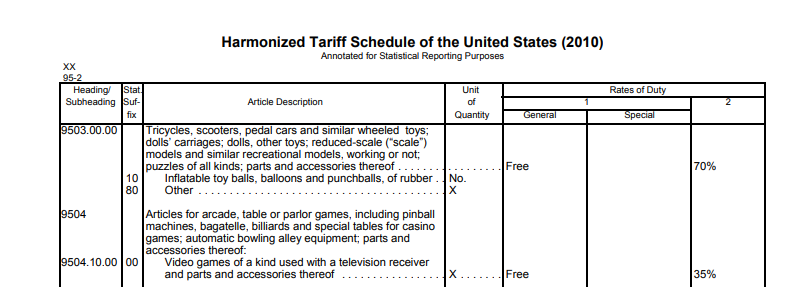
Toys are primarily classified under Chapter 95 of the Harmonized Tariff Schedule (HTS), specifically heading 9503 for most toy categories, including dolls, action figures, puzzles, building sets, ride-on toys, and reduced-scale models. The general duty rate for HTS 9503.00.00 for most trading partners is currently free, but additional tariffs under Chapter 99 may apply depending on the country of origin.
Classification errors happen more often than you might expect. A toy that includes a textile component (like a doll’s clothing) might be misclassified under a textile heading, attracting unnecessary duties. A ride-on electric vehicle could be classified as an electric vehicle rather than a toy if the product description on the invoice is vague. The key factors CBP considers for toy classification are the product’s material composition, its function, and the age group it targets.
Practical tips for getting classification right: write product descriptions on your commercial invoice that specifically reference the toy’s intended age group and play function. Maintain an internal classification file where you document your HTS rationale for each SKU. And if you’re genuinely uncertain, consider requesting a binding ruling from CBP, which gives you a legally binding classification determination before your goods ship.
Required Shipping & Entry Documents Checklist (Customs Side)
Smooth customs clearance starts with accurate paperwork. Here are the core documents you’ll need for a toy import entry:
- Commercial invoice: Must include accurate product descriptions (not just “toys” — specify the type, material, and intended age range), declared values per unit and per line item, seller and buyer information, country of origin, and Incoterms.
- Packing list: Should detail carton counts, gross and net weights, dimensions, and SKU-level mapping. Discrepancies between the packing list and the physical shipment are a common trigger for examination.
- Bill of lading (ocean) or air waybill (air): Consignee details must match the importer of record. Inconsistencies here can delay release.
- Children’s Product Certificate (CPC): Must be available upon request. Some importers include it proactively with their entry packet.
- Test reports from CPSC-accepted lab: Supporting documentation for the CPC.
- Tracking label evidence: Photos or samples showing compliant labels on products and packaging.
CBP expects importers to retain records for five years from the date of entry. This isn’t just a recommendation. Under 19 USC § 1508, CBP can audit your import records during that window, and failure to produce documentation can result in penalties.
Inspections, Holds, and Detentions: What to Do If Your Toy Shipment Gets Stopped
Even well-prepared importers occasionally face shipment holds. Common triggers include a missing or incomplete CPC, unclear or non-compliant labeling, inconsistencies between the invoice description and the physical product, and random selection for CPSC compliance examination.
If your shipment is stopped, response speed matters. Storage fees at the port accumulate daily, and extended detention can lead to forced re-export or destruction. Your immediate action plan should be to contact your customs broker, identify exactly what CBP or CPSC is requesting, and assemble the relevant documents (CPC, lab reports, tracking label photos, corrected invoices).
In some cases, the fix is straightforward: provide the CPC you forgot to include. In other cases, the issue may require corrective action. If labeling is non-compliant, you may be able to arrange relabeling at a bonded warehouse before release. If a classification is disputed, you’ll need to provide documentation supporting your HTS determination and potentially consult a trade attorney. If the goods are fundamentally non-compliant (failed testing, banned materials), re-export or destruction may be the only options.
Supply Chain Setup: Reduce Risk Before You Ship
The most cost-effective compliance strategy is to build it into your supply chain from the start rather than trying to fix problems at the border. Upstream controls at the supplier, factory, and pre-shipment level prevent the majority of clearance issues.
Supplier Vetting: Questions to Ask Before You Place the PO
Before you commit to a purchase order, screen your toy supplier for compliance maturity. Not every factory that makes toys understands U.S. import compliance requirements, even if they’ve exported to other markets. Key questions to ask include:
Can the factory provide proof of previous testing at CPSC-accepted labs? A factory that routinely exports to the U.S. should have a testing history. Ask for sample test reports (they can redact other buyers’ names). Do they have written material declarations and a change-control process? You need assurance that if the factory changes a paint supplier, switches resin types, or modifies a component, you’ll be notified before production runs. This is critical because material changes invalidate existing test reports.
Does the factory maintain lot and batch traceability? Can they track which raw materials went into which production run? This traceability is what connects your test reports to your tracking labels and CPCs. Without it, you’re guessing. Finally, is the factory willing to work with the CPSC-accepted lab you select, rather than insisting on their own testing provider? Some factories prefer labs they’re familiar with, but if those labs aren’t CPSC-accepted, the results don’t count.
Packaging & Labeling Workflow: Make Compliance Part of Artwork Approval
Labeling mistakes are among the most preventable compliance failures, yet they happen constantly because compliance teams and packaging design teams don’t coordinate. The fix is to make compliance review a mandatory gate in your artwork approval process.
Your artwork checklist should verify age grading labels (correct age range displayed prominently), all required warning statements (small parts warnings for ages 3-6, choking hazard warnings for specific components), manufacturer or importer name and address, and tracking label information (batch/lot, production date, factory location). Use version control for packaging files. Link each artwork revision to a specific production lot so you can trace which version was used if questions arise later. And be cautious with marketing claims. Describing a product as “educational” or “great for toddlers” on the packaging can influence how the CPSC classifies the product’s intended age group, potentially triggering additional safety requirements you hadn’t planned for.
The Importing Toys to the USA Checklist
Below is a phased checklist covering the complete import process from concept through post-arrival recordkeeping. Use it as a working document for each new product or SKU.
Phase 1: Before You Manufacture
This phase ensures your product concept, materials, and labeling plan comply with U.S. rules before money is committed to mass production.
- Confirm children’s product status. Determine whether the product is designed or intended primarily for children 12 and under. If yes, it’s a children’s product subject to full CPSIA requirements.
- Identify applicable safety standards. Review ASTM F963-23 and determine which sections apply based on your product’s type, materials, and features (sound, magnets, batteries, small parts, projectiles, etc.).
- Check additional rules. Identify whether lead paint limits (16 CFR 1303), phthalate restrictions, flammability standards (16 CFR 1610 for textiles), or other product-specific rules apply.
- Select a CPSC-accepted lab. Choose a testing laboratory from the CPSC’s accepted lab database that is accredited for the specific standards your product requires.
- Define the testing plan. Determine which tests are needed, how many samples are required, and the testing timeline relative to production.
- Draft tracking label specifications. Include all required traceability information in your supplier’s production specs: importer name, production date/location format, batch/lot numbering scheme.
- Build labeling requirements into artwork. Ensure packaging design includes age grading, warning statements, tracking label placement, and manufacturer/importer identification.
- Vet the supplier. Confirm the factory’s testing history, material control processes, and willingness to cooperate with your selected lab.
Phase 2: During Production & Testing
This phase keeps manufacturing lots, materials, and test samples aligned to prevent invalid certificates.
- Confirm materials match tested specs. Verify that the coatings, dyes, plastics, fabrics, and components used in the production run match the materials submitted for testing. Any change requires re-testing.
- Track lot and batch details. Record batch/lot numbers, production dates, and factory identification for every production run. This data feeds your tracking labels and CPC.
- Collect test reports. Obtain complete test reports from your CPSC-accepted lab. Confirm reports reference the correct product, manufacturer, and test standards.
- Prepare the CPC. Draft the Children’s Product Certificate tied to specific SKUs and lot numbers, referencing the applicable safety rules and corresponding test reports.
- Verify tracking labels on production samples. Confirm that tracking labels are permanently affixed, legible, and contain all required information on both the product and its packaging.
- Review packaging and labeling. Perform a pre-production or early production check of actual packaging against your approved artwork to catch errors before a full run is complete.
Phase 3: Pre-Shipment Documentation Check
Before goods leave the origin country, verify everything needed for customs clearance.
- Verify commercial invoice accuracy. Ensure product descriptions are specific (type, material, age range), declared values are accurate, and seller/buyer information matches your import records.
- Confirm packing list consistency. Carton counts, weights, and dimensions on the packing list must match the physical shipment. SKU-level mapping should be included.
- Check bill of lading / air waybill. Consignee and notify party details must match the importer of record and your customs broker’s requirements.
- Confirm shipping marks match documentation. Carton markings should align with what’s on the packing list.
- Assemble the compliance packet. Compile CPC + test reports + tracking label evidence (photos or samples) into a single, easily accessible digital folder per SKU.
- Coordinate with your customs broker/freight forwarder. Share the HTS classification, compliance documents, and any special handling instructions before the shipment arrives.
Phase 4: Arrival, Customs Clearance, and Post-Entry Recordkeeping
Cover arrival actions, inspection response readiness, and long-term record retention.
- Coordinate entry filing. Work with your customs broker to file the entry, confirm HTS classification, and ensure all entry documents are submitted accurately.
- Prepare a fast-response inspection folder. Have CPC, test reports, tracking label photos, and traceability records ready to submit within hours if CBP or CPSC requests them.
- Respond promptly to any holds or requests for information. Delays in responding increase storage costs and the risk of forced re-export.
- Confirm duty payments and entry summary. Verify that duties, taxes, and fees align with your classification and valuation.
- Retain all records for a minimum of five years. This includes entry documents, invoices, packing lists, CPCs, test reports, and correspondence with CBP. CBP can audit your records throughout this period.
- Schedule internal compliance audits. Periodically review your import files to ensure documentation is complete, current, and properly organized.
Most Common Mistakes and How to Avoid Them
Compliance failures in toy imports rarely come from exotic regulatory quirks. They come from ordinary process gaps that compound over time. Here are the most frequent issues and how to prevent them.
Using outdated or mismatched test reports. A test report is valid for the specific product, materials, and manufacturing process it was generated for. When a factory switches to a cheaper paint, uses a new adhesive, or sources components from a different sub-supplier, the original report no longer covers the product. Build a change-control agreement into your supplier contracts that requires notification before any material or process change.
Incorrect age grading or missing warnings. Age grading isn’t a marketing decision; it’s a compliance determination. If you grade a product “3 and up” to avoid the stringent under-3 testing requirements, but the product’s features and marketing clearly appeal to toddlers, you’re exposed. Conversely, if your packaging says “ages 6-12” but the product is suitable for younger children, you may be missing required warning labels.
Weak traceability (no lot or batch control). Without clear lot and batch tracking, you can’t connect a specific unit on a store shelf back to its test report and CPC. This makes targeted recalls impossible and can force you into a full product recall. It also means your tracking labels don’t contain meaningful information.
Inconsistent invoice descriptions causing classification or valuation issues. If your commercial invoice says “plastic toy” but your product listing says “educational STEM building kit,” CBP may question the classification. Keep descriptions consistent across invoices, packing lists, product listings, and compliance documents.
Mini Troubleshooting Guide: “If X Happens, Do Y”
- If your CPC or test reports are missing at the border: Contact your compliance team or testing lab immediately to obtain copies. Submit them to your customs broker as quickly as possible. If the documents genuinely don’t exist, you likely cannot clear the shipment without arranging testing and certification.
- If labeling is questioned by CBP or CPSC: Provide photographic evidence of compliant labels from pre-shipment inspection. If labels are actually non-compliant, explore whether relabeling at a bonded warehouse is possible before the goods are refused entry.
- If your HTS classification is disputed: Provide documentation supporting your classification rationale, including product descriptions, marketing materials, and any relevant CBP rulings. If the dispute is significant, escalate to a customs attorney or consider requesting a binding ruling for future shipments.
- If a product recall is triggered: Work with the CPSC immediately to define the scope of the recall using your lot/batch traceability records. The more precise your traceability, the narrower (and less expensive) the recall.
How a Logistics Partner Helps (and Where They Don’t)
Understanding the division of responsibilities between you and your logistics partners prevents dangerous assumptions.
A customs broker and freight forwarder can coordinate entry filing, manage document flow between you and CBP, provide shipment visibility, arrange transport and warehousing, and flag potential classification or documentation issues before they become problems. A good logistics partner streamlines the operational workflow so your goods move efficiently from factory to final destination.
What a logistics partner cannot do is take responsibility for your product’s safety compliance. The importer of record, owns product safety, testing, certification, and labeling accuracy. Your broker may remind you to have your CPC ready, but they can’t issue it for you or guarantee that your product meets ASTM F963.
The most effective approach is to build a repeatable standard operating procedure (SOP) for each product line. This SOP should define who handles compliance (testing, CPC, labels), who handles logistics (booking, documents, entry), and what triggers communication between the two teams. For example: “When a material change is confirmed, the compliance team notifies logistics so the entry packet is updated before the next shipment.”
Simplify Your Toy Import Logistics with Unicargo
Navigating the operational side of importing toys to the USA, freight booking, customs clearance, shipment tracking, and warehouse coordination is complex enough without doing it alone. At Unicargo, we’re a digital freight forwarding and e-commerce logistics partner with teams on three continents (USA, Israel, and China) and 13 warehouses worldwide, giving you boots-on-the-ground support at both origin and destination.
As part of Amazon’s Service Provider Network (SPN), we specialize in the exact logistics workflows that toy importers and e-commerce sellers depend on: international air and ocean freight, customs clearance coordination, Amazon FBA prep and labeling, warehousing and fulfillment, and PO management. Our digital platform gives you real-time shipment visibility, while our dedicated logistics managers provide the personalized support you need when unexpected issues arise, like a held shipment or a last-minute documentation request.
We don’t replace your compliance team, but we make the logistics side seamless so you can focus on getting your products right. If you’re importing toys and want a logistics partner that understands e-commerce supply chains inside and out, get in touch with our team to discuss your next shipment.
Conclusion + Next Step
Importing toys to the USA successfully comes down to a straightforward sequence: test at a CPSC-accepted lab, certify compliance in a CPC, label and trace every product and package, assemble accurate shipping documents, and clear customs with everything aligned.
The importers who avoid delays and penalties are the ones who build a centralized compliance and shipping “packet” for each SKU, one folder that contains the CPC, test reports, tracking label evidence, invoice templates, and classification rationale. When everything is in one place and kept current, responding to inspections takes hours instead of days.
Start with the phased checklist in this guide. Map it to your specific products. And when you’re ready to streamline the freight, customs, and fulfillment side of the equation, talk to Unicargo’s team about building a logistics workflow that keeps your toy imports moving.
FAQ
Do all toys imported to the USA need third-party testing? Yes. Under the CPSIA, any toy designed or intended primarily for children 12 and under must be tested by a CPSC-accepted third-party laboratory before it can be sold or distributed in the United States. This applies regardless of quantity or sales channel.
Who is responsible for issuing the Children’s Product Certificate (CPC)? The U.S. importer of record is responsible for issuing the CPC for products manufactured overseas. Even if your overseas supplier provides a certificate, the legal obligation falls on you as the importer to verify compliance and issue your own CPC.
What happens if my toy shipment is detained at U.S. customs? You’ll typically need to provide the missing documentation (CPC, test reports, labeling evidence) to CBP or the CPSC. Storage fees accumulate during detention, so speed matters. In some cases, relabeling at a bonded warehouse can resolve labeling issues. If the product is fundamentally non-compliant, re-export or destruction may be required.
Are toys from China subject to additional tariffs? Most toys fall under HTS heading 9503, which carries a general duty rate of “Free” for standard trade partners. However, additional tariffs under Chapter 99 may apply depending on the country of origin and current trade policy. Check the latest tariff schedule or work with your customs broker for up-to-date rates.
How long do I need to keep import records for toy shipments? CBP requires importers to retain all records related to an import entry for a minimum of five years from the date of entry. This includes invoices, packing lists, CPCs, test reports, entry summaries, and any correspondence with CBP or the CPSC.
Ready with your next toy shipment? Contact us or Get A Quote. We got you covered from A to Z, with full compliance and the best shipping routes and rates!