Shipping Lithium Batteries & Restricted Products: An E-commerce Compliance Guide
You’ve sourced a great product, nailed your listing, and sent your first shipment to Amazon – only to get a rejection notice you didn’t see coming. The culprit? That portable phone charger bundled with your main product, or the aerosol finishing spray you thought was just a normal consumer good.
Shipping lithium batteries and other restricted products catches even experienced e-commerce sellers off guard. What seems like an everyday item on store shelves becomes a compliance headache the moment it enters the freight and fulfillment system. This guide walks you through the most commonly flagged products, what fulfillment networks actually require, and a simple workflow to keep your inventory moving without delays or account friction.
Key Takeaways
- Everyday products trigger hazmat rules. Power banks, aerosols, perfumes, and nail polish are among the most commonly flagged items – not because they’re dangerous to consumers, but because commercial shipping has stricter standards.
- Three rule layers apply. Government regulations, carrier policies, and fulfillment program requirements (like Amazon FBA’s hazmat review) all need to be satisfied. Passing one doesn’t mean you’ve passed all three.
- Bundles create hidden risk. Adding a “free gift” battery pack or travel-size spray to your main product can turn a non-regulated shipment into one requiring hazmat handling.
- Documentation prevents delays. Have Safety Data Sheets for chemicals/cosmetics and battery specs (Wh rating, lithium content, cell count) ready before contacting your forwarder.
- Build compliance into your process. Check every new SKU for restricted components before ordering inventory, and audit existing products quarterly to catch formula changes or policy updates.
Why Sellers Get Flagged (And Why It’s Usually a Surprise)
Most sellers discover they’re dealing with restricted products the hard way: an inbound shipment gets rejected, a listing is suppressed, or inventory lands in “stranded” status with no clear path forward.
The reaction is almost always the same: “But it’s just a power bank” or “It’s only perfume – people carry it on planes all the time.” And that’s exactly the problem. What’s perfectly legal to carry as a consumer is often regulated when shipped commercially. The rules change based on quantity, packaging, transport mode, and destination.
When a product gets flagged, the consequences stack up quickly. You might face storage fees for inventory that can’t be processed, forced removal or disposal charges, carrier refusal to handle future shipments, or even account-level warnings from marketplaces. For sellers operating on tight margins and fast turnaround times, these disruptions hurt the most.
The confusion comes from three overlapping rule layers. First, there are government regulations from agencies like the Department of Transportation (DOT) and the Pipeline and Hazardous Materials Safety Administration (PHMSA) in the U.S., plus international frameworks like IATA for air transport and IMDG for ocean shipping. Second, carriers (airlines, ocean lines, trucking companies) often add their own restrictions on top of regulatory minimums. Third, fulfillment programs like Amazon FBA have their own hazmat review processes that can block products even when they’re technically legal to ship.
Understanding that these three layers exist – and that passing one doesn’t guarantee you’ll pass all three – is the first step toward avoiding surprises.
The “Sneaky Regulated” Products List (Most Common E-commerce Culprits)
Some products are obviously hazardous: industrial chemicals, compressed gas cylinders, flammable liquids in bulk. Those aren’t the ones that trip up e-commerce sellers. The real problem is “consumer goods” that trigger restricted handling because of what they contain or how they’re packaged.
A useful rule of thumb: if a product stores energy, sprays under pressure, smells like alcohol or solvent, or cures, dries, or heats up chemically – double-check its classification before shipping.
Bundling creates additional risk. That kit with a main product plus a “free gift” power bank? You’ve just turned a non-regulated shipment into one that requires hazmat handling. Multipacks of aerosol dry shampoo might be fine in small quantities but exceed thresholds when you ship a case of 24. Every variation in your catalog needs its own assessment.
Lithium Batteries in Everyday Products (Not Just Loose Cells)
Power banks and portable chargers are the number one surprise for e-commerce sellers. They’re everywhere – bundled with phone accessories, included as freebies, sold standalone – and they’re almost always regulated for shipping.
The key distinction that affects handling is whether batteries are “contained in equipment” (installed inside a device like a laptop), “packed with equipment” (loose batteries shipped alongside the device they power), or “shipped alone” (standalone batteries or power banks). Each configuration has different labeling, documentation, and packaging requirements. A wireless earbud case with a built-in battery faces different rules than the same battery shipped separately as a replacement part.
Transport mode matters significantly. Air freight has the strictest lithium battery regulations because battery fires at altitude are particularly dangerous. Ocean freight is generally more permissive but still requires proper classification. Ground shipping within a single country is often the easiest path, but international ground routes may cross into stricter jurisdictions.
According to the Federal Aviation Administration, lithium battery incidents on aircraft have been a growing concern, which is why regulators continue to tighten requirements for air transport of lithium batteries.
Aerosols & Pressurized Items
The aerosol category includes more products than most sellers realize: deodorant sprays, dry shampoo, hairspray, cleaning sprays, lubricants, spray paint, and even some food products. Anything in a pressurized container falls under special handling requirements.
The issue is temperature and pressure risk. Aerosol cans can rupture or explode if exposed to heat during transport or storage. Carriers are cautious about accepting them, especially for air freight where cabin pressure changes add stress to containers.
Common rejection reasons include missing hazmat labels, incorrect declarations on shipping documents, and inadequate outer packaging that doesn’t protect cans from damage. Even if you shipped the same product successfully before, a different carrier, route, or inspector might flag it the next time.
Cosmetics That Cross Into Regulated Territory
Beauty and personal care products are particularly tricky because similar-looking items can have completely different classifications. Perfume and cologne are regulated because of their alcohol content – typically 60-80% ethanol, which is flammable. Nail polish and nail polish remover contain solvents like acetone and ethyl acetate that also trigger hazmat requirements.
The challenge is that “same brand, different formula” can mean different classifications. A brand might sell both an alcohol-based perfume (regulated) and an alcohol-free body mist (non-regulated). Sellers who assume all products from one supplier have the same shipping requirements often get caught when they expand their catalog.
Some skincare products with high concentrations of certain active ingredients also fall into regulated territory, though these are less common. When in doubt, request a Safety Data Sheet (SDS) from your supplier – it will tell you if the product has any hazardous properties.
What Fulfillment Networks Typically Require for Hazmat/Restricted SKUs
Fulfillment programs like Amazon FBA follow a mix of external regulations and they have their own review processes that can be more restrictive than what’s legally required for transport.
Before a restricted product can be stored and shipped through FBA, it typically needs to pass a hazard review. This involves submitting product information, safety documentation, and sometimes test reports. Amazon maintains a database of reviewed products, but new items or variations need fresh approval.
Once approved, restricted products face ongoing limitations. They may be stored separately from regular inventory, subject to quantity caps, or restricted from certain shipping methods. A product approved for ground shipping to domestic customers might not be eligible for air freight to Alaska or Hawaii.
The frustrating part for sellers is that prior success doesn’t guarantee future acceptance. You might have shipped a product to FBA a dozen times, then have it flagged on shipment thirteen because of a policy update, a new inspector, or simply because your previous shipments slipped through without proper review. Treating initial success as permanent approval is a common and costly mistake.
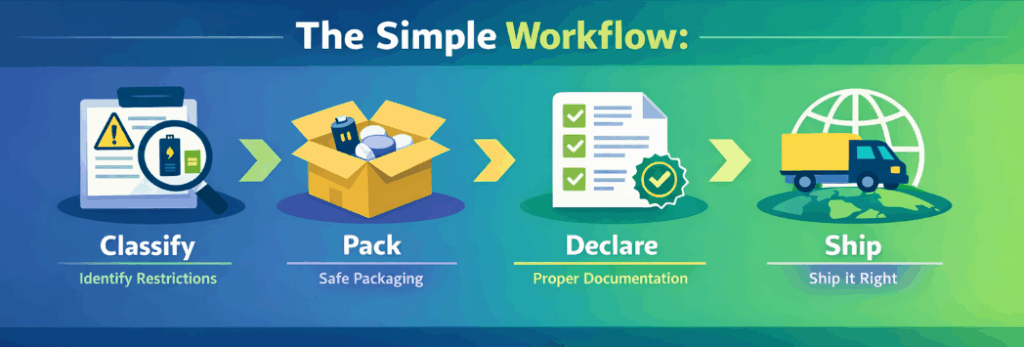
The Simple Workflow: Classify → Pack → Declare → Ship
Managing restricted products doesn’t require becoming a hazmat expert. It requires a consistent process you apply to every SKU before it enters your supply chain. Think of it as four steps: classify, pack, declare, and ship.
Classification means determining whether a product is regulated and under what category. This step requires accurate product data – don’t guess based on product names or assume something is fine because it’s sold in retail stores. Get Safety Data Sheets for anything chemical, cosmetic, or aerosol. Get battery specifications (watt-hour rating, lithium content, cell count) for anything with a battery.
Packaging comes next. Regulated products need specific packaging that matches the hazard type and transport mode. Lithium batteries require certain package labels and may need protective inner packaging. Aerosols often require cushioning and orientation markings. Using the wrong packaging for your chosen shipping method is a leading cause of rejections.
Declaration means consistent documentation across all shipping documents and booking details. If a product is regulated, it needs to be declared correctly on the commercial invoice, the bill of lading, and any hazmat declarations required by the carrier. Mismatched information between documents triggers inspections and delays.
Finally, ship with a carrier and route appropriate for your product. Not every carrier accepts every restricted product. Not every route is available for hazmat goods. Making sure your transport plan matches your product classification before booking saves time and money.
What to Send Your Forwarder (Forwarder-Ready Checklist)
Working with a freight forwarder makes restricted shipments easier, but only if you provide the right information upfront. Incomplete details lead to back-and-forth emails, missed booking windows, and preventable delays.
Before contacting your forwarder about a restricted product shipment, gather these items: product name, SKU, and clear photos of the item, its packaging, and any existing labels. For battery-containing products, you need the watt-hour (Wh) rating, lithium content in grams, number of cells, and whether batteries are installed in equipment, packed with equipment, or shipped alone. For cosmetics, chemicals, or aerosols, provide the Safety Data Sheet (SDS) – not a product spec sheet, but the actual SDS with hazard classifications.
Also communicate your intended shipping mode (air, ocean, ground), origin and destination, and whether the item is standalone, bundled with other products, or part of a kit. If you’ve had previous rejections or received hazard review outcomes from Amazon or another fulfillment program, share those details too – they help your forwarder understand what went wrong and how to avoid repeating it.
Essential Documentation and Mandatory Labeling
Getting your paperwork and package markings right is non-negotiable for shipping lithium batteries and restricted products. Missing or incorrect documentation leads to rejected shipments, while improper labeling can result in fines or seized cargo. Here’s what you need to have in place.
Required Documents for Lithium Battery Shipments
Shipper’s Declaration for Dangerous Goods (DGD): Required for all “fully regulated” lithium battery shipments (Section IA/IB under IATA regulations). This form details the UN number, proper shipping name, hazard class, and quantity. Your freight forwarder can help prepare this, but the shipper remains responsible for accuracy.
Air Waybill (AWB) or Bill of Lading (BOL): Must explicitly state that the shipment contains lithium batteries and include the applicable Packing Instruction number. For example, standalone lithium-ion batteries fall under PI965, batteries packed with equipment under PI966, and batteries contained in equipment under PI967. The IATA Lithium Battery Guidance Document provides detailed explanations of each packing instruction.
UN 38.3 Test Summary: This document certifies that the batteries passed mandatory safety tests covering altitude simulation, thermal cycling, vibration, shock, short circuit, impact, overcharge, and forced discharge. While it doesn’t need to be physically attached to every package, carriers can request it within 24 hours – so keep it accessible. PHMSA’s guidance on UN 38.3 Test Summaries outlines the specific requirements for manufacturers and distributors.
Safety Data Sheet (SDS): Though not always mandatory for finished battery products, having an SDS available provides important safety information about chemical composition and emergency procedures. For cosmetics, aerosols, and chemical products, an SDS is typically required.
Commercial Invoice: Must include a detailed breakdown of contents, specifying the number of batteries, watt-hour ratings, and weights. Vague descriptions like “electronics” or “accessories” will cause problems at customs and with carriers.
Mandatory Labels and Package Markings
All labels must be durable, weather-resistant, and clearly visible on the outer packaging. Damaged or illegible labels are treated the same as missing labels – your shipment will be rejected or delayed.
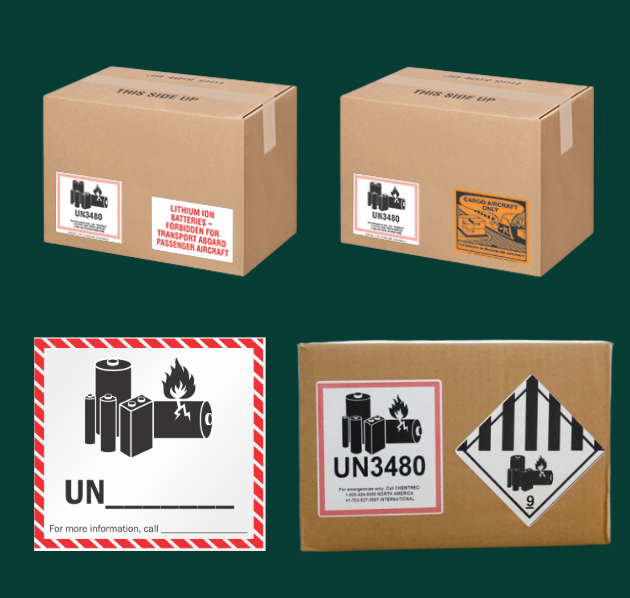
Lithium Battery Mark (UN 3480/3481/3090/3091): Required for most lithium battery shipments, including those qualifying for Section II exemptions. The mark features a red hatched border, a black battery icon with flames, and the appropriate UN number:
- UN 3480: Standalone lithium-ion batteries
- UN 3481: Lithium-ion batteries packed with or contained in equipment
- UN 3090: Standalone lithium-metal batteries
- UN 3091: Lithium-metal batteries packed with or contained in equipment
Note: The phone number on this label becomes optional after December 31, 2026.
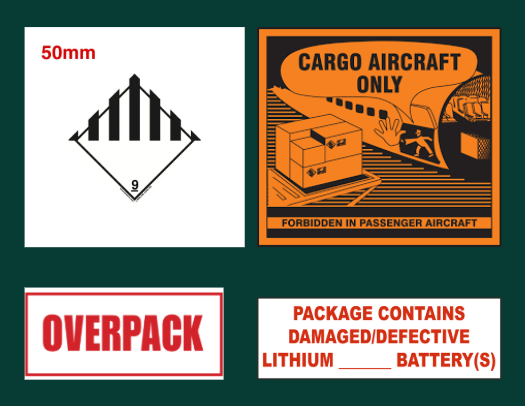
Class 9 Hazard Label: Required for fully regulated shipments – lithium-ion batteries exceeding 100Wh or lithium-metal batteries exceeding 2g of lithium content per cell.
Cargo Aircraft Only (CAO) Label: Mandatory when the package cannot be transported on passenger aircraft. This applies to larger lithium-ion batteries and certain battery configurations that exceed passenger aircraft limits.
Proper Shipping Name and UN Number: Must be clearly marked on the package exterior. For example: “UN3480, LITHIUM ION BATTERIES” or “UN3481, LITHIUM ION BATTERIES PACKED WITH EQUIPMENT.”
OVERPACK Label: Required when multiple smaller packages are consolidated into a single pallet, crate, or container. The overpack label indicates that inner packages comply with all applicable requirements.
Damaged/Defective Battery Label: Must be used when shipping broken, recalled, or defective batteries. These shipments face additional restrictions and may require special packaging approved by the carrier.
The FAA’s Lithium Battery Resources page provides visual guides and additional information on proper labeling for air transport.
Below are attached several samples of labels that are used for most cases. It’s important to check requirements before packing and shipping with your freight forwarder or agent and avoid surprises.
Labeling Requirements for Non-Battery Restricted Products
Aerosols, paints, cosmetics, and other chemical products have their own labeling requirements based on their hazard classification. These are governed by the IMDG Code for ocean shipping and IATA DGR for air transport.
Hazard Diamond Labels: Indicate the primary hazard class – for example, Class 3 (Flammable Liquid) for nail polish and perfume, or Class 2.1 (Flammable Gas) for certain aerosol products.
Limited Quantity (LQ) Mark: A black and white diamond symbol used for smaller quantities of hazardous goods that qualify for reduced requirements. Many consumer-sized cosmetics and aerosols can ship under limited quantity provisions.
Orientation Arrows: Required on packages containing liquid products to indicate which way is “up.” These arrows help handlers keep packages properly oriented during transport and storage.
Key 2026 Regulatory Updates
Lithium battery shipping regulations are updated annually. Here are the most significant changes taking effect in 2026:
30% State of Charge (SoC) Requirement Expansion: Effective January 1, 2026, lithium-ion batteries packed with equipment (PI966) with cells or batteries exceeding 2.7Wh must be charged to 30% or less of their rated capacity. Previously, this requirement only applied to standalone batteries (PI965). For batteries contained in equipment (PI967), IATA recommends (but does not require) that batteries be shipped at ≤30% SoC or with equipment displaying ≤25% battery capacity. This remains a recommendation rather than a mandatory requirement.. Lion Technology’s summary of IATA DGR changes provides a detailed breakdown of these updates.
Watt-Hour Marking Requirement: Lithium-ion batteries exceeding 100Wh must display their watt-hour rating on the outer battery case. This marking helps handlers quickly identify batteries that require fully regulated handling.
Important: Regulations change annually. Always verify current requirements with the latest IATA Dangerous Goods Regulations, IMDG Code, or 49 CFR 173.185 before shipping. The PHMSA Transporting Lithium Batteries page is also an essential reference for U.S. shippers. Your freight forwarder should be able to confirm which requirements apply to your specific products and shipping routes.
Common Mistakes That Cause Delays (And How to Avoid Them)
Certain errors show up repeatedly in restricted product shipments. Avoiding these common pitfalls will prevent most compliance headaches.
- Misdeclaring battery status is extremely common. Sellers mark shipments as “no lithium battery” when the product actually contains a small rechargeable cell – like a wireless device, LED light, or smart gadget. If it has a charging port, it almost certainly has a battery. Check every product, not just the obvious ones.
- Providing incomplete or outdated Safety Data Sheets causes delays when carriers or fulfillment networks can’t verify product classification. If your supplier reformulated a product, the old SDS may no longer be accurate. Request current documentation for every regulated SKU at least annually.
- Bundle creep is another frequent issue. Your main product isn’t regulated, but you add a bonus item – a small flashlight, a travel-size spray, a phone accessory – that is. Suddenly the whole shipment needs hazmat handling. Review every bundle and kit variation for restricted components.
- Using the wrong packaging or marks for your transport mode leads to rejections at origin or destination. Air freight has stricter requirements than ocean or ground. International shipments have different labeling standards than domestic. Make sure your packaging matches your actual shipping plan, not just the cheapest or most convenient option.
How Unicargo Helps E-commerce Teams Ship Restricted Goods With Less Friction
Navigating restricted product compliance is manageable, but it takes time- many e-commerce teams don’t have. Working with a freight forwarder experienced in hazmat and restricted goods can reduce the back-and-forth and keep shipments on schedule.
Unicargo supports e-commerce sellers through the documentation process, helping organize battery specifications, SDS files, and other required details before shipments are booked. This preparation work reduces the chance of last-minute rejections and speeds up carrier acceptance.
For sellers shipping restricted products regularly, lane and mode planning becomes important. Some routes and carriers are more accommodating for lithium batteries or aerosols than others. Unicargo’s teams across the U.S., China, MEA, and Europe can help identify transport options that are more likely to work for your specific product types.
Unicargo’s digital platform provides visibility into shipment milestones and documentation status, so you can track where restricted shipments are in the process and catch potential issues before they cause delays. For sellers managing multiple SKUs across different compliance categories, this operational visibility helps keep everything organized.
If you’re dealing with a small batch of restricted SKUs or planning an upcoming shipment that includes regulated products, reach out to Unicargo’s team for guidance on getting your documentation and shipping plan in order.
Conclusion: Make Compliance a SKU Launch Step
Restricted product compliance shouldn’t be something you deal with after a shipment gets rejected. Treat it as a standard part of your product launch process.
Add a restricted-goods check to every new product onboarding. Before you order inventory, before you create a listing, determine whether the product contains batteries, pressurized containers, flammable ingredients, or other regulated components. Get the documentation you need from suppliers upfront.
For your existing catalog, audit your top sellers and any bundles or kits quarterly. Products change, suppliers reformulate, and marketplaces update their requirements. What passed last year might not pass this year.
If you’ve been flagged, experienced rejections, or are expanding into new shipping lanes, consider getting a compliance-focused review of your product line. A little preparation prevents a lot of disruption – and keeps your inventory where it belongs: moving toward customers, not stuck in limbo.
Frequently Asked Questions
Do I need hazmat certification to ship lithium batteries?
It depends on your role in the shipment. If you’re an e-commerce seller using a freight forwarder and third-party fulfillment, you typically don’t need personal hazmat certification – your forwarder and carriers handle the regulated transport. However, you are responsible for providing accurate product information, proper packaging, and correct documentation. If you’re shipping hazmat goods yourself without a forwarder, training requirements may apply under DOT and IATA regulations.
Why did my shipment get rejected when I’ve shipped the same product before?
Prior success doesn’t guarantee future acceptance. Carriers update their policies, fulfillment networks refine their hazmat review processes, and different inspectors may catch issues that were previously overlooked. Your supplier may have also reformulated the product without notifying you. Treat every shipment as needing proper classification and documentation rather than assuming past approvals carry forward.
What’s the difference between batteries “in equipment” vs. “packed with equipment” vs. “standalone”?
These classifications affect labeling, packaging, and shipping restrictions. “Contained in equipment” means the battery is installed inside a device (like a laptop or wireless earbuds). “Packed with equipment” means loose batteries are shipped in the same package as the device they power but not installed. “Standalone” means batteries or power banks shipped by themselves. Standalone batteries typically face the strictest requirements, while batteries installed in equipment often qualify for less restrictive handling.
Can I ship aerosols and lithium batteries by air freight?
Yes, but with significant restrictions. Air transport has the strictest regulations for both product categories due to safety risks at altitude. Lithium batteries must meet watt-hour limits and packaging requirements specified under IATA Dangerous Goods Regulations. Aerosols must be properly classified and may be limited to cargo aircraft only, depending on their contents. Many sellers find ocean freight more straightforward for larger quantities of restricted products, reserving air freight for urgent or smaller shipments that meet all requirements.
What documents should I have ready before shipping restricted products?
At minimum, gather: the product name, SKU, and photos of the item and packaging; a current Safety Data Sheet (SDS) for any chemical, cosmetic, or aerosol product; and battery specifications (watt-hour rating, lithium content, number of cells, configuration) for any battery-containing product. Also note your intended shipping mode, origin, destination, and whether items are standalone or bundled. Having these details ready before contacting your forwarder significantly speeds up the booking process and reduces rejection risk.
Do lithium batteries need to be at 30% charge before I ship them, or can my freight forwarder do that?
The battery must already be at the required state of charge when you hand it over for shipment. This is the shipper’s responsibility, not the forwarder’s. As of January 1, 2026, lithium-ion batteries packed with equipment (PI966) exceeding 2.7Wh must be shipped at ≤30% state of charge. If you’re shipping devices with installed batteries, coordinate with your supplier or manufacturer to ensure batteries are charged to the correct level before they leave the factory. Freight forwarders cannot discharge batteries for you – the product must arrive compliance-ready.
My product has a lithium battery, but the supplier says it’s “exempt.” What does that mean?
“Exempt” typically means the battery qualifies for Section II provisions under IATA Packing Instructions, which have reduced packaging, labeling, and documentation requirements compared to fully regulated (Section I) shipments. For example, lithium-ion batteries ≤20Wh per cell or ≤100Wh per battery may qualify for Section II when packed with or contained in equipment. However, “exempt” doesn’t mean “no rules apply” – you still need proper markings, packaging standards, and specific notations on shipping documents. Always verify which exemption applies and ensure your forwarder has the correct battery specifications to determine eligibility.
What happens if customs finds undeclared lithium batteries or restricted goods in my shipment?
Undeclared hazmat can result in severe consequences: immediate shipment rejection, fines from carriers and regulatory agencies (potentially tens of thousands of dollars), your shipper account being flagged or banned, cargo being held or destroyed at your expense, and potential criminal liability in serious cases. Even if the issue was unintentional, you’re responsible for accurate declarations. If you’re unsure whether a product contains lithium batteries or restricted materials, ask your supplier directly and request documentation before shipping. It’s far better to delay a shipment for proper classification than to face penalties for non-compliance.
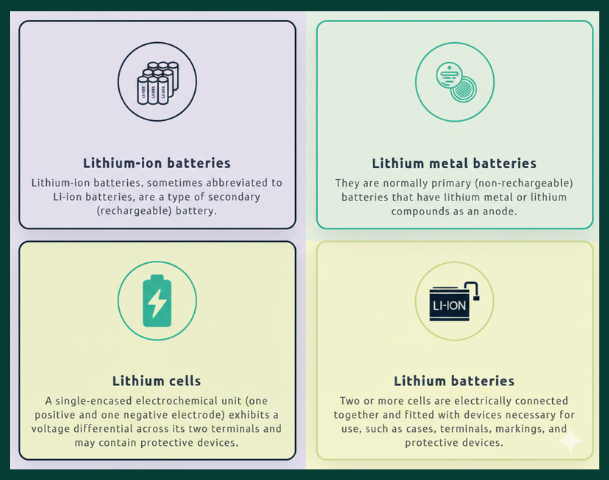
Below, you can find a thorough explanation of the different types of batteries commonly shipped and the differences between them.
Don’t hesitate to Contact Unicargo for consultation and shipment preparation. We’re here to help 😉