Top Largest Ports in the UK
The United Kingdom’s maritime heritage stretches back centuries, but today’s ports represent much more than historical landmarks. They serve as the backbone of British commerce, connecting businesses across the nation to global markets. Understanding which ports handle the most cargo and offer the best facilities can help you make smarter logistics decisions for your supply chain.
UK ports collectively handled 429.7 million tonnes of cargo in 2024, according to the UK Department for Transport. With over 120 commercial ports dotting the coastline, the nation’s maritime infrastructure processes roughly 95% of all international trade by volume. Whether you’re shipping containers from Asia, importing vehicles from Europe, or moving bulk commodities across the Atlantic, the right port choice can significantly impact your costs, delivery times, and overall supply chain efficiency.
Key Takeaways
- UK ports handle 95% of international trade – With over 120 commercial ports processing 429.7 million tonnes of cargo in 2024, these maritime gateways form the backbone of British commerce and global supply chains.
- Felixstowe dominates container shipping – Britain’s largest container port handles 48% of all UK containerised trade, processing over 4 million TEUs annually with direct connections to 700+ ports worldwide.
- Different ports excel at different cargo types – Immingham leads in bulk tonnage (46 million tonnes), Southampton specialises in vehicles and cruise traffic, Dover handles 33% of UK-EU trade, and Liverpool dominates transatlantic routes.
- Port selection directly impacts your bottom line – Choosing the right port based on cargo type, trade lanes, and distribution needs can significantly reduce transport costs, shorten delivery times, and improve supply chain reliability.
- Automation and green initiatives are reshaping operations – Major UK ports are investing heavily in smart technologies, electric infrastructure, and sustainable practices that will influence shipping costs and capabilities in the years ahead.

Why UK Ports Matter in Global Trade
The strategic importance of UK ports extends far beyond simply loading and unloading cargo. These facilities form critical links in international supply chains that keep British businesses competitive in global markets.
Consider the sheer scale of operations. According to the British Ports Association, over 95% of imports and exports by volume pass through UK ports, along with approximately 75% by value. This means nearly every product you encounter on store shelves or use in manufacturing has travelled through one of these maritime gateways.
Port infrastructure directly affects the cost, speed, and reliability of your shipments. A port with deep-water berths can accommodate larger vessels, which typically offer lower per-unit shipping costs. Strong rail and road connections reduce inland transport time and expense. Advanced cargo handling equipment speeds up turnaround times, keeping your goods moving toward their final destination.
For businesses sourcing from Asia or trading with North America and Europe, port selection influences everything from inventory planning to customer delivery promises. The top 10 ports account for approximately 70% of all cargo traffic at UK major ports, making them the primary focus for most importers and exporters seeking reliable logistics partners.
Port of Felixstowe
The Port of Felixstowe stands as Britain’s undisputed container champion. Located on the Suffolk coast, this maritime powerhouse handles approximately 48% of all UK containerised trade, making it the obvious first choice for businesses moving consumer goods, electronics, and manufactured products.
Felixstowe manages more than 4 million TEUs (twenty-foot equivalent units) annually and maintains direct connections with over 700 ports worldwide. The port’s deep-water berths can accommodate the world’s largest container vessels, including ultra-large container ships capable of carrying over 20,000 TEUs. This capacity means major shipping lines route their Asia-Europe services through Felixstowe, giving importers access to competitive freight rates and frequent sailings.
The port has invested heavily in automation, deploying remote-controlled gantry cranes and automated stacking systems that improve efficiency and reduce turnaround times. Its rail terminal ranks as the UK’s largest intermodal facility, offering extensive connections to distribution centres across the Midlands and northern England. The A14 provides direct motorway access to the M1, M6, and the broader UK road network.
Owned by Hutchison Port Holdings, Felixstowe continues to expand its capabilities. Recent dredging projects have deepened berths to 16.5 metres and beyond, ensuring the port remains competitive as container ships continue growing in size.
Port of Southampton
The Port of Southampton serves as one of Britain’s most versatile maritime facilities, excelling across multiple cargo categories while maintaining its position as Europe’s leading cruise turnaround port.
Southampton handles approximately 1.5 million TEUs annually through its container terminal, operated by DP World. The port processed 3 million cruise passengers in 2024, contributing over £1 billion to the regional economy. It also serves as the UK’s number one vehicle handling port, processing hundreds of thousands of cars each year for both import and export.
What makes Southampton particularly valuable is its natural geography. The port benefits from a unique double-tide system that provides extended periods of high water, allowing deep-draught vessels continuous access. This natural advantage, combined with purpose-built deep-water berths, makes Southampton ideal for businesses requiring reliable access for the largest ships afloat.
The port’s location on the south coast offers strategic advantages for transatlantic trade and connections with European markets. Strong intermodal links via road and rail connect Southampton to distribution centres throughout southern and central England. Associated British Ports, which owns the facility, continues investing in infrastructure including shore power connections that allow cruise ships to reduce emissions while docked.
Port of London
The Port of London represents one of the world’s most complex port systems, spanning 95 miles of the River Thames and comprising over 70 independently operated terminals. This vast network handles diverse cargo types that serve London and the broader Southeast region.
According to government statistics, London accounts for approximately 12% of all UK major port tonnage traffic, consistently ranking among the top ports by volume. The port complex handles everything from containers and dry bulk to liquid products and building materials. Its terminals serve as critical supply points for the capital’s construction industry, fuel distribution, and consumer goods.
The Port of London Authority (PLA) manages navigation and safety across this extensive waterway while individual terminal operators handle cargo operations. This structure allows for specialisation across different facilities, with some terminals focusing on aggregates, others on oil products, and others on containerised freight.
The Thames has seen significant investment in recent years, with sustainable initiatives including the UK’s first hybrid pilot cutters and extensive shore power development. The Thames Vision 2050 programme continues guiding development toward a cleaner, more efficient port complex.
London Gateway
London Gateway deserves special attention as one of Europe’s most modern container terminals. Opened in 2013 and operated by DP World, this deep-sea facility represents a £1.5 billion investment in cutting-edge port infrastructure.
The terminal currently handles nearly 2 million TEUs annually through its semi-automated operations. Robotic stacking cranes work alongside ship-to-shore gantries among the tallest in Europe, capable of servicing vessels carrying up to 24,000 containers. The port’s location just 25 miles from central London provides exceptional access to the UK’s largest consumer market.
DP World announced a £1 billion expansion in 2024 that will add two new all-electric berths, bringing the total to six and potentially making London Gateway Britain’s largest container port within five years. A second rail terminal will accompany this expansion, further strengthening connections to inland distribution centres.
The adjacent logistics park, one of Europe’s largest port-centric facilities, allows businesses to combine warehousing, distribution, and value-added services with direct port access. This integrated approach reduces handling and transport costs while speeding goods to market.
Port of Immingham
While Felixstowe leads in containers, the Port of Immingham claims the title of UK’s largest port by total tonnage. Located on the Humber Estuary, this bulk cargo specialist handles approximately 46 million tonnes annually, making it central to Britain’s industrial supply chains.
Immingham’s strength lies in energy and bulk commodities. The port processes massive volumes of oil, coal, biomass, and renewable fuels that power Britain’s economy. Its terminals serve refineries, power stations, and manufacturing facilities throughout the Midlands and northern England. The Humber International Terminal can accommodate vessels carrying up to 130,000 tonnes of bulk cargo.
The port also handles significant roll-on/roll-off traffic, with regular ferry services to Northern Europe and Scandinavia operated by DFDS. Container operations complement the bulk facilities, providing flexibility for businesses with diverse shipping needs.
Owned by Associated British Ports, Immingham sits at the heart of the Humber ports complex that also includes Grimsby, Hull, and Goole. This concentration of facilities creates the UK’s leading multi-port gateway, serving industrial customers across multiple sectors. Recent investment includes a £500 million programme developing green hydrogen production capabilities, positioning Immingham as a future hub for sustainable energy.
Port of Liverpool
The Port of Liverpool serves as Britain’s gateway to the Atlantic, offering unmatched connectivity for transatlantic trade. Its position on the west coast provides significant advantages for businesses trading with North America, Ireland, and beyond.
Liverpool handles approximately 45% of all UK container traffic with North America, making it the dominant player in transatlantic shipping. The £400 million Liverpool2 terminal, opened in 2016, transformed the port’s capabilities. This deep-water facility can accommodate vessels carrying up to 18,000 TEUs, putting Liverpool on par with major European container hubs.
The port’s strategic location means that 35 million people in the UK and Ireland live closer to Liverpool than to traditional container ports in the south of England. For businesses serving northern markets, this translates to shorter road miles, reduced transport costs, and faster delivery times. Strong rail connections extend this reach, with services linking directly to major distribution centres.
Operated by Peel Ports Group, Liverpool continues attracting major shipping lines. The port serves as a UK call for the 2M Alliance (Maersk and MSC) transatlantic services, connecting directly with US East Coast ports including Newark, Baltimore, Norfolk, and Savannah. Ongoing investment in cranes and terminal infrastructure supports continued growth in container volumes.
Port of Dover
The Port of Dover occupies a unique position in UK logistics as Europe’s busiest international ferry port. Unlike deep-sea container ports such as Felixstowe or Southampton, Dover does not handle large container vessels. Instead, the port specialises exclusively in roll-on/roll-off (Ro-Ro) ferry traffic, serving as the primary gateway for road freight and passenger travel between the UK and the European Union. The 21-mile crossing to Calais – approximately 90 minutes – makes Dover the fastest route between Britain and mainland Europe.
Dover handles 33% of all UK trade in goods with the EU and processes over 2 million freight vehicles annually. The port manages 31% of all heavy goods vehicles transiting UK seaports, demonstrating its dominance in roll-on/roll-off traffic. During peak periods, Dover processes up to 10,000 freight vehicles and 15,000 passenger vehicles daily.
The 21-mile crossing to Calais makes Dover the fastest route between Britain and mainland Europe. For businesses shipping perishable goods, time-sensitive components, or products requiring flexible delivery schedules, this short-sea option provides crucial advantages over deep-sea container shipping. Multiple ferry operators – including DFDS, P&O Ferries, and Irish Ferries – offer frequent departures throughout the day.
Post-Brexit, Dover invested heavily in border infrastructure to maintain efficient traffic flow. The port continues developing technology solutions including AI-powered traffic prediction systems that help manage vehicle movements and reduce waiting times. A new cargo terminal at the Western Docks provides modern facilities for non-accompanied freight and cold-chain storage.
Honorable Mentions: Other Major UK Ports
Beyond the headline ports, several facilities play vital regional or specialised roles that businesses should consider depending on their cargo types and geographic requirements.
Milford Haven ranks as the UK’s leading energy port, handling approximately 35 million tonnes of cargo annually. Located in Wales, the port hosts two major LNG terminals – South Hook and Dragon – that together can receive around 20% of UK gas demand. Oil refineries and product terminals make Milford Haven central to Britain’s fuel supply chain.
Teesport serves the industrial northeast, specialising in chemicals, steel, and manufacturing supplies. Its location near major chemical plants and the industrial heartland of Teesside makes it essential for businesses in these sectors. The port benefits from Freeport status, offering tax advantages for qualifying operations.
Forth Ports operates multiple facilities across Scotland, including Grangemouth, Leith, and Dundee. These ports collectively serve Scottish industry while providing connections to European and global markets. Investment in offshore wind support services positions these ports for growth in renewable energy logistics.
Trends Shaping the Future of UK Ports
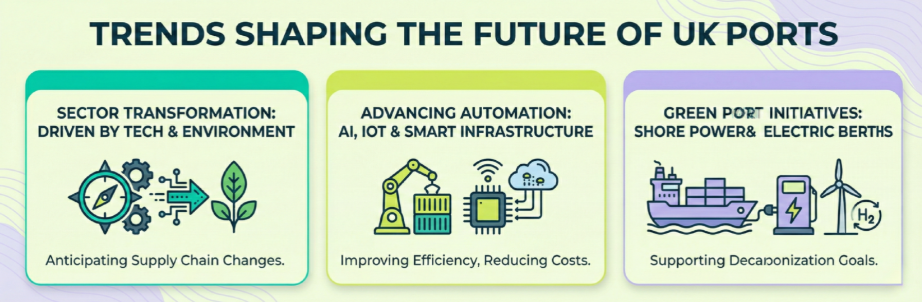
The UK port sector faces significant transformation driven by technology, environmental requirements, and evolving trade patterns. Understanding these trends helps businesses anticipate changes that may affect their supply chains.
Automation continues advancing across major terminals. Felixstowe, London Gateway, and Liverpool all employ automated stacking cranes and increasingly sophisticated yard management systems. These technologies improve efficiency and reduce handling costs, benefits that ultimately reach shippers through competitive pricing. Over 60% of global ports now invest in smart infrastructure incorporating AI, IoT sensors, and digital twin technology.
Green port initiatives are reshaping operations as environmental regulations tighten. Southampton’s shore power facilities allow cruise ships to plug into the electrical grid rather than running engines while docked. Similar investments are spreading across container terminals. London Gateway’s expansion features all-electric berths, while Immingham develops green hydrogen production capabilities. These investments support the maritime industry’s decarbonisation goals while often improving operational efficiency.
Post-Brexit customs arrangements continue evolving. Dover and other ports handling EU traffic have invested heavily in border infrastructure and digital systems to maintain efficient cargo flow. While additional checks add complexity, improved technology and streamlined processes help minimise delays. Businesses should work with experienced logistics partners who understand current requirements and can navigate regulatory changes.
Choosing the Right Port for Your Supply Chain
Selecting the optimal UK port depends on your specific cargo types, trade lanes, and distribution requirements. A thoughtful analysis can yield significant cost savings and service improvements. It’s important to understand that it’s the shipping lines that decide which ports they go to, their different lanes, contracts, and this is where freight forwarders who have knowledge and understand customers’ needs can suggest the best choice out of the possibilities. There are a lot of moving parts, and having a smart team behind you (a knowledgeable freight forwarder) will steer you towards the right choice of port.
Match port strengths to your cargo characteristics. Container importers from Asia typically benefit from Felixstowe’s direct services and competitive rates. Businesses trading with North America may find Liverpool’s transatlantic focus offers better value and shorter transit times to northern UK markets. Companies shipping vehicles should consider Southampton’s specialised facilities and deep automotive expertise.
Consider proximity to your distribution centres. A port closer to your warehouse or end customers reduces inland transport costs and transit time. For businesses serving the Southeast, London Gateway or Southampton may offer advantages. Those focused on northern markets might prefer Liverpool or Immingham despite longer sea voyages.
Evaluate handling speed and reliability. Port congestion and delays directly impact your inventory costs and customer service. Check terminal performance metrics and speak with freight forwarders about their experiences. Ports investing in automation and technology often deliver more consistent turnaround times than those relying solely on manual operations.
Why Businesses Trust Unicargo as Their UK Logistics Partner
Navigating the complexity of UK port operations requires expertise that goes beyond simply booking freight. Unicargo brings deep experience across all major UK ports, helping businesses optimise their shipping strategies for cost, speed, and reliability.
Our platform combines digital tools with dedicated logistics managers who understand each port’s unique characteristics. Whether you’re shipping containers through Felixstowe, managing roll-on/roll-off traffic through Dover, or coordinating bulk cargo through Immingham, we provide the visibility and support needed to keep your supply chain running smoothly.
As an Amazon Service Provider Network partner, we specialise in e-commerce logistics including FBA prep, labelling, and direct delivery to fulfilment centres. Our 13 warehouses worldwide and teams on three continents – USA, EMEA, and China – enable us to support complex international supply chains with local expertise at every stage, and on a global level
Optimize Your Shipping with Smarter Logistics
Traditional freight forwarding often leaves businesses struggling with limited visibility, slow communication, and fragmented services. Modern digital solutions transform this experience while maintaining the personal support you need when problems arise.
Unicargo’s end-to-end platform provides real-time shipment tracking, streamlined booking, and automated customs clearance. When unexpected challenges emerge – delayed vessels, port congestion, or documentation issues – your dedicated logistics manager works directly to resolve them. This combination of technology and human expertise delivers the reliability your business depends on.
Ready to simplify your UK port logistics? Contact Unicargo to discuss how our freight forwarding and e-commerce logistics services can strengthen your supply chain operations.
Frequently Asked Questions
What are the major ports in the UK?
The UK has over 120 commercial ports, but the major ports handling the bulk of cargo include Felixstowe (largest container port), Immingham (largest by tonnage), Southampton (vehicles and cruise), London (diverse cargo across 70+ terminals), Liverpool (transatlantic trade), and Dover (busiest ferry port). Together, the top 10 ports handle approximately 70% of all UK port traffic.
What is England’s busiest port?
It depends on how you measure “busiest.” By container volume, the Port of Felixstowe is the busiest, handling 48% of UK containerised trade and over 4 million TEUs annually. By total tonnage, the Port of Immingham leads with approximately 46 million tonnes per year. For ferry traffic, Dover is the busiest, processing over 2 million freight vehicles and 11 million passengers annually.
Who is the largest port operator in the UK?
Associated British Ports (ABP) is the UK’s largest port operator by number of facilities, owning and operating 21 ports including Southampton, Immingham, Hull, and Cardiff. Other major operators include Hutchison Port Holdings (Felixstowe), DP World (London Gateway and Southampton container terminal), and Peel Ports Group (Liverpool, Manchester Ship Canal, and several Scottish ports).
How long does shipping from UK ports to major destinations take?
Transit times vary significantly by destination and shipping method. Container shipments from Felixstowe to Asian ports typically take 25-35 days. Transatlantic crossings from Liverpool to US East Coast ports average 10-14 days. Dover ferry crossings to Calais take approximately 90 minutes. For time-sensitive cargo, these differences can significantly impact inventory planning and delivery schedules.
How has Brexit affected UK port operations?
Brexit introduced new customs requirements for UK-EU trade, particularly affecting ports like Dover that handle high volumes of European traffic. Ports invested heavily in border infrastructure, digital systems, and additional staffing to manage checks. While initial disruptions occurred, most major ports now operate efficiently with adapted processes. Businesses should ensure proper documentation and work with experienced customs brokers to avoid delays.