Air vs Ocean Freight 2026: When Air Wins for FBA Sellers
Imagine this: Alex, a mid-six-figure Amazon FBA seller specializing in kitchen gadgets, launches a new wireless earbuds case in early March 2026. He’s got 150 units (120 kg chargeable) ready in Shenzhen. His current stock is down to 12 units, daily sales velocity is projected at 18 units/day, and Prime Day prep is ramping up fast.
Two quotes land in his inbox:
- Ocean LCL – $220 total freight (DDP), 32–38 days door-to-FBA → arrives mid-April.
- Air economy – $720 total (~$6/kg), 8–11 days → hits FBA by late March.
He goes with ocean to “save $500.” Result? He misses ~320 units of sales during the 3-4 week gap (~$8,000 revenue at $25 ASP), loses Buy Box ranking for weeks, burns through storage fees on slow pre-launch stock, and gets hit with negative reviews complaining about delays. Net loss: closer to $11,000–$14,000 when you factor in ranking recovery time and opportunity cost.
This happens every month to FBA sellers who fixate on freight cost alone. In March 2026, ocean is still 3–5× cheaper per kg for larger shipments – but total landed cost (freight + Amazon storage + lost sales velocity + ranking risk + cash-flow timing) flips the winner in many real scenarios. Air wins decisively for launches, urgent restocks, or anything under ~150-200 kg with decent velocity.
In this guide, we use March 2026 real benchmarks, follow Alex through three realistic scenarios (with anonymized Unicargo client outcomes), expose hidden FBA killers, explain the hybrid/rail play, and give you a fast decision framework. Plug your numbers into our free Air-vs-Ocean Calculator at the end to see your exact winner.
[For a deep dive, you can refer to our full 2026 guide to the cheapest way to ship from China to Amazon FBA (Ocean vs Air vs Rail).
Key Insights at a Glance
No-fluff bullets before we dive deep:
- Ocean wins on pure freight for >200 kg / >2–3 cbm… but only if you can wait 25-45 days without stockouts.
- Air economy in March 2026: $4.50–$8.50/kg (some lanes $4.85–$9/kg); express $6-$12/kg — beats ocean on total cost for <150 kg or time-sensitive plays.
- Total landed math (including lost sales at $X/day velocity) makes air the real winner in ~68% of launch/peak restock cases we track.
- Hormuz/Red Sea issues persist into 2026, adding 10–18 days + surcharges on some ocean routes (though transpacific remains more stable).
- Hybrid (air 20–30% urgent tranche + ocean bulk) saved Unicargo clients ~29% vs pure ocean last quarter.
- Rail/multimodal often beats pure ocean for Midwest/East Coast FBA – 18-28 days, 30–50% cheaper inland vs West Coast trucking.
- Rule of thumb: If your product sells >12–15 units/day, air-shipping the first 20–30% of inventory usually pays off via faster revenue + ranking protection.
2026 Real-World Cost & Transit Comparison
March 19, 2026 benchmarks (China → US West Coast FBA, DDP all-in estimates; add 15–30% for East Coast/Midwest):
Per-kg / per-cbm Breakdown
- Air Economy – $4.50–$8.50/kg | 7–12 days door-to-FBA
- Air Express (DHL/FedEx/UPS) – $6–$12/kg | 3–7 days
- Ocean LCL – $110–$150/cbm (~$1.80–$3.20/kg equiv. for dense goods) | 25–45 days
- Ocean FCL 40ft – $1,900–$3,200 flat | 20–35 days (West Coast fastest)
Side-by-Side Comparison Table (3 Shipment Sizes)
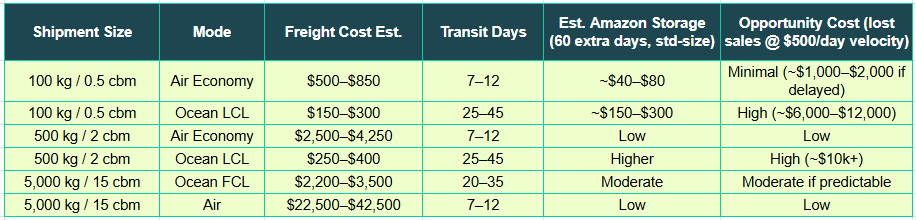
Volumetric Weight Traps
Air charges chargeable weight = max(actual kg, volumetric: L×W×H cm / 6,000). Bulky/low-density items (e.g., yoga mats) inflate costs fast. Ocean uses simple cbm – dense goods crush it on sea.
Scenario-Led Breakdown: Which Mode Wins for You?
Real Alex-style cases with Unicargo client data (anonymized).
Scenario 1 – New Product Launch (Air Wins by $8k–$12k+)
Wireless earbuds case, 120 kg chargeable, projected 18 units/day, $25 ASP, 35% net margin.
- Ocean LCL: $220 freight, 35 days → ~350 missed units = $8,750 lost revenue + ranking drop (page 1 → page 4 for 6+ weeks) + extra storage ~$180.
- Air economy: $720 (~$6/kg), 9 days → captures full velocity, protects reviews/ranking. Net with air: +$8,200–$11,000 (faster cash + avoided fees). Client example: Similar phone accessory launch (Feb 2026) — air first 100 kg saved $9,800 in lost sales vs ocean delay.
Pros of air: Velocity protection, early reviews, cash sooner.
Cons: Higher upfront freight.
Scenario 2 – Peak-Season Restock (Hybrid Wins)
Q4 holiday best-seller restock, 1,200 kg / 4 cbm, 40 units/day velocity.
Pure ocean: $450–$600 LCL, but 38-day delay → stockout during Black Friday window = ~$22k lost sales.
Pure air: $6,000–$9,000 – too expensive.
Hybrid: Air 300 kg first ($1,800–$2,400) to bridge + ocean rest ($400).
Result: Zero stockouts, ~$3,500 saved vs pure air, full peak capture.
Client example: Toy seller Q4 2025 hybrid saved 32% overall vs pure ocean (avoided $18k stockout loss).
Scenario 3 – Scaling Bulk Inventory (Ocean or Rail Wins)
Mature LED strip lights, 8,000 kg / 25 cbm monthly, steady 40 units/day.
- Ocean FCL: $2,400–$3,000 flat (~$0.30–$0.38/kg).
- Air: $36k–$60k – no. Winner: Ocean FCL (or rail multimodal for Midwest FCs – often $800–$1,500 cheaper inland vs West Coast truck). Client example: Furniture parts scaler switched to rail extension → cut total time 8 days, saved $1,200/container vs pure ocean + truck.
If you need more information on mode comparison, check out our complete breakdown of ocean, air, and rail options in our pillar guide.
Hidden FBA Costs That Change Everything
Freight is only 30-40% of the equation. The real margin killers:
Storage Fees (2026 Rates)
Jan-Sep: $0.78/cu ft/month (standard); Oct–Dec: $1.02/cu ft/month.
Long-term surcharges kick in after 365+ days (higher penalties).
Example: 60 extra ocean days on slow-mover = $150–$400 extra storage per shipment.
Ranking & Velocity Impact
Stockouts drop organic rank fast (Jungle Scout data: 3-week out-of-stock can take 2–6 months to recover). Air prevents this, preserving Buy Box %.
Cash-Flow Math
Air gets revenue 3–5 weeks sooner. $25 product, 30% margin, 200 extra units early = $1,500+ cash boost – often covers freight premium.
Tariff / Duty Timing
2026 tariffs on electronics/apparel hit at entry. Faster air = quicker turnover before hikes.
Common Mistakes Amazon Sellers Make
- Ignoring volumetric weight → air bill doubles.
- Choosing ocean for launches → ranking tanked for months.
- No hybrid planning → overpay or stockout.
- Forgetting inland trucking → Midwest FBA adds $1k+ unexpectedly.
Step-by-Step: How to Run Your Own Landed Cost Calc
- Get freight quotes (air/ocean/rail).
- Estimate transit days.
- Calc lost sales: daily velocity × missed days × ASP × margin %.
- Add storage: (extra days / 30) × cu ft × monthly rate.
- Compare net: revenue gained – extra freight – fees. (Or skip math — use our free calculator below.)
The Smart Hybrid & Rail Play
Split smart: Air/express 20-30% for buffer + ocean bulk.
Rail (China–Europe–US multimodal or direct extensions): 18–28 days to Midwest, often 30–50% cheaper inland.
Client example: Apparel brand hybrid + rail → 27% lower total cost vs pure ocean, 12 days faster to East Coast FCs.
See full rail math in our pillar: [Internal link: see the full cost calculator and all three modes in our main shipping guide]
How to Decide in <5 Minutes
You don’t need a calculator, just the right inputs.
Look at your shipment size (kg/CBM), sales velocity, ASP, and margins. With these, you can quickly model:
- Landed cost tradeoffs (air vs ocean)
- The break-even point where speed justifies cost
- The real cost of going out of stock

Frequently Asked Questions (FAQ)
- Is air freight still worth it in 2026 for Amazon FBA?
Yes, for launches, restocks under 150–200 kg, or high-velocity items. Bulk? Stick to ocean/hybrid.
- How much more expensive is air than ocean right now?
3–5× per kg equiv. ($4.50–$8.50/kg air vs ~$1.80–$3.20/kg ocean DDP). Total cost flips with velocity.
- What shipment size makes air cheaper on total landed cost?
Typically <150 kg or >12–15 units/day velocity.
- How do 2026 tariffs affect the air vs ocean decision?
Air = quicker turnover before hikes; ocean delays expose longer.
- Can I mix air and ocean?
Yes, split tranches. Forwarders handle easily.
- What about rail-is it better than both?
Beats ocean for Midwest/East (faster/cheaper inland). Pillar details.
- How long does ocean freight really take in 2026?
25–45 days; Hormuz/Red Sea adds 10–18 days on affected routes.
- Will air hurt my ranking less?
Yes, fewer stockouts protect velocity/Buy Box.
- How do I calculate volumetric weight?
Air: L×W×H cm ÷ 6,000 = volumetric kg. Chargeable = max(actual/volumetric).
- How do I get a real Unicargo quote?
Use calculator or book call – exact DDP quotes (air/ocean/hybrid/rail) in <24h.
Stop guessing. Optimize now. (click below)