How to Avoid Demurrage and Detention Fees: A 2026 Playbook for Importers
Between April 2020 and March 2025, just nine ocean carriers collected roughly $15.4 billion in demurrage and detention charges from U.S. importers, according to Federal Maritime Commission (FMC) quarterly data. That number is not a typo, and it is not a pandemic anomaly fully behind us. Even after Q1 2025 saw the first meaningful decline in billings since the COVID peak, D&D remains one of the most painful and least predictable line items on any import budget.
The good news is this: most of those fees are preventable, and a meaningful portion of the ones that land in your inbox are disputable under federal regulations that took effect in 2024. If you ship full containers from Asia, sell on Amazon FBA, or import as a small-to-mid-size business, knowing how to avoid demurrage and detention fees is not a nice-to-have skill. It is one of the highest-leverage cost controls in your supply chain.
This guide walks through what these fees actually are, why they keep happening in 2026, the FMC rule that is still your strongest defense (even after a major court ruling), nine practical avoidance tactics, and exactly what to do when a non-compliant invoice does land on your desk.
TL;DR – Key Takeaways
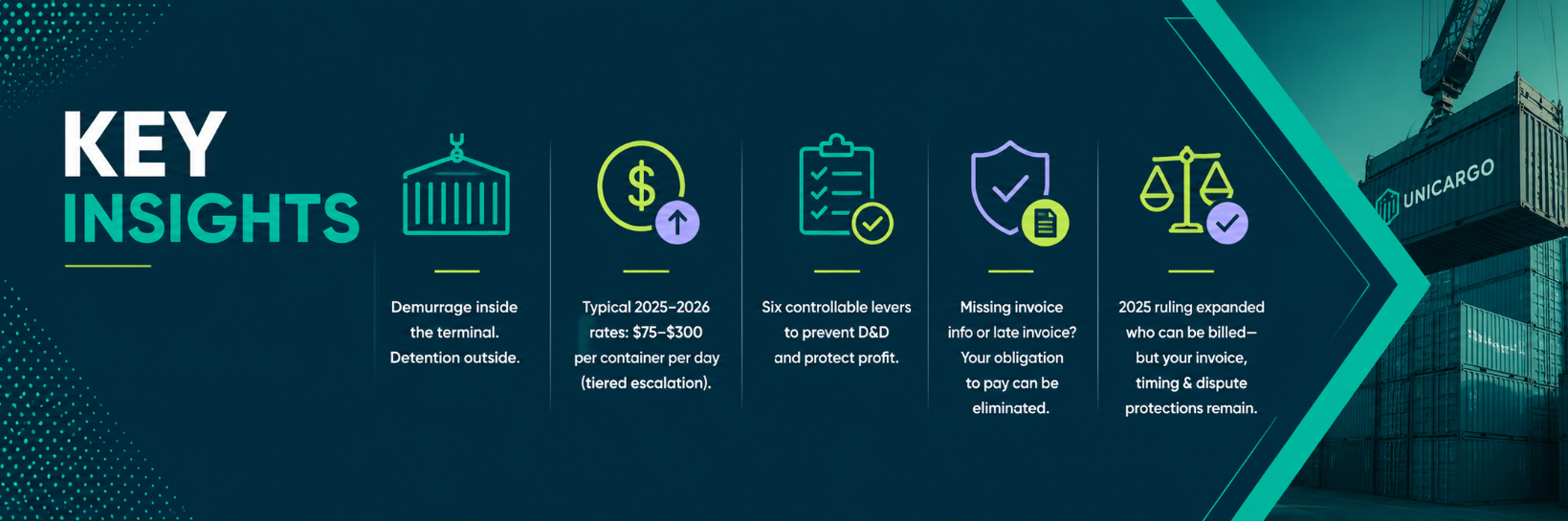
- Demurrage is charged when a loaded container sits inside the marine terminal past its free time. Detention is charged when the carrier’s container is outside the terminal in your possession and isn’t returned empty in time.
- Typical 2025–2026 rates: roughly $75–$300 per container per day for demurrage, with tiered escalation as days pile up; detention often follows a similar curve and in some yards can be quoted per hour.
- Six controllable levers: pre-clear customs, negotiate free time in your service contract, pre-book drayage and chassis, transload at a 3PL near the gateway port, run real-time last-free-day visibility, and dispute non-compliant invoices instead of paying them by default.
- Under the FMC’s 2024 rule, a missing required field on an invoice can wipe out your obligation to pay – and the same is true if the invoice is issued more than 30 calendar days after the charge was last incurred.
- The September 2025 D.C. Circuit ruling in World Shipping Council v. FMC changed who can be billed (motor carriers are back in play under contractual privity), but it left every invoice-content, timing, and dispute protection fully intact.
What Are Demurrage and Detention Fees (and Why They’re Different)
Most importers know the terms roughly, but the difference between them gets blurred in everyday conversation. That blur costs money, because the avoidance playbook for each is different and the responsibility paths under the FMC rule are different too.
Both fees exist because ocean carriers and marine terminals need their assets – containers and yard space – to keep flowing. Free time is the grace period a carrier or terminal gives you to use those assets before the meter starts. Cross the line, and one of two clocks starts ticking.
Demurrage – Time Inside the Terminal
Demurrage is the fee an ocean carrier or marine terminal operator (MTO) charges when a loaded container stays inside the port terminal beyond the allotted free time after vessel discharge. The most common triggers are customs clearance delays, missing or wrong documentation, late drayage pickup, and exam holds from CBP or partner government agencies.
Free time for demurrage is typically three to seven calendar days, depending on the carrier’s tariff and the specific terminal. After that window closes, charges accrue daily. According to industry rate surveys, average 2025 demurrage rates range from $75 to $300 per container per day, often on a tiered schedule that climbs steeply once a container has been sitting past free time for more than a few days. By day 8, you may be paying double or triple the day-1 rate per box.
The party that charges demurrage is typically the ocean carrier (the VOCC or, in some lanes, an NVOCC). Marine terminals sometimes also assess a separate “storage” charge that functions the same way. Either way, the trigger is the same: a loaded container still inside the gates.
Detention – Time Outside the Terminal
Detention – sometimes called “per diem” in carrier tariffs – is the fee charged when the carrier’s container leaves the terminal in your possession (or your trucker’s) and isn’t returned empty by the deadline. The container could be sitting at your warehouse, at a transloader, in a drayage yard, or stuck because nobody can find a chassis to bring it back.
Detention triggers are predictable: slow unloading at the destination warehouse, no chassis available to return the empty, or terminal “shut-out” days when empty returns simply aren’t accepted because the port is congested. Free time for detention is usually three to five days for smaller importers, though high-volume shippers can negotiate 14 to 20 days as part of annual service contracts.
The important thing to remember: detention is almost always assessed by the ocean carrier, not “the port.” It is the single fee that importers most often misattribute, which makes disputes harder to pursue because the wrong party gets the angry email.
Why the Distinction Matters
Each fee has a different prevention play and a different responsibility path. Demurrage is fundamentally about getting the box out of the terminal fast – which means clearing customs early, having drayage pre-booked, and avoiding documentation friction. Detention is about getting the box back empty fast – which means unloading quickly, having chassis to return, and not getting caught on a shut-out day.
Here is a quick comparison:
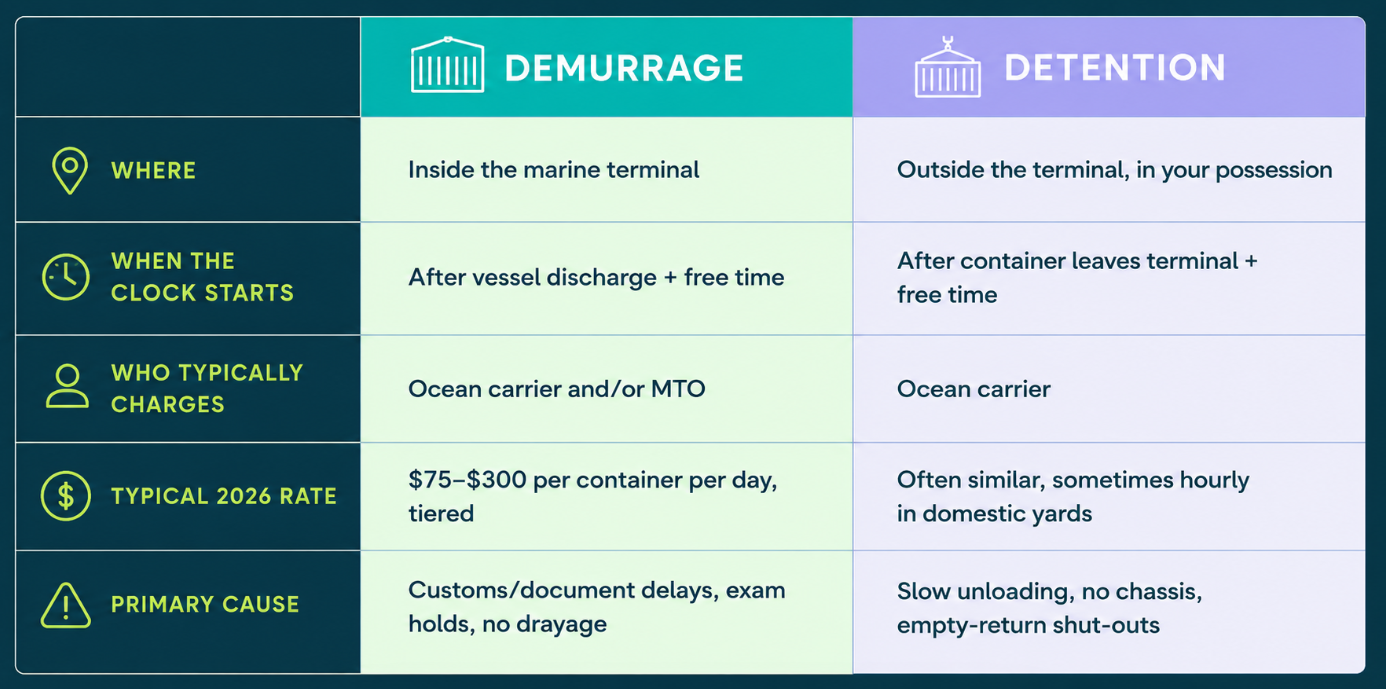
Keep this mental model in your back pocket. Every avoidance tactic that follows maps to one or both of these failure modes.
What’s Actually Driving D&D Fees in 2026
D&D charges feel random when you are the one paying them, but they are not. The underlying drivers are a fairly short, predictable list – most of which the importer can influence directly. The headline pressures are still there in 2026, just rearranged.
The Real Cost Picture
The cost picture is unforgiving. As mentioned earlier, the FMC reports that nine major ocean carriers collected approximately $15.4 billion in D&D charges between April 2020 and March 2025. Both billed and collected amounts hit their peak in Q4 2024 – about 85% higher than the Q2 2020 baseline – before Q1 2025 saw a 24% sequential drop in billings and a 19% drop in collections. That dip is welcome news, but the structural pressure has not gone away.
Run the per-container math on your own desk, and the abstract numbers become concrete fast. A modest 10-day delay at $200 per day equals $2,000 of demurrage on a single container. Across a 12-container shipment from China, that is $24,000 of unplanned cost on one sailing – and that is before you add chassis fees, storage, lost margin from stockouts, or Amazon’s own low-inventory penalties. For a typical 40-foot FCL ocean shipment from China to the U.S., a single bad week at the terminal can wipe out the freight savings you spent months negotiating.
The Five Root Causes
In our experience, almost every D&D event we have seen at a U.S. gateway port traces back to one or more of five root causes:
- Customs clearance delays. This is the number-one demurrage trigger we encounter. ISF filing errors, wrong HTS codes, missing certificates of origin, undeclared partner-government-agency requirements (FDA Prior Notice, CPSC certificates, USDA permits), and PGA holds all park containers at the terminal while the clock runs.
- Port congestion. Labor disruptions like the 2024 ILA contract negotiations, Red Sea rerouting that pushed extra volume onto Cape of Good Hope sailings, and ongoing pressure on transpacific lanes can all back vessels up at berth. Even modest congestion adds two or three days to the discharge-to-pickup window.
- Drayage and chassis shortages. At LA/Long Beach during peak season, finding a chassis on the day you actually need one can be the single hardest task of the week. No truck, no chassis, no empty return slot – the container sits.
- Documentation friction. A late bill of lading, a mismatched commercial invoice, a missing telex release, or an ISF filed past the 24-hour-before-loading deadline can each freeze a container in place.
- Warehouse-side bottlenecks. This is the cause importers most often forget to model. If your receiving warehouse can’t accept the container fast enough – or if your Amazon FBA appointment is two weeks out – your free time runs out before you ever touch the goods.
The Amazon FBA Squeeze (Where E-Commerce Sellers Get Hit Hardest)
This last one deserves its own section, because it is where Amazon FBA sellers consistently get squeezed and it is the gap that most generic D&D guides ignore. The structure of the FBA program creates a specific D&D vulnerability that ocean importers in other channels do not face in the same way.
Here is the core problem: Amazon does not act as importer of record. You – the seller – carry full responsibility for the container from origin to the FBA fulfillment center’s dock door. And during Q4, Prime Week, October Big Deal Days, and the Black Friday lead-up, FBA appointment calendars routinely push delivery windows back five to fourteen days. If your free time is five days and Amazon’s next available appointment is ten days out, you are paying detention before the container even moves.
The structural fix is to decouple your free time from your FBA appointment by transloading at a third-party warehouse near the gateway port. Strip the container in 24–48 hours, return it empty to the carrier inside free time, and then deliver palletized inventory to FBA on Amazon’s calendar, not the carrier’s. For sellers shipping from China – where the post-de minimis tariff environment and Amazon’s January 2026 end to in-house FBA prep have already raised the stakes – this single move can be worth thousands of dollars per container.
The 2024 FMC Final Rule – Your Most Underused Defense
If there is one section of this guide to bookmark, it is this one. Most importers treat D&D invoices as unavoidable bills to be paid and forgotten. Under the Federal Maritime Commission’s 2024 Final Rule on Detention and Demurrage Billing Requirements, they are something very different: they are contestable, and a non-compliant invoice eliminates your obligation to pay it.
What Changed on May 28, 2024
On May 28, 2024, the FMC’s Final Rule on Demurrage and Detention Billing Requirements – codified at 46 CFR Part 541 – took effect for most provisions. The rule was a direct response to OSRA 2022, after Congress directed the FMC to “further define prohibited practices” around D&D charges in the wake of pandemic-era billing abuses.
Three pillars define what the rule actually requires:
- Required invoice contents. Demurrage and detention invoices must include specific data points across identifying, timing, rate, dispute, and certification categories.
- A 30-day issuance deadline. Under 46 CFR 541.7, a billing party must issue the invoice within 30 calendar days from the date the charge was last incurred. Late invoice? Billed party does not have to pay.
- A 30-day dispute window with required response. The billed party has at least 30 calendar days from invoice issuance to request mitigation, refund, or waiver, and the billing party must attempt to resolve the dispute within 30 days of receipt.
The killer provision is buried in 46 CFR 541.6: failure to include any of the required minimum information in a demurrage or detention invoice eliminates any obligation of the billed party to pay the applicable charge. In plain English: if the invoice is missing a required field, you do not owe the money. The rule applies to VOCCs, NVOCCs, and MTOs invoicing for U.S. import or export shipments.
What the September 2025 Court Ruling Actually Means
On September 23, 2025, the U.S. Court of Appeals for the D.C. Circuit issued its decision in World Shipping Council v. Federal Maritime Commission. The court vacated one section of the rule – 46 CFR 541.4 – which had specified that invoices could only be issued to either the contracting party or the consignee. The court held that the FMC had not adequately justified its categorical exclusion of motor carriers, even when those motor carriers had a direct contractual relationship with the billing party.
This is where many ranking articles on the topic stopped updating. Here is what the ruling actually changed and what it did not:
- What changed. Ocean carriers can now once again invoice motor carriers under carrier haulage agreements, where contractual privity exists. The bright-line restriction on who can be billed is gone until the FMC issues a new rulemaking or further explanation.
- What did not change. Every other provision of 46 CFR Part 541 remains fully in force. That includes the invoice content requirements (541.6), the 30-day issuance deadline (541.7), the 30-day dispute window, the resolution timeline, and the rule that missing required information eliminates the obligation to pay. The FMC has also signaled it may revisit the billed-party question in a future rulemaking.
For the typical importer, the practical implication is small. Your protections under the rule – the ones that let you contest non-compliant invoices and stale bills – are intact. As one legal analysis put it after the ruling, the teeth of the D&D invoicing requirements are still in place. What changed primarily affects motor carriers and the contractual paperwork between ocean carriers and their trucking partners.
The Required Invoice Contents (Your Forensic Checklist)
Now for the action item. Every D&D invoice you receive should be audited against the rule before you authorize payment. Under 46 CFR 541.6, a compliant invoice must include:
- Identifying information: the bill of lading number, the container number(s), the port of discharge or other relevant location, and the basis for why you are the proper party liable for the charge.
- Timing information: invoice date, applicable due date, the allowed free time, the start and end dates of the period for which charges are assessed, container availability or earliest return dates, and any clock-stopping events.
- Rate information: the applicable tariff rule, terminal schedule, service contract number, or negotiated arrangement on which the rate is based, plus the specific per-day rates used.
- Dispute information: the contact details for asking questions or requesting fee mitigation, a URL or other digital pathway to the carrier’s dispute process, and the timeframes within which a dispute must be filed and resolved.
- Certifications: statements from the billing party that the charge is consistent with FMC rules and that the billing party’s own performance did not cause or contribute to the underlying charge.
If any of those fields are missing, vague, or wrong, you have grounds to refuse payment. Build a 60-second review checklist and run every D&D invoice through it before anyone in your accounts-payable inbox cuts a check.
How to Dispute a Non-Compliant Invoice
The process to dispute a non-compliant invoice is straightforward, but you have to move fast:
- Step 1 – Request mitigation, refund, or waiver from the billing party within 30 days of invoice issuance. This is your strongest leverage point. Cite the specific provisions of 46 CFR 541.6 or 541.7 that the invoice violates, and attach evidence (terminal shut-out notices, exam-hold timestamps, chassis-shortage records).
- Step 2 – Give the billing party 30 days to attempt resolution. The 30-day windows can be extended by mutual agreement, but only with documentation.
- Step 3 – Escalate to the FMC if the carrier stalls or denies on weak grounds. You can file a Charge Complaint with the FMC for rapid review, request informal assistance from the Office of Consumer Affairs and Dispute Resolution Services (CADRS), or file a formal action before the FMC’s Administrative Law Judges. Importantly, in a Charge Complaint, the common carrier bears the burden of proof for establishing the reasonableness of the charge.
Document everything from the moment a container is delayed. Screenshots, email timestamps, terminal notices, and CBP hold messages are the evidence file that wins disputes.
9 Practical Ways to Avoid Demurrage and Detention Fees
Now to the playbook itself. None of these tactics is exotic, but combining all nine across your shipping program is what separates importers who treat D&D as the cost of doing business from importers who keep it under control. Each tactic maps to one or more of the root causes above.
1. Pre-Clear Customs Before the Vessel Berths
The single highest-leverage tactic and the one most importers underuse. U.S. Customs and Border Protection allows your customs broker to file the entry summary (CBP Form 7501) as soon as the manifest is accepted by CBP – typically days before the vessel actually berths. A container that arrives with a release message already attached can move to drayage the same day it discharges, instead of waiting at the terminal for paperwork.
For a fully compliant ocean entry filed before arrival at Los Angeles, release typically averages 24 to 48 hours – and most of that clock can run while the vessel is still at sea. If pre-clearance is not standard in your import operation, this should be the first conversation you have with your broker or customs and compliance partner.
2. Get Your HTS Codes and Documentation Right the First Time
The fastest way to turn a routine import into a multi-day demurrage event is a documentation mismatch. A wrong HTS code can trigger a manual review, a manifest hold, or a full physical exam. CBP exam fees alone can run $300 to $2,000+ per container, and that does not count the demurrage accruing while the container sits.
The most common errors we see: commercial invoice values that do not match the packing list (even a $50 discrepancy can flag the entry), missing or inconsistent country of origin declarations, and incomplete PGA paperwork for regulated products. If you import toys, food, cosmetics, electronics, or anything else with FDA, CPSC, FCC, or USDA touchpoints, those certificates need to be in your broker’s hands before the vessel sails – not in the days after it berths.
3. Negotiate Free Time Up Front, Not Under Pressure
Most importers accept their carrier’s baseline free time as fixed. It is not. Three to five days is the default; high-volume importers can negotiate 7, 14, or even 20 free days as part of an annual service contract.
Two negotiation tactics that often get left on the table: explicit waiver triggers tied to port congestion or carrier-side delays (blank sailings, vessel bunching, port skips), and longer detention free time during your known peak season. If you ship 40+ containers a year through one gateway, ask. Free time is a negotiable line item, not a fixed term of physics.
4. Pre-Book Drayage and Chassis the Moment You Have an ETA
Chassis shortages are one of the most predictable causes of demurrage at major U.S. gateways. The fix is also predictable: book drayage and a chassis 7 to 10 days before vessel arrival, not the morning the container is supposed to be picked up. Identify a backup drayage provider before you need one. At LA/Long Beach especially, work with carriers that have coverage at both ports and can shift bookings if one terminal is more congested than the other.
The cost of a pre-booked dray is the same as a last-minute one. The cost of not having one when free time expires can be 10x to 20x the trucking rate, day after day.
5. Use Transloading to Decouple Your Free Time from Your Final Delivery
If you take only one structural lever from this list, take this one. Transloading is the process of stripping the container at a 3PL warehouse near the port – typically within 24 to 48 hours of discharge – and returning the empty container to the carrier inside free time. Your palletized cargo then moves to its final destination (FBA, Walmart, Target, your DC, a customer) on a separate, controlled timeline.
What transloading does is convert a ticking-clock problem (the carrier’s free time) into a controlled-clock problem (your own warehouse turn time). For Amazon FBA sellers facing 7-to-14-day appointment windows during peak, this single change is often the difference between a profitable container and one that loses money before a single unit ships. Our transloading service is built around exactly this play – and we pair it with Amazon prep work at the same facility so the inventory leaves ready for inbound at the FC.
6. Pick Your Port Strategically – Don’t Default to the Busiest Lane
LA and Long Beach handle roughly a third of all U.S. containerized imports. They are the cheapest lane for most Asia-origin freight, and they are also structurally the most congestion-prone. For some shipments, that trade-off is correct. For others, it costs more than it saves.
Compare on total landed cost, not just freight rate. If your alternative is a $200/container higher rate at Oakland, Houston, Savannah, or NY/NJ, but you avoid three days of demurrage and reach an inland FBA hub a week faster, the math is not close. This is especially true during Asia peak season and during known LA/LB labor or weather events. Run the numbers per lane, per quarter.
7. Monitor Containers in Real Time – and Set Alerts for Last Free Day
The single most important date in any D&D management workflow is your last free day. Most importers learn theirs from the invoice, after it has already passed. The fix is to know it in advance, automate alerts around it, and trigger internal action 72 hours before.
Use a freight forwarding platform with terminal-level visibility, automated last-free-day alerts, and predictive ETAs that flag delays before they cascade. A 6-day vessel delay that becomes a 6-day demurrage event was preventable; the information was available three weeks before the box discharged. Set internal triggers: 72 hours before last free day, drayage must be booked, customs must be released, and the receiving warehouse must have an appointment confirmed.
8. Build Buffer Time Into Your Delivery Calendar – Especially Around FBA Appointments
Q4, Prime Week, October Big Deal Days, and the run-up to Chinese New Year all compress receiving calendars on both ends of the supply chain. The mistake is planning inventory arrivals to land during the appointment crunch instead of comfortably before it. Building in two to three weeks of buffer for peak periods is not over-engineering; it is the single cheapest insurance policy in your import operation.
Peak season surcharges and carrier-side disruptions compound the receiving problem, so the buffer needs to absorb both. If you have access to off-site 3PL storage near the gateway port, use it as a holding pattern when FBA receiving is congested. Your goods are safe, the container is back with the carrier, and the inventory clock runs on your terms.
9. Digitize Your Documents and Centralize Communication
Paper-based or email-buried bills of lading, ISF filings, and commercial invoices create exactly the documentation gaps that trigger D&D. A single source of truth – a forwarder platform with document management, EDI integrations with your customs broker, and shared visibility across your team, your supplier, and your trucker – eliminates the back-and-forth that loses hours during the windows that matter most.
Digital freight forwarding is not just a UX upgrade. It is a structural fix for the small documentation errors that, multiplied across dozens of containers, become the largest line item on your D&D summary at year-end.
When the Fees Happen Anyway – Your Dispute Playbook
Even with every tactic above dialed in, some D&D charges will land. A storm closes a terminal. A CBP exam holds your container for nine days. A chassis shortage on one critical day blows your free time despite a pre-booked drayage slot. When that happens, the goal shifts from prevention to recourse.
The 30-Day Window Is Your Friend
Under 46 CFR 541.8, the billed party has at least 30 calendar days from invoice issuance to request mitigation, refund, or waiver. The billing party then has 30 days to attempt resolution, extendable by mutual agreement. Miss the window and you have effectively forfeited your strongest piece of leverage.
The dispute window is non-negotiable for one reason: it is the only stretch of time during which the carrier’s regulatory obligation to respond on a clock is in force. After 30 days, you can still pursue the charge, but you are doing so without the rule’s procedural muscle behind you.
Build the Evidence File Before You Argue
Most disputes do not fail because the charge was reasonable. They fail because the importer cannot prove the carrier-side or external cause of the delay. The evidence you want in the file:
- Terminal shut-out notices showing days when empty returns were not accepted
- Chassis-shortage documentation from your drayage carrier with timestamps
- Holiday and weather closure records from the terminal or port authority
- CBP exam-hold timestamps showing when the hold was placed and lifted
- Carrier-side delay records: vessel bunching, blank sailings, port skips, late discharge
- Email and platform timestamps showing drayage was booked, attempted, and refused at the gate
Centralize this evidence in the same system that manages your D&D invoices, so the chain of cause and effect is one click away when you need it.
Escalate Through the FMC When the Carrier Stalls
If the billing party denies the dispute on weak grounds or simply does not respond inside the 30-day window, escalation paths are open:
- The FMC’s Charge Complaint process provides rapid review by the Bureau of Enforcement, Investigations, and Compliance. In a Charge Complaint, the common carrier bears the burden of proof on the reasonableness of the charge.
- The Office of Consumer Affairs and Dispute Resolution Services (CADRS) offers informal ombuds assistance, mediation, and arbitration – at no charge – to help resolve D&D disputes.
- Formal action before the FMC’s Administrative Law Judges is available for larger or more complex disputes.
One useful feature of the rule for forwarder-routed shipments: an NVOCC acting as both billing and billed party in the same charge chain can inform its own billing party that the charge has been disputed by its billed party, and the underlying carrier must then provide an additional 30 days for the NVOCC to dispute the charge upon that notice. In practice, that means a good customs and compliance team working inside your forwarder can dispute non-compliant charges upstream on your behalf without you ever managing the back-and-forth.
How Unicargo Helps You Stay Ahead of Demurrage and Detention
We built Unicargo around the structural truth this article is built on: D&D is mostly preventable when freight forwarding, customs, drayage, and warehousing sit inside one operation instead of being handed off between four vendors. Our teams sit on three continents – USA, Israel, and China – so we own origin booking, U.S. customs clearance, gateway-port drayage, and final-mile delivery as a single workflow rather than a chain of handoffs.
Pre-clearance is the default, not the exception. Our customs team files entries as soon as the manifest is accepted by CBP, so containers move on release day instead of waiting on paperwork. Our LA-area and East Coast warehouses give clients a transload buffer for exactly the use case described above: strip the container in 24 to 48 hours, return it empty inside free time, and ship palletized cargo to Amazon FBA fulfillment centers, Walmart, Target, or your DC on your schedule. Because we are part of Amazon’s Service Provider Network (SPN), FBA prep, labeling, and appointment scheduling sit inside the same workflow – no third handoff between the transloader and the inbound carrier.
Our digital platform surfaces last-free-day alerts, terminal milestones, and exception flags in real time, so our logistics managers can act before the clock runs out instead of after. And when D&D invoices do arrive – because some always will – our compliance team audits each one against the FMC’s 2024 rule. If required fields are missing, if the issuance window was blown, or if a carrier-side delay caused the charge, we dispute it on the client’s behalf inside the 30-day window.
If you want a real conversation about where D&D is hitting your operation hardest and what the structural fix looks like for your lanes, reach out to our team. We are happy to look at a recent shipment, a recent invoice, or a recent peak-season postmortem and tell you exactly where the leverage points are.
FAQ
How much do demurrage and detention fees cost in 2026?
Demurrage typically runs $75 to $300 per container per day on a tiered schedule – early days are cheaper, later days much more expensive. Detention is often similar in range, and in some domestic yards is even quoted hourly. The per-container math compounds fast: a 10-day delay at $200 a day is $2,000 on one container, and across a 12-container FCL shipment that is $24,000 on a single sailing. Your actual rate depends on the carrier’s tariff, the terminal, and any negotiated free time in your service contract.
What’s the difference between demurrage and detention?
Both kick in when a container exceeds the carrier’s free time, but the location is different. Demurrage applies when a loaded container sits inside the marine terminal past free time – usually because of customs, documentation, or drayage delays. Detention applies when the carrier’s container is outside the terminal in your possession (or your trucker’s) and isn’t returned empty in time, usually because of slow unloading, chassis shortages, or empty-return shut-outs. Different locations, different prevention plays.
Can I dispute demurrage and detention charges?
Yes – and you should, more often than you probably do. Under the FMC’s 2024 Final Rule (46 CFR Part 541), every D&D invoice must include specific identifying, timing, rate, dispute, and certification information, and must be issued within 30 calendar days of when the charge was last incurred. Missing required fields or a late invoice eliminates your obligation to pay. You then have 30 days from invoice issuance to request mitigation, refund, or waiver, and the carrier has 30 days to attempt resolution. If they stall, you can escalate to the FMC.
Who is responsible for paying demurrage and detention fees?
Historically the importer or consignee, depending on the bill of lading and service contract. The FMC’s 2024 rule originally restricted invoicing to the contracting party or the consignee, but the September 2025 D.C. Circuit ruling in World Shipping Council v. FMC vacated that section. Ocean carriers can now once again bill motor carriers under carrier-haulage agreements where contractual privity exists. For most importers, though, the practical answer is unchanged: if you contracted for the ocean transport and the container is yours, you are still the most likely billed party.
How can Amazon FBA sellers avoid demurrage when FBA appointments are delayed?
Transloading is the structural answer. If your container’s free time is five days and Amazon’s next FBA appointment is two weeks out, you cannot win that math by negotiating with the carrier. Strip the container at a 3PL near the gateway port within 24 to 48 hours, return it empty inside free time, and then deliver palletized inventory to FBA on Amazon’s appointment calendar. The combined cost of transloading plus pallet drayage is almost always lower than the alternative detention bill – and during Q4 or Prime Week, the gap is not even close.
Ready to quote your next shipment? let’s get started – click below!