Peak Season Surcharges & GRI Forecast 2026: What Carriers Are Planning Now
If you’re an Amazon FBA seller planning your Q2 or Q3 restocks from China right now, the ocean freight market just threw you another curveball. In the past few weeks of March 2026, major carriers have rolled out new Peak Season Surcharges (PSS) and General Rate Increases (GRI) on key lanes – even while spot rates remain relatively soft post-Lunar New Year.
Spot rates for China to US West Coast are hovering around $1,450–$1,900 per 40ft, and East Coast around $2,400–$2,700. But once you layer on the fresh PSS, emergency geopolitical add-ons (thanks to the ongoing Hormuz situation), and other fees, your all-in landed cost jumps noticeably.
This isn’t panic-worthy yet, but it is a clear warning sign for the real 2026 peak season later this year. Smart FBA sellers who act now can still lock in protection.
By the way, if you want to deep dive into the cheapest way to ship from China to Amazon FBA in 2026, have a quick browse for optimal shipping savings.
TL;DR
Carriers rolled out new Peak Season Surcharges (PSS) and GRIs in March 2026, adding $500–$2,000+ per container on transpacific and related lanes. Spot rates are still low (~$1,450–$2,700/40ft China–US), but effective costs are climbing due to stacked fees and Hormuz/Red Sea rerouting. For Amazon FBA sellers, this means tighter margins on Q2/Q3 inventory. Here’s the exact March 2026 table, real landed-cost impact examples, and 7 proven ways to beat or minimize these surprises – including how Unicargo clients saved 18–27% last peak by locking flexible DDP contracts early.
Why PSS & GRI Matter More Than Ever for Amazon FBA Sellers in 2026
Peak Season Surcharges (PSS) are temporary fees carriers add when demand surges and capacity tightens. General Rate Increases (GRI) are broader base-rate hikes. Together, they quietly destroy your profit margins if you’re not watching.
How surcharges quietly erode your FBA margins
A $500–$1,000 PSS on a 40ft container might sound manageable – until you realize it hits on top of base ocean freight, THC, documentation, destination charges, and Amazon’s own inbound fees. For a typical 10–15 cbm FBA shipment, that can add $0.15–$0.40 per unit to your landed cost. Multiply by thousands of units and it’s real money that comes straight out of your Q4 selling season profits.
The difference between base spot rates and all-in landed cost
Spot rates you see on Freightos or SCFI look attractive right now. But your actual invoice includes PSS, GRI, emergency conflict surcharges, bunker adjustments, and potential congestion fees. In March 2026, the gap between “published spot” and “what you actually pay” is widening again because of geopolitical volatility.
Live March 2026 Carrier Announcements (big comparison table)
Here’s the most up-to-date summary of PSS and related increases announced or effective in March 2026 (as of March 26):
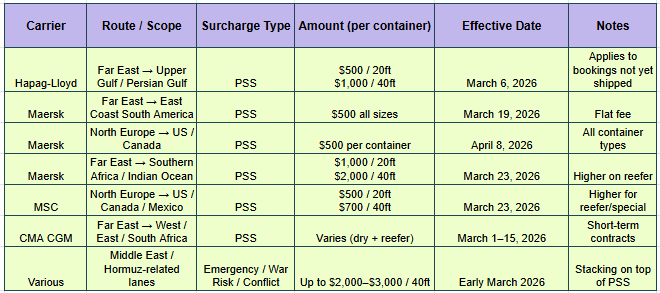
Note: Data compiled from official carrier advisories – always verify the latest on carrier portals as situations evolve quickly.
Transpacific & China-origin PSS highlights
The biggest direct pain for Amazon FBA sellers is on China-origin cargo feeding into US gateways. While no massive new PSS has hit the core China–US lane yet in March, the ripple from Gulf and Africa announcements plus Hormuz rerouting is tightening capacity and pushing indirect costs higher.
Other key lanes affecting supply chains
Surcharges on Africa, Latin America, and Europe-origin routes are pulling vessels and equipment away from transpacific services, creating secondary pressure on FBA routing.
How These Surcharges Hit Your China → Amazon FBA Landed Cost
Real example: 10 cbm shipment to LAX vs ATL (before/after)
Assume a standard 40ft HC dry container with ~12 cbm usable volume, shipping consumer electronics or apparel from Shenzhen.
- Base spot rate (mid-March 2026): ~$1,700 USWC / ~$2,600 USEC
- Add typical March PSS/emergency stack: +$500–$1,000
- All-in ocean + local charges: $2,400–$3,800 depending on destination and terms
Before surcharges (early March quote): Landed cost per unit (for 500 units) ≈ $4.80–$6.20
After current PSS stack: +$0.25–$0.55 per unit
For high-volume FBA sellers, this easily adds thousands per container. Multiply across multiple SKUs and the impact on Q3 cash flow is significant.
Interactive cost calculator tip
Use tools like Freightos or our Unicargo quote form to model “all-in DDP” scenarios. Screenshot your quotes before and after adding known PSS — it’s the fastest way to see the real hit.
The Geopolitical Wildcards (Hormuz, Red Sea, tariffs) Driving Extra Fees
The March 2026 Hormuz crisis (escalation following strikes) has forced rerouting, higher insurance, and emergency surcharges across multiple carriers. Many vessels are back to Cape of Good Hope routing, adding 10–18 days and extra bunker costs that get passed on.
Current Hormuz crisis impact on container routing and fuel costs
Carriers like Maersk, Hapag-Lloyd, and CMA CGM have suspended or rerouted services, triggering war-risk and emergency conflict surcharges of $1,500–$3,000+ on affected legs. Even if your cargo isn’t going to the Gulf, global equipment repositioning and fuel volatility create upward pressure on transpacific rates.
Emergency surcharges stacking on top of PSS
These are additive – not instead of – PSS. That’s why all-in costs feel higher than the headline spot rates suggest.
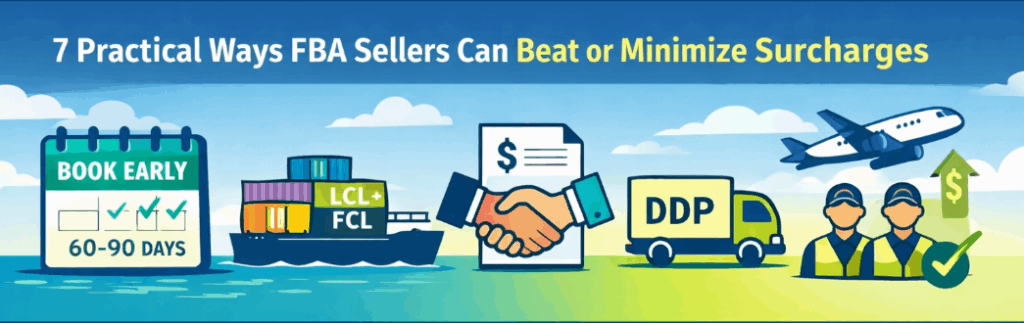
7 Practical Ways FBA Sellers Can Beat or Minimize Surcharges
- Book 60–90 days early for Q2/Q3 – carriers reward forward commitment with lower effective rates.
- Negotiate flexible contracts with volume commitments but rate caps or PSS waivers where possible.
- Mix LCL and FCL strategically – smaller test orders via LCL can avoid full-container surcharges.
- Consider DDP terms – shifts some destination surprises to the forwarder (Unicargo clients often see smoother all-in pricing).
- Monitor and switch gateways – sometimes routing via a different US port saves more than the PSS adds.
- Use air freight as a hedge for high-margin or urgent SKUs when ocean + PSS exceeds breakeven.
- Partner with a forwarder who locks slots early – this was the #1 reason Unicargo clients avoided the worst of 2025 peaks.
Booking strategies and contract tips
Start RFQ conversations now for your 2026-2027 contracting season. March is often the window when carriers are hungriest for committed volume.
When to consider air freight as a hedge
If PSS + rerouting pushes ocean all-in above $4–$5/kg equivalent for your product, air at $4.85–$9/kg (March 2026 levels) can protect margins and speed-to-FBA.
Unicargo’s Playbook – How We Lock Rates and Protect Your Margins
At Unicargo we’ve been helping Amazon FBA sellers navigate volatile ocean freight markets since the early days of the program, long before most forwarders even understood FBA labeling, prep requirements, or FC routing rules.
What sets our approach apart in situations like the current March 2026 PSS and Hormuz-driven emergency surcharges is full end-to-end control and predictability. Instead of leaving you exposed to last-minute carrier add-ons, we focus on locking in capacity early, building transparent all-in pricing (especially under DDP terms), and handling everything from origin consolidation to final Amazon delivery in one seamless flow.
Here’s how that works in practice for FBA sellers facing surcharge pressure:
- Early capacity securing and rate protection – We monitor carrier announcements daily and reserve space weeks or months ahead of PSS effective dates. Clients on our flexible contracting programs often avoid the full impact of stacked PSS and emergency fees because we secure committed allotments before the market tightens.
- Transparent DDP quoting with no hidden surprises – Many FBA sellers switch to DDP with us specifically to shift destination charges, duties, and potential add-ons away from their own cash flow. Our all-in quotes include ocean freight, local charges, customs clearance, inland trucking, Amazon delivery appointments, and prep – so you see the true landed cost upfront rather than discovering extra PSS or war-risk fees at invoice time.
- Owned infrastructure for speed and reliability – We operate our own warehouses in China, the US, UK, Germany, and India, plus our own U.S. trucking fleet. This control lets us move cargo quickly from port to our facilities for any needed Amazon prep (labeling, bundling, polybagging, ticketing) and then deliver directly to the correct FBA fulfillment centers. It reduces dwell time, avoids congestion-related fees, and gives us more flexibility when carrier schedules shift due to rerouting.
- Digital platform for real-time visibility – Every shipment comes with 24/7 access to our platform – live tracking, milestone notifications, document management, and API integration if needed. When a surcharge or delay pops up (as happened with several Hormuz-related reroutes in early March), you’re not waiting on emails; you see the status and updated ETA immediately and can make informed decisions.
- Deep Amazon FBA compliance expertise – As one of the first forwarders built specifically around the FBA program, our team knows Amazon’s rules inside out – from shipment plan creation and labeling standards to FC routing and inventory placement. This expertise prevents rejections, disposal fees, or stranded stock that can turn a surcharge hit into a much larger loss.
- Customized mix of services – Whether you need ocean FCL/LCL, air freight as a hedge for urgent high-margin SKUs, express options, or consolidated multi-origin shipments, we tailor the plan to your volume, product type, and cash-flow needs. Many clients combine our upstream China warehousing and prep with downstream U.S. trucking to optimize the full chain and reduce overall exposure to spot-market volatility.
Last peak season, clients using our locked DDP programs and early-booking approach saw 18–27% lower effective costs on average compared to those relying purely on spot-market bookings that got hit hard by stacked PSS and emergency surcharges. The difference came down to predictability and control rather than chasing the absolute cheapest headline rate.
If your current setup leaves you reacting to carrier announcements instead of planning around them, it might be worth reviewing your routing for the coming Q2/Q3 restocks. For a deeper dive on how to optimize your shipping, check out our “cheapest way to ship from China to Amazon FBA in 2026” blog for more guidance.
Ready to explore more predictable options for your next China → Amazon FBA shipment? Contact our team here.
FAQ – Peak Season Surcharges & GRI 2026
1. What are peak season surcharges (PSS) in 2026?
PSS are temporary fees carriers add during high-demand periods to manage capacity. In 2026 they are appearing earlier and stacking with geopolitical emergency surcharges.
2. Which carriers announced new PSS in March 2026?
Hapag-Lloyd, Maersk, MSC, and CMA CGM have all issued PSS on various lanes, with Maersk and Hapag-Lloyd being the most active on routes that indirectly affect FBA supply chains.
3. How much are current PSS amounts for China to US routes?
Direct China–US PSS is still limited in March, but related emergency and rerouting fees are adding $500–$2,000+ per 40ft on affected or ripple lanes.
4. Will GRI 2026 actually stick or get rolled back?
Many GRIs are “attempted” and partially rolled back depending on actual demand. PSS, however, tend to stick once effective because they are tied to immediate capacity pressure.
5. How do Hormuz issues affect my Amazon FBA shipments?
Rerouting increases transit times, fuel costs, and triggers emergency surcharges that raise global rates and tighten equipment availability even on transpacific routes.
6. What’s the difference between PSS and emergency fuel/war risk surcharges?
PSS is demand-driven and seasonal. Emergency/war-risk surcharges are event-driven (e.g., Hormuz conflict) and can appear suddenly on top of PSS.
7. When is the best time to book to avoid 2026 peak surcharges?
Aim for 60–90 days before your needed sailing. For true Q4 peak (Sept–Nov), start locking capacity in March–June 2026.
8. Can switching to DDP terms help reduce surprise fees?
Yes, DDP shifts many destination charges and potential add-ons to the forwarder, giving you more predictable landed costs (especially valuable with volatile surcharges).
9. How do these surcharges compare to 2025 levels?
2026 surcharges are appearing earlier and stacking more aggressively due to ongoing geopolitical volatility, though base spot rates started the year softer than 2025 peaks.
10. Should I switch freight forwarders because of rising surcharges?
If your current forwarder isn’t proactively locking capacity or offering transparent all-in protection, yes – the savings and peace of mind often outweigh switching costs. Many FBA sellers who moved to Unicargo in 2025 cited better surcharge handling as the top reason.
Are you ready with your next shipment? Our team is ready to do the heavy lifting – getting you the best routes, best prices, and optimal conditions. Click below!