Amazon Multi-Channel Fulfillment for TikTok Shop and Shopify: A Tactical Guide to Setup, Automation, and Scale
If you sell on Amazon and you’re expanding to TikTok Shop or Shopify, you’ve probably asked the same question every multi-channel seller eventually asks: do I really need a separate fulfillment setup for every channel?
Amazon Multi-Channel Fulfillment (MCF) says no. It lets you use the inventory already sitting in Amazon’s warehouses to fulfill orders from Shopify, TikTok Shop, and other off-Amazon channels – without splitting stock or managing multiple warehouse relationships.
On paper, it sounds like the simplest path to multi-channel growth. In practice, it works well under specific conditions, creates friction under others, and leaves major gaps in the supply chain that most guides never mention.
This guide walks you through everything: how MCF actually works across TikTok Shop and Shopify, the step-by-step setup process, the cost and compliance details you need to evaluate, common failure points, and – critically – where MCF ends and the rest of your logistics infrastructure needs to begin. Whether you’re exploring MCF for the first time or pressure-testing a setup you’ve already started, this is the tactical playbook.
TL;DR (Key Takeaways)
- Amazon MCF lets you fulfill TikTok Shop and Shopify orders from a single Amazon inventory pool, reducing the need for separate warehouse operations across channels.
- TikTok Shop officially confirmed MCF as a supported fulfillment method in February 2026, clearing up months of policy uncertainty. Shopify has a free, Amazon-built MCF app for U.S. and U.K. sellers.
- MCF fees are higher than standard FBA – single-unit orders saw a $0.35–$0.41 per unit increase as of January 2026 – so margin analysis by SKU and channel is essential before going live.
- MCF only handles the last mile. It does not manage international freight, customs clearance, FBA prep, branded packaging, or reverse logistics. Those gaps are where most multi-channel operations break down.
- A hybrid approach – MCF for standard domestic fulfillment, paired with a logistics partner for inbound freight, customs, prep, and branded D2C orders – is how the most operationally mature sellers run multi-channel at scale.
Why Sellers Are Combining Amazon MCF, TikTok Shop, and Shopify
Multi-channel selling is no longer a growth strategy reserved for enterprise brands. It’s table stakes. According to research published by Digital Applied, multi-channel sellers earn 190% more revenue than single-channel retailers. Meanwhile, TikTok Shop has emerged as one of the fastest-growing sales channels in e-commerce, with $9 billion in U.S. GMV in 2024 and rapid year-over-year expansion continuing into 2026.
Sellers who already have products in Amazon FBA warehouses are naturally asking: Why would I build a second fulfillment operation when Amazon can ship those same products to my TikTok Shop and Shopify customers?
That question is the entire premise behind MCF. And for a growing number of sellers, it’s the right one to ask.
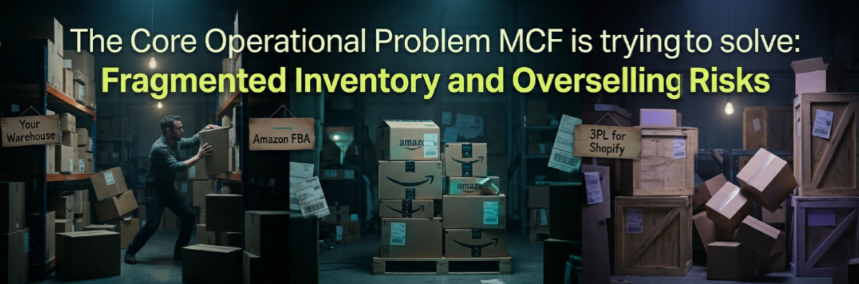
The core operational problem MCF is trying to solve
When you sell on multiple channels without a unified fulfillment backend, problems compound quickly. Inventory gets fragmented – some stock sits in your own warehouse, some at Amazon, some at a 3PL you set up for your Shopify store. Each pool operates independently, which means you’re constantly at risk of overselling on one channel while sitting on excess stock in another.
Manual order routing slows everything down. A TikTok Shop order comes in, and someone on your team has to figure out where to ship it from, update the inventory count across systems, and manually enter tracking. Multiply that by dozens or hundreds of daily orders, and the process collapses under its own weight.
MCF’s core promise is consolidation: one inventory pool in Amazon’s fulfillment centers, one fulfillment engine handling pick-pack-ship across channels, and automated tracking that flows back to each storefront. For lean teams that can’t afford a warehouse manager or a dedicated operations hire, that consolidation is genuinely valuable.
Where this model works best
MCF is a strong fit for a specific seller profile. If you already store inventory with Amazon FBA, sell standardized products that don’t require custom packaging or kitting, operate primarily in the U.S. domestic market, and run a lean team that values automation over warehouse control, MCF can simplify your multi-channel operations significantly.
It’s also particularly useful for sellers who are adding TikTok Shop to an existing Shopify-plus-Amazon setup. Rather than onboarding a separate 3PL just to handle TikTok orders, MCF lets you route those orders through the same Amazon inventory you’re already managing.
Sellers with predictable demand patterns and simple catalogs – think a brand with 20–50 SKUs, all standard-size, all shipping domestically – tend to get the most out of MCF with the fewest headaches.
Where it starts to break down
MCF isn’t a universal solution, and it’s important to understand the constraints before building your operations around it.
Packaging control is limited. MCF ships in unbranded (or sometimes Amazon-branded) boxes. If you’re a D2C brand on Shopify where unboxing experience matters – or you’re selling on TikTok Shop where creator-driven unboxing content drives sales – this can be a real brand disconnect.
Returns get complicated. MCF returns go back to Amazon’s fulfillment centers, not to a warehouse you control. You have limited ability to inspect, restock, or reroute returned products, and channel-specific return policies often don’t align with Amazon’s handling process.
Fee economics don’t work for every product. MCF fulfillment fees run 30–50% higher than standard FBA rates. For low-margin products or small basket sizes, those fees can erode profitability quickly – especially for single-unit orders, which saw the steepest fee increases in 2026.
Marketplace compliance can create friction. TikTok Shop and other marketplaces have their own fulfillment and tracking requirements. While MCF is now officially supported on TikTok Shop, the integration architecture requires careful configuration to keep tracking numbers compliant and delivery windows accurate.
For sellers who need branded packaging, complex kitting, international fulfillment, or tight control over returns, MCF alone won’t be enough. That’s not a failure of the tool – it’s a scope limitation that requires additional logistics infrastructure to address.
How Amazon MCF Works Across TikTok Shop and Shopify
Before diving into setup, it helps to understand the mechanics of how MCF actually processes orders from off-Amazon channels.
MCF is a fulfillment service that uses Amazon’s warehouse network to pick, pack, and ship orders that originate outside of Amazon.com. Unlike standard FBA – where the order comes from an Amazon customer buying on Amazon – MCF handles orders from your Shopify store, TikTok Shop, or any other connected channel.
The inventory is the same. Your FBA stock and your MCF stock sit in the same Amazon fulfillment centers. When a Shopify or TikTok Shop order comes in, MCF picks from that shared pool, ships the package, and returns tracking information to the originating channel.
The key difference is how orders get routed to Amazon and how tracking gets sent back. That’s where connectors, apps, and middleware come in.
End-to-end flow: Shopify order to Amazon MCF shipment
Here’s what the order lifecycle looks like when a customer places an order on your Shopify store and Amazon MCF handles fulfillment:
- Customer places an order on your Shopify store. The order enters your Shopify admin with product, quantity, and shipping details.
- The MCF connector sends the order to Amazon. If you’re using the native Amazon MCF and Buy with Prime app for Shopify (free, available for U.S. and U.K. orders), the order is automatically routed to Amazon Seller Central as an MCF fulfillment request. Third-party connectors like WebBee, ByteStand, or Pipe17 can also handle this step with additional features like carrier blocking and virtual bundles.
- Amazon picks, packs, and ships. The item is pulled from your FBA inventory, packed in unbranded packaging, and shipped via Amazon’s carrier network. Standard delivery typically arrives within three business days; expedited can arrive in two.
- Tracking syncs back to Shopify. The MCF app or connector pushes the tracking number and shipment status back to your Shopify admin, where the order is marked as fulfilled. Your customer receives a shipping notification with tracking details.
- Inventory updates across channels. The shared inventory count decreases, and the updated stock level syncs to your Shopify dashboard to prevent overselling.
The entire process can run hands-off once properly configured. The critical setup work happens in SKU mapping, shipping speed configuration, and exception handling – which we’ll cover in the setup playbook below.
End-to-end flow: TikTok Shop order to Amazon MCF shipment
The TikTok Shop flow follows a similar pattern but has some important differences driven by marketplace requirements.
- The customer places an order on TikTok Shop. The order is captured in TikTok’s Seller Center with product and shipping details.
- A middleware or integration app routes the order to Amazon MCF. TikTok Shop doesn’t have a direct, native Amazon MCF connection the way Shopify does. Instead, sellers use integration tools like WebBee, AfterShip, Rithum, LINGXING, or 4Seller ERP to bridge the two platforms. Some sellers also route TikTok orders through Shopify first and then into MCF.
- Amazon fulfills the order. The item is picked from FBA inventory and shipped.
- Tracking syncs back to TikTok Shop. This is a critical step. The integration must pass the MCF tracking number back to TikTok’s Seller Center with Amazon identified as the shipping provider. TikTok validates that tracking numbers come from MCF (using AFTN – Amazon Fulfillment Tracking Number – format). As of February 2026, TikTok allows up to five non-MCF tracking numbers per shop to account for occasional configuration errors, but the expectation is that MCF-routed orders use MCF tracking consistently.
- Order status updates in TikTok Seller Center. The order moves to “shipped” status and the buyer receives delivery updates.
A key consideration: TikTok Shop updated its logistics policies in February 2026, initially signaling that sellers would need to use TikTok’s own logistics services (Fulfilled by TikTok, Upgraded TikTok Shipping, or Collections by TikTok). However, TikTok subsequently confirmed that Amazon MCF remains a supported fulfillment method when configured properly. This policy clarification is important – it means MCF is viable for TikTok Shop, but sellers need to follow TikTok’s warehouse configuration requirements and tracking standards to stay compliant.
Inventory logic: one pool, multiple channels
The operational appeal of MCF is that you maintain a single inventory pool in Amazon’s fulfillment centers for both FBA and off-Amazon orders. You don’t need to split stock between warehouses or guess how much to allocate to each channel.
But “single pool” doesn’t mean “set it and forget it.” When multiple channels draw from the same inventory, a demand spike on one channel can cause stockouts on every other channel simultaneously. A TikTok Shop product that goes viral can drain your Amazon FBA stock in hours.
This makes inventory planning more important, not less. Sellers running MCF across multiple channels need to maintain buffer stock, set safety thresholds by SKU, forecast demand by channel, and – most critically – ensure their inbound replenishment pipeline is fast and reliable enough to keep up with multi-channel demand. We’ll come back to this point, because it’s where MCF’s biggest hidden dependency lives.
What MCF Doesn’t Cover: The Gaps Most Guides Skip
Most guides about Amazon MCF treat fulfillment as if inventory just magically appears in Amazon’s warehouse, ready to be shipped. It doesn’t. MCF is a last-mile fulfillment engine – it picks, packs, and ships orders from inventory that’s already sitting in Amazon’s network. Everything that happens before that point is your responsibility, and the logistics involved are anything but simple.
Getting inventory into Amazon: the logistics MCF assumes you’ve solved
For MCF to work, your products need to arrive at Amazon fulfillment centers on time, in the right quantities, and fully compliant with FBA requirements. If you’re sourcing from overseas – and most Amazon sellers importing from China are – that means managing an entire inbound logistics chain that MCF never touches.
That chain includes international freight forwarding (choosing between ocean and air shipping based on lead times, cost, and product volume), customs clearance and duty payment (including ISF filing for ocean shipments), and FBA-compliant prep at the destination – labeling, poly-bagging, bundling, and carton-level packaging that meets Amazon’s receiving standards.
When any part of this inbound chain breaks down – a shipment gets held at customs, a container misses its delivery appointment at the fulfillment center, or prep labels are applied incorrectly – the cascade effect hits every channel MCF serves. A two-week delay in inbound freight doesn’t just cause a stockout on Amazon. It causes a stockout on your Shopify store and your TikTok Shop simultaneously, because they’re all drawing from the same pool.
This is the dependency that makes MCF both powerful and fragile. The more channels you connect to a single inventory pool, the more critical your inbound supply chain becomes. And that supply chain requires logistics expertise that most MCF guides completely ignore. If you’re shipping full containers to Amazon, our guide to FCL shipments to FBA breaks down the process in detail.
Branded experience and packaging control
MCF ships in unbranded or Amazon-branded packaging. There are no custom inserts, no branded boxes, no thank-you cards, no tissue paper. The customer receives a plain brown box with a shipping label.
For pure Amazon sellers, this is fine – customers expect Amazon packaging. But for D2C brands on Shopify who have invested in a premium unboxing experience, MCF creates a jarring disconnect. A customer orders from your beautifully designed Shopify store and receives a package that looks like it came from Amazon. At best, it’s confusing. At worst, it undermines the brand identity you’ve worked to build.
On TikTok Shop, this matters even more. TikTok’s sales model is driven by creator content, and unboxing videos are a significant part of that ecosystem. When a product arrives in a generic brown box instead of branded packaging, it kills the visual storytelling that drives TikTok engagement.
For sellers where brand presentation is a competitive advantage, MCF’s packaging limitations are a genuine constraint – not a minor inconvenience. This is one of the clearest scenarios where a 3PL with custom prep and kitting capabilities becomes a necessary complement to MCF.
Returns, reverse logistics, and the complexity MCF doesn’t manage
When a customer returns an MCF order, the product goes back to Amazon’s fulfillment centers. You don’t control the inspection process, you have limited visibility into restocking decisions, and the return handling may not align with your channel-specific return policies.
TikTok Shop and Shopify each have their own return expectations and timelines. Amazon’s return handling doesn’t automatically map to those requirements, which means you may need to manage customer communications separately from the actual product return flow.
International returns add another layer of complexity. MCF’s domestic network doesn’t extend to managing cross-border returns, and the cost of returns handled poorly – both in lost product value and customer experience – adds up quickly.
For sellers with high return rates, complex product categories, or international customers, a dedicated reverse logistics process – often managed through a logistics partner with warehouse infrastructure – provides far more control than relying on Amazon’s default handling.

Step-by-Step Setup Playbook
This section turns the guide into a tactical implementation checklist. Follow these steps in order to reduce the risk of customer-facing failures and operational surprises.
Step 1: Confirm channel and catalog readiness
Before connecting anything, verify the foundations are in place. Confirm that your Amazon Seller Central account is active with FBA inventory available for MCF. Check that your Shopify store and/or TikTok Shop seller account are in good standing with fulfillment permissions enabled.
Clean up your SKU structure. Inconsistent SKU naming between Amazon, Shopify, and TikTok is one of the most common causes of failed order routing. Every product you plan to fulfill through MCF needs a clear, consistent identifier that maps correctly across platforms.
Decide which SKUs should route through MCF and which shouldn’t. Not every product in your catalog is a good MCF candidate. Items that require custom packaging, special handling, or international fulfillment may need a different fulfillment path.
Step 2: Connect Shopify to Amazon MCF
For U.S. and U.K. sellers, the simplest path is the Amazon MCF and Buy with Prime app for Shopify, which is free and built by Amazon. Install the app from the Shopify app store, log in with your Amazon Seller Central credentials, and connect your accounts.
Map your Shopify SKUs to your Amazon SKUs. The app can auto-map products where SKU names match exactly. For products with different SKU values between platforms, you’ll need to do manual mapping.
Configure your shipping speeds. Map your Shopify shipping options to MCF’s delivery tiers (standard, expedited). Set your default MCF speed, and define what happens when MCF can’t fulfill an order – whether the order should wait, cancel, or fall back to a different fulfillment method.
For sellers who need additional capabilities like carrier blocking (preventing Amazon Logistics from being used as the shipping carrier), virtual bundles, or multi-country support, third-party connectors like WebBee or ByteStand provide those features at a monthly subscription cost.
Test the connection with a small batch of orders before going live. Place test orders, verify that tracking numbers sync back correctly, and confirm that inventory counts update in both Shopify and Seller Central.
Step 3: Decide the TikTok Shop connection model
TikTok Shop requires more architectural planning than Shopify because there’s no single, Amazon-built integration app. You have two primary approaches:
Direct integration via a TikTok Shop MCF connector. Tools like WebBee, AfterShip, Rithum, LINGXING, and 4Seller ERP connect TikTok Shop directly to Amazon MCF. The connector captures TikTok orders, sends MCF fulfillment requests to Amazon, retrieves tracking numbers, and pushes them back to TikTok Seller Center.
Routing through Shopify as a bridge. Some sellers import TikTok Shop orders into Shopify first (using TikTok’s Shopify integration), then route them to MCF through the Shopify-MCF connection. This adds a layer of complexity but can simplify reporting if Shopify is already your operational hub.
Whichever model you choose, configure your MCF warehouse in TikTok’s Seller Center by going to Logistics → Warehouses and adding your MCF warehouse address. Each shop can designate up to three MCF warehouses. TikTok validates that tracking numbers originate from MCF, so make sure your integration is passing AFTN-format tracking numbers correctly.
Step 4: Configure fulfillment rules and shipping preferences
Go beyond “it’s connected” and into “it runs reliably.” Set MCF service levels that match your channel commitments. If your TikTok Shop promises three-day delivery, make sure MCF’s standard speed consistently meets that window.
Define cutoff times for order processing. MCF has its own processing timelines, and orders placed late in the day may not ship until the next business day.
Set up backorder and exception handling. What happens when MCF can’t fulfill an order because of a stockout? Define whether the order should be held, canceled, or routed to an alternative fulfillment path. Document these rules so your team knows how to respond when exceptions occur.
Step 5: Secure your inbound supply chain before going live
This step is the most overlooked and the most important. MCF is only as reliable as the inventory behind it. Before you scale multi-channel demand through MCF, make sure your inbound logistics are locked down.
Confirm that your freight forwarding and customs clearance workflow is dependable and repeatable. If you’re importing from overseas, ensure your freight partner can deliver inventory to Amazon fulfillment centers on schedule and with full FBA compliance – correct labeling, proper packaging, and delivery appointments scheduled within Amazon’s requirements. For a deep dive on this process, see our complete guide to shipping from China to Amazon FBA in 2026.
Set a replenishment cadence based on multi-channel demand, not just Amazon sales. When you add Shopify and TikTok Shop to the same inventory pool, your sell-through rate increases. Your reorder points need to reflect that combined demand, plus a buffer for unexpected spikes (especially on TikTok, where a single viral video can generate thousands of orders in a day).
If you don’t have a reliable logistics partner managing your origin-to-Amazon delivery chain, this is the time to find one – and our freight forwarder vetting checklist can help you evaluate candidates. Stockouts across all your channels simultaneously is not a recoverable situation – it’s a business crisis.
Step 6: Run a controlled pilot before full launch
Start with a limited subset of SKUs – ideally your top sellers that have stable demand and simple fulfillment requirements. Route a small volume of orders from each channel through MCF and validate every step of the process.
Check that tracking numbers sync correctly to both Shopify and TikTok Shop. Confirm that customer notifications fire properly. Monitor how returns are routed and whether your return policies align with MCF’s handling process. Document any exceptions and build an internal playbook for how your team should respond to each one.
Only after the pilot runs clean for at least two to four weeks should you expand to your full catalog and full order volume.
Costs, Limits, and Operational Tradeoffs
MCF can reduce complexity, but it doesn’t eliminate cost tradeoffs. Before committing to MCF as your multi-channel fulfillment strategy, evaluate the full economics – not just the per-unit fee, but the total cost of getting products from factory to customer.
Cost callout: what sellers should evaluate before switching on MCF
MCF fulfillment fees are higher than standard FBA rates. As of January 15, 2026, single-unit MCF orders saw a fee increase of $0.35–$0.41 per unit, roughly four to five times the $0.08 increase applied to standard FBA. Multi-unit orders saw smaller hikes, and orders with three or more standard-size items saw no MCF increase at all.
Storage costs follow the same FBA fee structure – monthly rates based on product size, time of year, and storage utilization. Peak-season surcharges during Q4 apply to MCF orders just as they do to FBA.
For eligible sellers shipping significant MCF volume, Amazon’s 2026 Preferred Pricing program offers tiered discounts: up to 15% off MCF fulfillment fees and up to $1 in FBA credits per MCF unit shipped for sellers moving more than 19,000 units annually. Below 1,200 units, there’s no discount – the program is designed for committed MCF sellers, not occasional users.
But the MCF fee is only one piece of the equation. The total landed cost of multi-channel fulfillment includes international freight, customs duties, FBA prep and labeling, MCF fulfillment fees, storage costs, integration software subscriptions, and return handling expenses. Evaluating MCF profitability in isolation – without accounting for inbound logistics costs – gives you an incomplete picture.
Run the math at the SKU level. A product with a $40 average selling price and healthy margins may absorb MCF fees comfortably. A $15 product with thin margins and single-unit orders may not survive them.
Limit callout: compliance, packaging, and customer experience constraints
Beyond cost, MCF introduces non-financial constraints that affect channel fit and brand control.
Packaging: MCF ships in unbranded boxes. For Shopify D2C brands and TikTok Shop sellers where brand presentation matters, this is a meaningful limitation.
Carrier restrictions: Some marketplaces (notably Walmart, though that’s outside this guide’s scope) require that Amazon Logistics not be used as the shipping carrier. MCF connectors like WebBee and ByteStand offer the option to block Amazon Logistics, but it’s a setting you need to actively configure.
Tracking expectations: TikTok Shop validates MCF tracking numbers against AFTN format. If your integration doesn’t pass tracking correctly, orders may show as unfulfilled in TikTok’s system, which can hurt your seller performance metrics.
Inventory limits: FBA and MCF share the same inventory allocation and affect your IPI (Inventory Performance Index) score identically. MCF volume counts against your FBA restock limits, so sellers already constrained by Amazon’s inventory caps need to factor MCF demand into their storage planning.
Common Failure Points and How to Prevent Them
Understanding where real implementations break helps you avoid preventable mistakes. These are the four failure patterns we see most often.
1. SKU mismatches and failed order routing
Bad catalog hygiene is the fastest way to break MCF automation. When SKU names differ between Shopify, TikTok Shop, and Amazon – or when product bundles aren’t mapped correctly – orders fail to transmit, MCF can’t find the matching inventory, and customers don’t get their products.
The fix is unglamorous but essential: maintain a single source of truth for your product catalog with consistent identifiers across all platforms. Audit your SKU mapping before going live and recheck it whenever you add new products. Treat product data governance as an ongoing process, not a one-time setup task.
2. Tracking sync delays and marketplace friction
When tracking numbers don’t sync back to TikTok Shop or Shopify promptly, downstream problems multiply. Customers see their order as “processing” long after it’s actually shipped. Marketplace algorithms may flag your account for late fulfillment. Customer support tickets spike.
Monitor tracking sync daily during the first few weeks after launch. Set up alerts for orders that haven’t received tracking within the expected window. If your integration tool consistently lags on tracking passback, that’s a signal to evaluate a different connector – not something to accept as normal.
3. Inventory stockouts caused by channel demand spikes
This is the scenario that catches multi-channel sellers off guard. A TikTok creator features your product, the video gets traction, and orders pour in at a rate your forecasting model never anticipated. Because every channel draws from the same pool, that viral moment doesn’t just affect TikTok – it empties the inventory your Shopify and Amazon customers depend on, too.
Prevention requires both a demand strategy and a supply strategy. On the demand side, maintain a buffer stock and consider setting inventory reserves by channel during high-risk periods. On the supply side, ensure your inbound replenishment pipeline is fast enough to respond – and know when to use air freight versus ocean for urgent restocks. A logistics partner who can expedite freight, clear customs quickly, and deliver FBA-prepped inventory to Amazon on a tight timeline is the difference between a temporary spike and a sustained stockout.
4. Over-reliance on one fulfillment network
Putting every channel into Amazon’s fulfillment network creates a single point of failure. If Amazon experiences a capacity constraint, a receiving delay, or a policy change that affects MCF, every one of your sales channels goes down simultaneously.
Smart sellers build hybrid fulfillment models – MCF for standard domestic orders where it performs well, and a 3PL or logistics partner with dedicated warehousing for orders that need branded packaging, international shipping, special handling, or simply a fallback option when MCF can’t deliver.
Decision Framework: Is Amazon MCF the Right Fulfillment Model for You?
MCF is a tool, not a strategy. The right question isn’t “should I use MCF?” – it’s “where does MCF fit within my fulfillment operation, and what else do I need?”
Best-fit scenarios for MCF
MCF makes the most sense when you already have a meaningful FBA inventory footprint, your catalog is straightforward (standardized SKUs, no custom kitting), your order volume is concentrated domestically, and your team is lean enough that automation matters more than warehouse control.
If you’re adding TikTok Shop or Shopify to an existing Amazon business and want to start fulfilling off-Amazon orders within days rather than weeks, MCF is the fastest path to get there.
When you’ve outgrown MCF (or never fit it)
MCF alone is insufficient when your business needs branded packaging or custom inserts for D2C orders, when you’re managing complex returns that require inspection and restocking control, when you’re expanding internationally and need freight forwarding, customs, and compliance expertise, or when you need multi-warehouse control for geographic distribution or product-specific handling.
It’s also insufficient when your growth rate means that inbound supply chain reliability has become a bottleneck. If your products frequently go out of stock because the freight, customs, and prep pipeline can’t keep up with multi-channel demand, the problem isn’t MCF – it’s everything that happens before MCF.
The hybrid approach: MCF + logistics partner
The most operationally mature multi-channel sellers don’t choose between MCF and a logistics partner. They use both.
In a hybrid model, MCF handles standard domestic fulfillment for orders where speed and automation matter most – particularly Amazon marketplace orders (via FBA) and straightforward off-Amazon orders routed through Shopify or TikTok Shop. The logistics partner handles everything MCF can’t: international freight from factory to Amazon or partner warehouses, customs clearance and compliance, FBA prep and labeling, branded D2C fulfillment for orders where packaging matters, reverse logistics and returns processing, and supply chain visibility from origin to delivery.
This model gives sellers the automation and delivery speed of Amazon’s network for the orders where it works, plus the flexibility, control, and end-to-end capability of a dedicated logistics partner for everything else.
How We Support Multi-Channel Sellers Beyond What MCF Can Do
At Unicargo, we work with multi-channel sellers every day who are building exactly this kind of hybrid fulfillment operation. We see the pattern clearly: MCF handles the last mile well, but the supply chain that feeds it – and the capabilities that sit outside it – are where sellers need the most help.
As an Amazon SPN (Service Provider Network) partner, we specialize in the logistics that MCF was never designed to cover. Our team manages international freight forwarding from factory to Amazon fulfillment centers or our own warehouses – whether that’s ocean freight from Shenzhen, air freight for urgent replenishment, or a combination of both. We handle customs clearance and compliance, ISF filing, duty calculation, and the regulatory details that keep your shipments moving without holds or delays.
Our FBA prep services ensure your inventory meets Amazon’s receiving standards: labeling, poly-bagging, bundling, and carton-level packaging, all handled before delivery to the fulfillment center. When inventory needs to arrive on a tight schedule to prevent multi-channel stockouts, our team coordinates delivery appointments and manages the inbound timeline end-to-end.
For sellers who need branded fulfillment – custom packaging, inserts, and a D2C experience that MCF can’t provide – we offer warehousing and D2C shipping from our facilities. And when returns come in from off-Amazon channels, our reverse logistics services give you inspection, restocking, and routing control that Amazon’s default process doesn’t.
Every client works with a dedicated logistics manager – a real person who knows your business, your channels, and your supply chain. When automation works, we stay out of the way. When something breaks – a shipment gets held at customs, a viral TikTok clears your inventory, a container misses its appointment – our team steps in and solves it.
We built our platform to give you real-time visibility across your entire supply chain, from origin to warehouse to customer. Because MCF can tell you when an order shipped, but it can’t tell you when the next container of inventory will arrive. We can.
Conclusion
Amazon Multi-Channel Fulfillment can be a powerful engine for sellers who want to use a single inventory pool to fulfill orders across Shopify, TikTok Shop, and Amazon. When the setup is clean, the economics work for your catalog, and channel compliance requirements are met, MCF removes a significant amount of operational friction from multi-channel selling.
But MCF is only one piece of the logistics puzzle. It doesn’t handle the international freight that gets products into Amazon’s warehouses. It doesn’t manage customs clearance or FBA prep. It doesn’t offer branded packaging or controlled reverse logistics. And it doesn’t protect you from the supply chain disruptions that can take every channel offline at once.
The sellers who scale multi-channel successfully treat MCF as a component of a broader fulfillment strategy – not the entire strategy itself. They pair MCF’s automation and delivery speed with a logistics partner who manages the inbound supply chain, handles the exceptions, and fills the gaps that MCF leaves open.
If you’re building a multi-channel operation across Amazon, Shopify, and TikTok Shop – or if you’re already running one and feeling the strain of supply chain gaps – talk to our team. We’ll help you design a fulfillment model that works across every channel, from factory floor to customer doorstep.
FAQ
Can Amazon fulfill TikTok Shop orders?
Yes. Amazon MCF is officially supported as a fulfillment method for TikTok Shop. TikTok confirmed this in its updated MCF guide published in February 2026. Sellers need to configure their MCF warehouse in TikTok Seller Center and use a compatible integration tool (such as WebBee, AfterShip, Rithum, or 4Seller ERP) to route orders from TikTok to Amazon and sync tracking numbers back. Tracking must follow the AFTN format to meet TikTok’s validation requirements.
Can I use the same Amazon inventory for Shopify and TikTok Shop?
Yes – that’s one of the primary advantages of MCF. FBA inventory serves both Amazon marketplace orders and MCF orders from Shopify, TikTok Shop, and other connected channels. However, shared inventory means a demand spike on any single channel depletes stock for all others. Sellers need to maintain safety stock buffers, forecast demand by channel, and ensure their inbound replenishment pipeline can keep pace with combined multi-channel demand.
How do tracking numbers sync back to each channel?
For Shopify, the Amazon MCF app (or a third-party connector) automatically pushes tracking numbers and shipment status back to your Shopify orders page. For TikTok Shop, the integration tool sends the MCF tracking number to TikTok Seller Center with Amazon identified as the shipping provider. Tracking sync timing depends on the connector used – most tools update within minutes to a few hours. Monitor sync closely during the first weeks after launch and set up alerts for orders that haven’t received tracking within the expected window.
How should returns be handled for MCF orders?
MCF returns go back to Amazon’s fulfillment centers by default. Sellers need to define a clear return address and process for each channel. On Shopify, you control the return policy and can direct customers to return products to Amazon or to an alternative warehouse. On TikTok Shop, return handling must comply with the platform’s return policies, and the return warehouse address should be configured in Seller Center. For sellers who need inspection, grading, or custom restocking workflows, working with a logistics partner that offers reverse logistics services provides more control than Amazon’s standard return handling.
What are the biggest risks when using MCF for multi-channel fulfillment?
The most significant risks are margin erosion from MCF fees on low-ASP products, inventory stockouts when a demand spike on one channel empties the shared pool, tracking sync failures that hurt marketplace performance metrics, limited brand control due to unbranded packaging, and over-dependence on a single fulfillment network without a fallback. A hybrid approach – MCF for standard domestic fulfillment plus a logistics partner for inbound freight, branded orders, and returns – mitigates most of these risks.
Do I need a freight forwarder or customs broker if I’m using MCF?
Absolutely. MCF only fulfills orders from inventory that’s already in Amazon’s warehouses. It has nothing to do with how products get there. If you’re sourcing from overseas, you need a freight forwarder to move goods from the factory to the port and across the ocean, a customs broker (or a logistics partner who handles customs clearance) to get them through U.S. Customs, and FBA-compliant prep services to make sure the inventory meets Amazon’s receiving requirements. For a full breakdown of this process, see our guide on shipping from China to Amazon FBA. Without reliable inbound logistics, MCF has nothing to ship – and every channel connected to it goes dark.
Are you ready with your next shipment?
Click below to get a quote, along with a personalized follow-up by one of our team experts – helping you get the most optimized shipment solution.