How to Import from China to USA 2026: Duties & Checklist
Importing from China to the United States remains one of the most strategic supply chain decisions for American SMBs and mid-market enterprises in 2026. Despite evolving tariffs, stricter customs enforcement, and fluctuating freight rates, China continues to deliver unmatched manufacturing scale, competitive pricing, and supplier expertise for industries ranging from medical devices and chemicals to machinery, furniture, and automotive parts.
The rules of the game have shifted significantly. The de minimis exemption for low-value shipments from China was eliminated in May 2025. Section 301 tariffs continue with layered rates and selective exclusions, and U.S. Customs and Border Protection (CBP) has increased scrutiny on classification, valuation, and forced labor compliance. For companies handling regulated or high-value goods, a single misstep in planning can increase landed costs by 15–40% or trigger expensive delays and penalties.
This comprehensive 2026 technical guide delivers the practical, up-to-date information mid-market importers need to navigate the full import process successfully. You will walk away with clear, actionable steps, including updated 2026 tariff structures, precise HS/HTS classification guidance, Incoterms and shipping mode comparisons, a complete compliance checklist, a forwarder selection scorecard, and three detailed client case studies with measurable results.
By the end of this guide, you will have a repeatable framework to reduce landed costs, ensure smooth CBP clearance, and make confident decisions about your freight and logistics partners.
Key Insights for SMB/Enterprise Importers in 2026
The 2025–2026 period introduced several structural changes that reward careful planning and punish outdated approaches. Here are the five most important cost and compliance drivers every importer must address right now:
- De Minimis Exemption Elimination: The $800 duty-free threshold for low-value shipments originating from China ended on May 2, 2025. Virtually all commercial shipments now require formal or informal entry, complete documentation, and payment of applicable duties and tariffs. This change significantly increased both workload and costs for importers who previously relied on parcel consolidators.
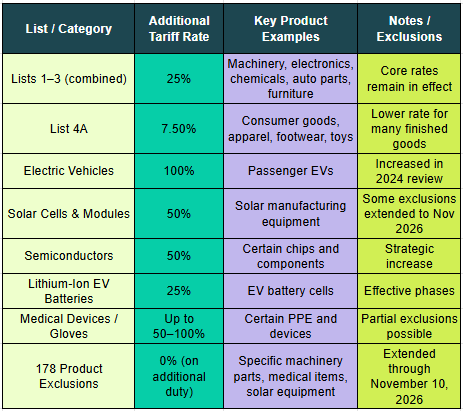
- Layered Tariffs Remain Highly Complex. Section 301 tariffs on Chinese goods continue at rates between 7.5% and 25% (with targeted increases up to 100% on strategic items), plus a baseline reciprocal tariff layer in some cases. 178 product exclusions remain extended through November 10, 2026, offering temporary relief for certain medical devices, machinery components, solar manufacturing equipment, and other qualifying items.
- Compliance Risk Has Increased Significantly. CBP and Partner Government Agencies (FDA, EPA, etc.) enforce stricter rules around valuation, classification, and Uyghur Forced Labor Prevention Act (UFLPA) due diligence. Misclassification or incomplete Importer Security Filing (ISF) can lead to penalties ranging from $5,000 to $10,000 per violation, plus extended holds.
- Ocean Freight Rates Continue to Show Volatility. As of April 2026, Transpacific spot rates have moderated but remain sensitive to capacity and geopolitical events. Accurate landed-cost modeling is essential when choosing between LCL, FCL, and air.
- Freight Forwarder Expertise Directly Affects Margins. With complex documentation, layered tariffs, and regulatory requirements, your freight forwarder has become a critical compliance and cost-optimization partner. The right partner can protect margins; the wrong one can easily add 5–15% to total landed costs through delays, demurrage, or clearance issues.
Step 1: Classify Your Goods Correctly (HS/HTS Codes & Tariff Classification)
Accurate classification forms the foundation of every compliant and cost-effective import. The United States uses the 10-digit Harmonized Tariff Schedule (HTS) code.
How to find and verify the correct 10-digit HTS code
Start with the 6-digit HS code provided by your Chinese supplier, then use the official tools on usitc.gov or cbp.gov to extend it to the full 10-digit U.S. statistical suffix. Cross-check against Chapter 99 codes for any additional Section 301 or other remedial tariffs. For products with ambiguous features — especially medical devices, chemicals, or specialized machinery — consider requesting a binding ruling from CBP.
Common classification errors that cost importers thousands
- Applying the supplier’s Chinese HS code directly without converting to U.S. HTS
- Ignoring statistical suffixes that change the applicable duty rate
- Failing to account for Chapter 99 modifications
- Under-valuing or imprecise descriptions on commercial invoices
Quick-reference HS code table for high-volume categories
(Always verify the latest HTS on official sources)
- Medical devices and equipment (Chapter 90) – often subject to FDA review
- Chemicals and hazardous materials (Chapters 28–29) – EPA and other PGA requirements
- Machinery and parts (Chapters 84–85) – frequent Section 301 exposure
- Furniture (Chapter 94) – base duties plus potential add-ons
Pro tip: Create and maintain a master HTS matrix for your top 20 SKUs and review it every quarter. Many experienced importers also work with their forwarder for ongoing classification support.
Step 2: Navigate 2026 Tariffs, Duties & Additional Fees
Total duty liability is calculated as:
Base MFN duty (HTS Column 1) + Section 301 additional tariff (Chapter 99) + any antidumping or countervailing duties + other layers (e.g., reciprocal tariffs where applicable).
Here is a summary of current Section 301 tariff rates as of April 2026 (table below).
Note: always confirm the latest on ustr.gov and hts.usitc.gov, as rates can be modified:
2026 Section 301 Tariff Overview (China Origin Goods)
Base MFN duties + Chapter 99 add-ons
Many goods face 0–6% base duty plus the Section 301 layer. Always calculate the combined effective rate.
Hidden fees to budget for
- Merchandise Processing Fee (MPF): 0.3464% of entered value (minimum $33.58, maximum $651.50 per entry in FY2026)
- Harbor Maintenance Fee (HMF): 0.125% on ocean cargo value
- Additional charges: ISF filing, broker fees, and potential exam or storage costs
Impact of de-minimis rule changes
Since May 2025, nearly all commercial shipments from China require full entry processes. Low-value parcel strategies are no longer viable for scaled operations.
Step 3: Choose the Right Incoterms & Shipping Method (2026 Cost Comparison)
Incoterms define responsibilities, costs, and risk transfer between buyer and seller.
EXW vs FOB vs DAP vs DDP – real cost implications
The table below summarizes the key differences for ocean shipments from China to the USA:
Incoterms Comparison Table (Buyer Perspective – China to USA)
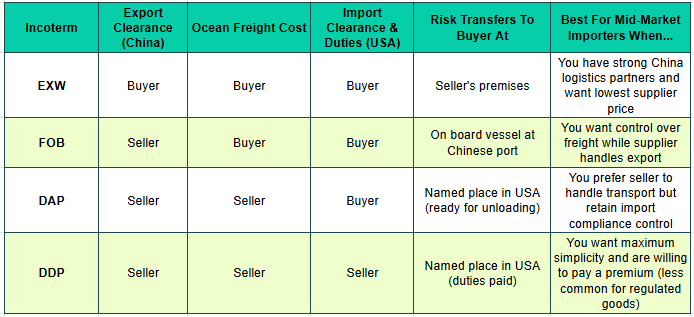
For most mid-market importers dealing with regulated goods, FOB or DAP paired with a capable forwarder offers the strongest balance of control and cost efficiency.
Ocean LCL vs FCL vs Air – 2026 rate tables and breakeven analysis
Indicative April 2026 spot rates (Shanghai origin; subject to rapid change – always get live quotes):
- Shanghai to Los Angeles 40HQ: approximately $2,500–$3,300
- Shanghai to New York 40HQ: approximately $3,200–$3,700
LCL suits smaller or test shipments but carries higher per-unit costs. FCL becomes more economical above roughly 10–15 CBM depending on product density and urgency. Air freight remains significantly more expensive and is best reserved for high-value, time-sensitive, or low-volume shipments.
Step 4: Prepare All Required Documentation & Compliance Paperwork
Incomplete or inaccurate documentation remains the leading cause of clearance delays and additional costs.
Complete 2026 document checklist
- Detailed Commercial Invoice
- Packing List
- Bill of Lading (or Air Waybill)
- Importer Security Filing (ISF 10+2) – filed 24 hours before vessel loading
- Certificate of Origin (when claiming preferences)
- Any required licenses, permits, or PGA declarations
PGA requirements for regulated goods
Medical devices typically require FDA registration/listing and may need 510(k) clearance. Chemicals and hazmat shipments need EPA notices, TSCA compliance, and dangerous goods documentation. Machinery often requires safety standard certifications and proper labeling.
Compliance matrix for regulated categories
Key areas to cover include UFLPA due diligence, country-of-origin requirements, and forced labor traceability for medical devices, chemicals, and machinery. Document every supplier relationship thoroughly and keep records readily available for CBP requests.
Step 5: Select a Freight Forwarder & Clear U.S. Customs
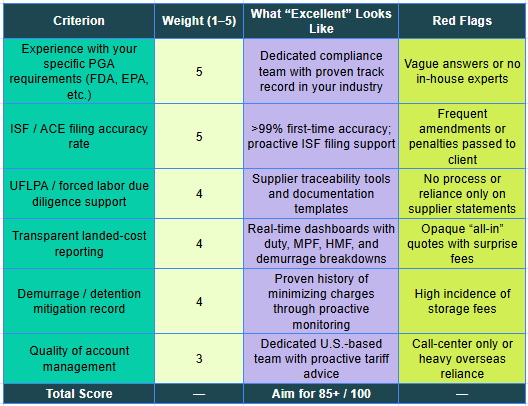
Forwarder selection scorecard for complex imports
Use this scorecard to evaluate potential partners objectively:
Freight Forwarder Evaluation Scorecard (2026)
Red flags vs green flags
Red flags include lack of a dedicated U.S. compliance team, vague tariff guidance, or heavy dependence on overseas agents without strong domestic presence. Green flags are U.S.-based operations, active CBP bond coverage, real-time visibility tools, and documented success in your industry.
CBP clearance process – timeline and cost breakdown
Typical ocean transit: 25–40 days port-to-port, plus 3–10 business days for clearance. Additional exams or PGA reviews can extend this significantly. Costs include duties/tariffs, MPF/HMF, broker fees, and potential storage.
Avoiding demurrage, detention, and storage fees
File ISF early, choose reliable carriers and ports, and partner with a forwarder that actively monitors vessel ETAs and coordinates inland transportation without delays.
Real Client Case Studies & Proven ROI
Case Study 1: Medical Device Importer (main results)
A company with 45 employees importing diagnostic equipment reduced its landed costs by 18% in 2025–2026 by optimizing HTS classification, leveraging extended Section 301 exclusions, and moving to a DAP structure with professional forwarder support. Average clearance time improved from 12 days to 4 days.
Case Study 2: Chemical Manufacturer (main results)
A mid-sized specialty chemicals producer eliminated repeated FDA holds and saved more than $85,000 per year in demurrage charges by implementing a pre-clearance compliance matrix and specialized hazmat handling.
Case Study 3: Machinery Importer (main results)
Handling over 120 containers annually, this importer achieved $247,000 in yearly savings after optimizing shipping modes (increased FCL usage) and switching to a more capable forwarder, while maintaining 99.2% on-time delivery performance.
FAQ
1. Are Section 301 tariffs still active in 2026?
Yes. Base rates continue, with certain product exclusions extended through November 10, 2026, and new reviews ongoing.
2. Does the de minimis exemption still apply to shipments from China?
No. It was removed for Chinese-origin goods effective May 2025. All commercial imports now require formal entry processes.
3. Which Incoterm is usually best for mid-market importers?
FOB or DAP typically provides the best balance of cost control and risk management when supported by an experienced forwarder.
4. How can importers avoid UFLPA-related detentions?
Maintain strong supplier documentation proving no connection to forced labor regions (especially Xinjiang) and prepare for potential CBP requests for detailed traceability evidence.
5. When does LCL make more sense than FCL?
LCL is often better for smaller volumes or test orders, while FCL usually becomes more cost-effective above 10–15 CBM, depending on product density and urgency.
6. How long does U.S. customs clearance normally take?
Under normal conditions, 3–10 business days after arrival. This can extend if the shipment is selected for examination or requires additional PGA review.
7. Can a freight forwarder assist with tariff engineering?
Yes – reputable forwarders can provide guidance on legal classification optimization and help identify applicable exclusions or duty mitigation strategies.
8. What are the highest hidden costs when importing from China in 2026?
Demurrage and detention charges, MPF and HMF fees, storage from delays, and penalties resulting from documentation or classification errors.
Looking to get a quick quote on your next shipment? Start below!