How to Import Furniture to the USA: The Complete 2026 Compliance & Cost Guide
The furniture aisle is one of the busiest in American e-commerce, and it has also become one of the most heavily regulated. According to Statista’s analysis of the US furniture sector, US furniture imports topped $72 billion in 2024, with China, Vietnam, and Mexico as the top supplier countries. That import dependency is exactly why Washington has spent the last 18 months reshaping the rules: a new Section 232 tariff regime on wood products, the long-delayed Lacey Act Phase VII expansion, a mandatory federal stability standard for dressers, and the end of paper Lacey Act filings have all landed on importers’ desks in quick succession.
If you plan to sell furniture on Amazon, Walmart, Wayfair, Target, or your own D2C site, importing furniture to the USA in 2026 is not the exercise it was even two years ago. The mistakes are more expensive, the documents have changed, and a single misclassified HTS code can move the duty rate by 25 percentage points or more. This guide walks through the entire process – tariffs, compliance by furniture category, documentation, shipping, and the points where importers most often get burned – with the current rules in plain language.
TL;DR – Key Takeaways
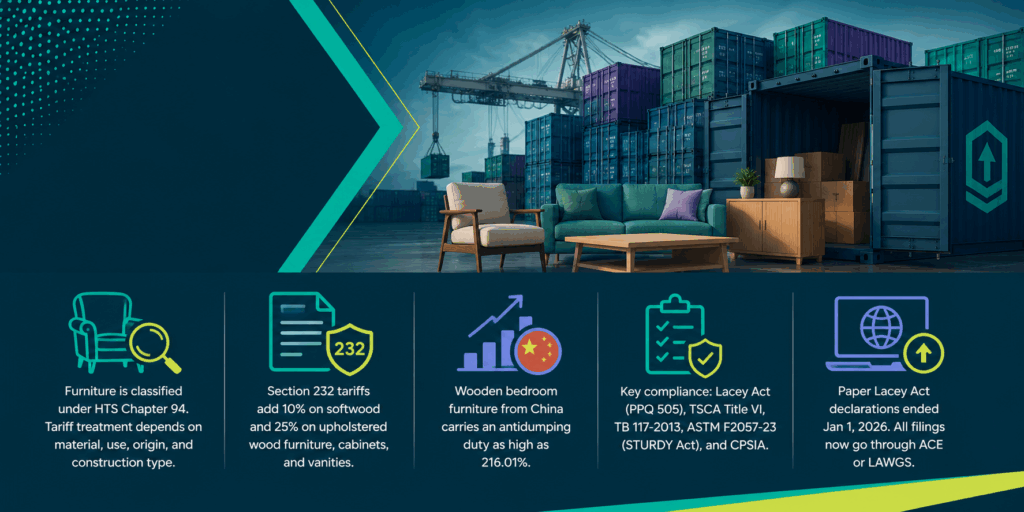
- Furniture is classified under HTS Chapter 94. Tariff treatment depends on material, intended use, country of origin, and whether the item is upholstered, composite, or solid wood.
- Section 232 tariffs effective October 14, 2025, add 10% on softwood timber and lumber and 25% on upholstered wooden furniture, kitchen cabinets, and vanities. The January 1, 2026 increase was delayed by White House proclamation to January 1, 2027.
- Wooden bedroom furniture from China still carries an antidumping duty as high as 216.01% under the China-wide entity rate.
- Compliance touchpoints include the Lacey Act (PPQ 505), TSCA Title VI for composite wood, TB 117-2013 (16 CFR Part 1640) for upholstered flammability, ASTM F2057-23 under the STURDY Act for dressers and chests, and CPSIA for children’s furniture.
- Paper Lacey Act declarations ended on January 1, 2026. All filings now go through CBP’s Automated Commercial Environment (ACE) or APHIS’s Lacey Act Web Governance System (LAWGS).
Why Importing Furniture to the USA Is More Complicated in 2026 Than It Used To Be
Furniture has always been a high-volume, low-margin import category. What has changed in the last 18 months is the cost of getting any of it wrong.
The market opportunity is still enormous. The US is the world’s largest furniture importer, and furniture e-commerce in the US generated roughly $72.9 billion in 2025, with Amazon, Home Depot, and Walmart leading online sales. Wayfair and Target run their own routing-guide ecosystems, and the D2C category from upholstery brands to modular sofas continues to expand. Demand is not the problem.
Three regulatory shifts since 2023 have changed the operating environment.
First, the Section 232 tariff regime on wood products went live on October 14, 2025, adding a 10-25% layer on top of any existing duties for affected items. Second, the Lacey Act’s Phase VII expansion took effect on December 1, 2024, sweeping most furniture HTS codes into mandatory declaration requirements that previously did not apply. Third, the STURDY Act made ASTM F2057-23 the mandatory federal stability standard for clothing storage units, an Amazon and Wayfair best-seller category.
The cost of compliance failure now scales with the tariff burden. A misclassified HTS code on a 40-foot container could mean a five-figure surprise duty bill at liquidation. And marketplace sellers carry an extra layer of risk that CBP enforcement does not even touch: Amazon, Walmart, and Wayfair can pull ASINs and freeze inventory for missing test reports or certificates even after the goods have cleared customs.
Can You Import Furniture into the USA? What’s Allowed and What’s Not
Yes. Almost any type of furniture can be imported commercially. The complexity lives in the tariff stack and the compliance requirements, not in whether the goods are admissible.
Sofas, beds, dressers, tables, chairs, office furniture, outdoor and patio sets, children’s furniture, upholstered seating, wood, metal, glass, rattan, and plastic furniture are all permitted. Limited categories trigger flat prohibitions or specialized scrutiny. Endangered woods listed under CITES – Brazilian rosewood (Dalbergia nigra), certain mahoganies, ramin, and others – are restricted or banned. Surface coatings containing lead above 0.009% (90 ppm) are not permitted on consumer goods sold in the US. Untreated raw wood without APHIS-approved treatment is generally refused at the port.
There is a meaningful split between commercial and personal entry. Personal household effects that the owner used abroad for at least one year before importation can usually enter duty-free under CBP Form 3299. Anything imported for resale, regardless of channel, is a commercial entry and requires the full documentation set described later in this guide.
The threshold between informal and formal entry is $2,500. Below that value, simplified procedures may apply, though most commercial furniture shipments easily exceed it.
Furniture Tariffs, Duties, and Section 232: What You’ll Actually Pay in 2026
For decades, the duty rate on a piece of furniture was usually a single number you could look up in the Harmonized Tariff Schedule. That world ended quietly over the last few years, and disappeared completely on October 14, 2025.
In 2026 the landed cost on a furniture container is the sum of base HTS duty plus Section 232 (if applicable) plus AD/CVD (if applicable) plus any IEEPA or reciprocal tariffs in effect at time of entry plus a stack of smaller fees. None of those layers cancel each other out. They add up. Misjudge any one of them and the margin disappears.
The four sections below break down how each piece works.
Understanding HTS Chapter 94 and Furniture Classification
Furniture is classified under Chapter 94 of the Harmonized Tariff Schedule of the United States. The three headings that matter most are 9401 (seats and chairs), 9403 (other furniture), and 9404 (mattresses and bedding articles).
Within those, the most common 6-digit headings for imported furniture include 9403.30 (wooden furniture for offices), 9403.40 (wooden furniture for kitchens), 9403.50 (wooden furniture for bedrooms), 9403.20 (other metal furniture), 9401.61 (upholstered seats with wooden frames), and 9401.71 (upholstered seats with metal frames). Mattresses fall under 9404.21 (cellular rubber or plastic) and 9404.29 (other materials).
Classification turns on what the item is, what it is made of, what it is intended for, and where it comes from. Material and intended use are the two that get importers in trouble. A wooden bedroom chair lives under a different subheading than a wooden dining chair, and an upholstered wooden armchair classified incorrectly under “other” can mean the difference between 0% additional duty and a 25% Section 232 layer on top of the base rate. The base most-favored-nation rate from NTR countries is 0% for most wood furniture, but that headline number tells you almost nothing about your actual landed duty.
Misclassification is not a small risk. CBP has a five-year audit window on entries, and a finding that the wrong code was used can trigger back-duty assessment with interest, penalties, and in the worst cases referral for fraud. Most reputable customs brokers will run a binding ruling request through CBP’s eRulings system on any SKU where the classification is genuinely ambiguous.
Section 232 Tariffs on Wood and Upholstered Furniture (the October 2025 Change)
The single most consequential change for furniture importers in years arrived in Presidential Proclamation 10976, signed September 29, 2025. The proclamation imposed Section 232 national security tariffs on softwood timber and lumber, upholstered wooden furniture, kitchen cabinets, and vanities. CBP published implementation guidance in CSMS #66492057 on October 10, 2025, and the duties took effect for goods entered for consumption on or after October 14, 2025.
The rates currently in effect are:
- Softwood timber and lumber (HTSUS 4403-4407): 10% additional duty under HTSUS 9903.76.01
- Upholstered wooden furniture (HTSUS 9401): 25% additional duty under 9903.76.02
- Completed kitchen cabinets, vanities, and parts (HTSUS 9403): 25% additional duty under 9903.76.03
The proclamation set country caps for specific trading partners, with rates capped at 10% for the UK and 15% for the EU and Japan, reflecting parallel negotiations. The rates were scheduled to escalate on January 1, 2026, to 30% for upholstered furniture and 50% for cabinets and vanities. That escalation was delayed by Presidential Proclamation issued December 31, 2025, pushing the higher rates out to January 1, 2027, while ongoing negotiations continue.
A few mechanical points are worth flagging. The Section 232 duties stack on top of base HTS rates and on top of existing trade remedies such as antidumping duties. Drawback is available under 19 CFR Part 190 for goods that are re-exported. Imports admitted to Foreign Trade Zones on or after October 14, 2025, are required to be classified under “privileged foreign” status, meaning the duty rate is locked in at the time of FTZ admission rather than at the time of withdrawal – an important detail for FTZ-based fulfillment operations.
The practical takeaway: if you import upholstered wooden sofas, chairs, or recliners, or any item classified as a wooden kitchen cabinet or vanity, your duty exposure jumped by 25 percentage points overnight in October 2025. Plywood under HTS 4412 was specifically excluded, and non-upholstered solid-wood furniture outside the cabinet/vanity category is generally also outside the Section 232 scope – but the line is narrow enough that classification accuracy now genuinely matters in dollars.
Section 301, Anti-Dumping, and Countervailing Duties: The China Problem
If your supply chain still includes Chinese-origin furniture, the duty math has not worked in your favor for years, and the gap has only widened.
Two China-specific layers stack on top of any other duty you owe.
The first is the Section 301 List 3 tariff at 25%, in effect since September 2018 and upheld by the Federal Circuit in 2025. List 3 broadly covers furniture under HTS Chapter 94 – wooden bedroom furniture, dining furniture, office furniture, tables, chairs, and most other Chinese-origin furniture categories. The rate applies whether or not the SKU is also caught by AD/CVD, and it has no statutory sunset; it remains in effect until the USTR determines that the underlying trade practices have changed, which has not happened in eight years. For a routine wooden dining chair from China, that alone moves the effective rate from a 0% MFN base to 25%.
The second layer is the antidumping duty order on wooden bedroom furniture from the People’s Republic of China, in effect since 2005. The Department of Commerce conducts annual administrative reviews; the most recent final results published in September 2025 left the China-wide entity rate at 216.01%. Any Chinese exporter without an established separate rate ships subject merchandise at that level, and the cash deposit applies at entry.
Wooden cabinets and vanities from China carry separate antidumping and countervailing duty orders with combined rates that have exceeded 250% for non-cooperative parties.
These layers all stack. A wooden bedroom dresser from China without a separate AD/CVD rate carries a 0% base MFN + 25% Section 301 + 216.01% AD/CVD = 241.01% before Section 232 (where applicable), MPF, HMF, or any reciprocal tariff in effect at time of entry. An upholstered wooden chair from China subject to AD/CVD adds the 25% Section 232 layer on top of that. This is the single biggest reason marketplace listings for bedroom furniture and cabinetry get pulled at CBP, and the single biggest reason the China-origin bedroom segment has largely exited US e-commerce supply chains over the last two years.
Country-of-origin shopping does not solve this if the substantial transformation analysis fails. Customs is alert to “assembly” operations in Vietnam, Malaysia, or Cambodia that consist of screwing legs onto Chinese-manufactured tops. The general rule is that the country where the last substantial transformation occurred – a change in name, character, or use – determines origin. Cosmetic operations do not qualify. The importer is the Importer of Record and is liable for the correct duty regardless of any supplier representation.
Other Fees: MPF, HMF, and Customs Bonds
The big-dollar layers above are not the only line items in the duty calculation.
The Merchandise Processing Fee, set by CBP at 0.3464% of the entered value, applies to every formal entry. The minimum per entry runs about $32 and the cap sits around $634.62, with adjustments published annually. The Harbor Maintenance Fee adds 0.125% of the value on ocean shipments arriving at US ports.
A customs bond is required for every formal entry. Most regular importers carry a continuous bond rather than filing a single transaction bond per shipment; the continuous bond minimum is $50,000 or 10% of duties, taxes, and fees, whichever is greater. For Chinese-origin wooden bedroom furniture subject to AD/CVD, brokers typically require an AD/CVD-specific bond running 5-10x the standard bond value to cover liquidation exposure. Brokerage fees, ISF filing fees, and ACE entry fees add another $200-$500 per shipment depending on the broker.
A worked example for a $40,000 container makes the layered structure concrete. The base duty rate may be 0%. MPF caps at roughly $635. HMF lands around $50. A 25% Section 232 layer on upholstered wooden furniture adds $10,000. Brokerage and ISF together run another $250-$400. That is before drayage, FBA prep, or any AD/CVD exposure. Plan with the full stack in mind, never the headline rate.
Compliance Requirements by Furniture Type
Furniture compliance is not a single checklist. The regulations break by what you are actually shipping, and most importers will have at least two of the subsections below applying to their catalog. The organizing principle: pick the products in your SKU mix and read the matching subsections. Skip the rest.
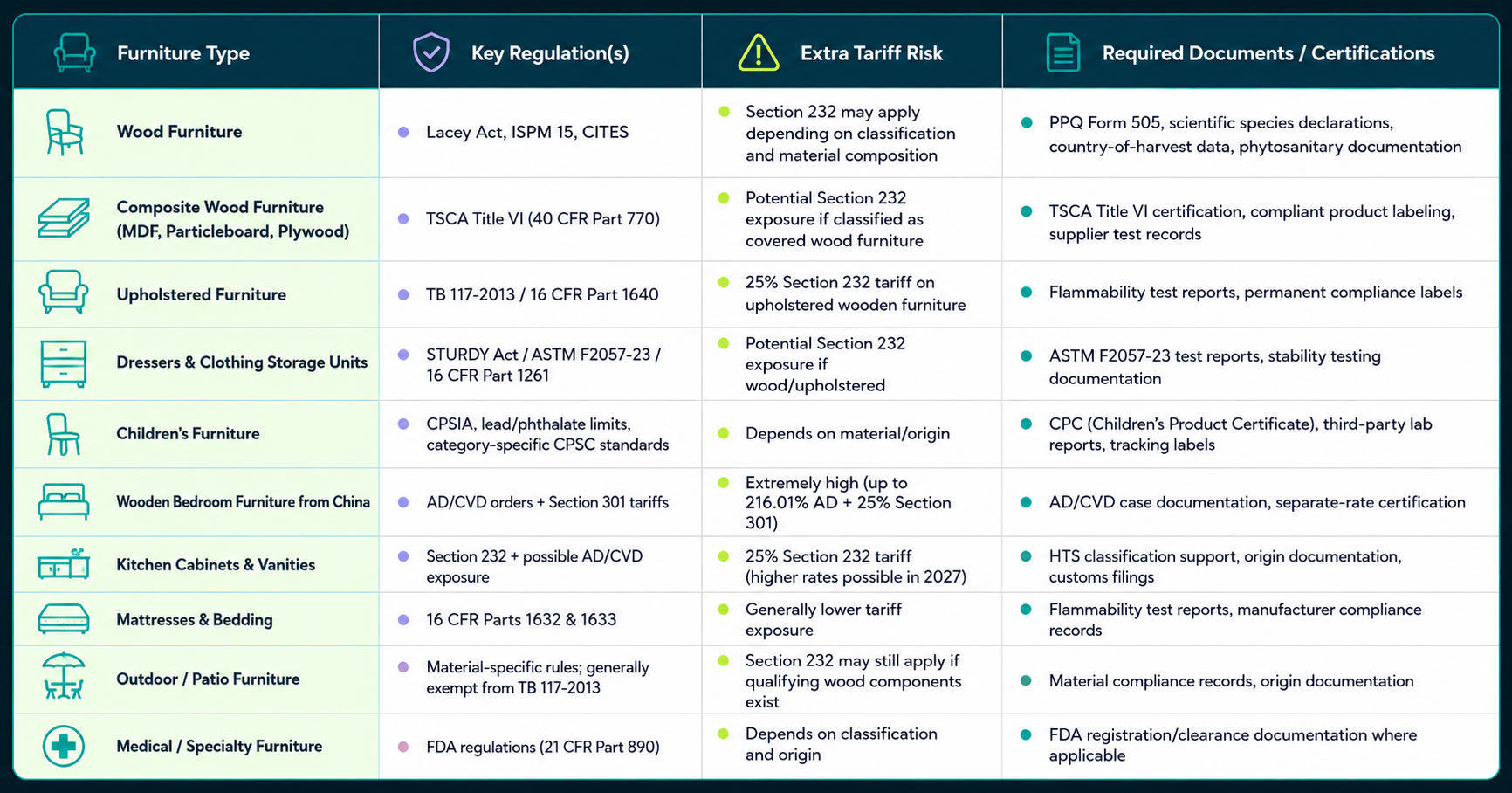
The table below summarizes the main compliance triggers, tariff risks, and required documentation by furniture category.
Wood Furniture – Lacey Act, APHIS Heat Treatment, and CITES
Anything containing solid wood components triggers three regulatory layers worth knowing.
The Lacey Act prohibits trade in plant or plant products harvested in violation of US or any foreign law. The statute carries no innocent-owner defense. Importers must do due diligence on the legality of harvest, even when working through Chinese, Vietnamese, or Indonesian suppliers.
Phase VII of the Act’s implementation went live on December 1, 2024, adding approximately 450 HTS codes to the declaration requirement. Furniture is now squarely in scope. The declaration is filed on PPQ Form 505 and captures the scientific name (genus and species) of every plant component, the country of harvest, the value, and the quantity. Generic entries like “wood” or “various” no longer satisfy the requirement.
As of January 1, 2026, APHIS no longer accepts paper PPQ 505 submissions. All declarations now flow through ACE or through APHIS’s Lacey Act Web Governance System (LAWGS). Importers who relied on paper filings in the past need to be set up in one of those systems before their next entry.
APHIS also requires wood packaging material and solid wood components in some cases to be heat-treated to a core temperature of 56°C (132.8°F) for at least 30 minutes, or treated with an approved chemical fumigation. The standard is documented under ISPM 15, and untreated wood is a frequent reason for cargo holds.
CITES applies if your product contains an endangered species. Brazilian rosewood, certain mahoganies, ramin, and a growing list of rosewood species are restricted. Furniture containing CITES-listed species needs additional permits and may be flat-out prohibited from US commerce regardless of harvest legality.
A de minimis exception applies for incidental plant material at or below 5% by weight per HTS line and a total of 2.9 kg, primarily relevant for items where wood is a minor accent material rather than the main component.
Composite Wood Furniture – TSCA Title VI Formaldehyde Standards
If your furniture uses MDF, particleboard, or hardwood plywood – and most affordable e-commerce furniture does – TSCA Title VI applies.
The Formaldehyde Standards for Composite Wood Products under TSCA Title VI sit at 40 CFR Part 770. The standards cover hardwood plywood, medium-density fiberboard (MDF), and particleboard, as well as any finished good containing those panels. The panel producer carries the testing burden, working with an EPA-recognized Third-Party Certifier (TPC).
For importers, the obligations are documentation and labeling. Each finished product must be labeled by the fabricator at the point of manufacture, and for imported goods, the label must be in place by the date of importation, not the date the goods arrive at your warehouse. The label needs to identify the fabricator, the month and year of production, and include a TSCA Title VI compliance statement.
Records have to be kept for at least three years and need to include invoices or bills of lading bearing the compliance statement. Import certification is filed electronically through ACE; both EPA and CBP can place entries on hold for missing certification or labels.
Marketplace pressure on TSCA documentation has been escalating. Wayfair and Amazon increasingly request TSCA Title VI documentation as part of their seller onboarding for new composite-wood SKUs, and missing paperwork is a routine reason for listing suspensions even when CBP has cleared the goods.
Upholstered Furniture – TB 117-2013 / 16 CFR Part 1640 Flammability
The federal flammability standard for upholstered furniture is one of the most poorly understood compliance areas, partly because it became federal relatively recently.
Since June 25, 2021, all upholstered furniture manufactured, imported, or reupholstered for the US market must comply with California Technical Bulletin 117-2013, which is now codified federally at 16 CFR Part 1640. The standard applies a smolder-resistance test to cover fabrics, barrier materials, resilient filling, and decking on upholstered furniture intended for indoor use.
The labeling requirement, in force since June 25, 2022, requires a permanent label reading: “Complies with U.S. CPSC requirements for upholstered furniture flammability.” For products also sold into California, the SB-1019 flame-retardant disclosure label remains a separate state-level obligation.
Exemptions exist for outdoor cushions, items with less than half an inch of filling, certain children’s products with their own product safety regimes, and prescription medical furniture, but they are narrow and should be confirmed with a testing lab before assuming any SKU is exempt. Mislabeling can trigger Section 15(b) reporting obligations and CPSC-led recalls, which are expensive and reputationally damaging for any marketplace seller.
Clothing Storage Units – STURDY Act and ASTM F2057-23
Dressers, chests, armoires, and wardrobes are categories that move enormous volume on Amazon and Wayfair, and they are now subject to a mandatory federal stability standard.
The STURDY Act (“Stop Tip-overs of Unstable, Risky Dressers on Youth”) was signed into law in December 2022. The CPSC voted on April 19, 2023, to adopt ASTM F2057-23 as the mandatory consumer product safety standard, codified at 16 CFR Part 1261, with an effective date of September 1, 2023.
The standard applies to free-standing clothing storage items intended for bedroom use, including chests, drawer chests, armoires, chifforobes, bureaus, door chests, and dressers. Coverage triggers when all three of these criteria are met: the unit is at least 27 inches tall, weighs at least 30 pounds, and contains at least 3.2 cubic feet of enclosed storage volume.
The testing protocol includes a simulated clothing load test (drawers and shelves loaded at 8.5 pounds per cubic foot), a horizontal dynamic force test, and a carpet-tilt stability test with a simulated child weight. Units shipped with drawer interlocks must pass an additional set of requirements ensuring the interlocks engage automatically and don’t require consumer assembly.
The safety case behind the rule is significant. CPSC data through 2022 documented 234 fatalities and approximately 84,100 ED-treated injuries between 2000 and 2022, with roughly 80% of fatalities involving children under 72 months. Amazon and Wayfair have both been aggressive about delisting non-compliant ASINs since the standard took effect, and a missing test report is one of the fastest routes to an inbound shipment refusal.
Children’s Furniture – CPSIA, Lead, Phthalates, and Tracking Labels
Anything intended for use by children under 12 picks up an additional layer of compliance that goes well beyond adult furniture rules. The Consumer Product Safety Improvement Act of 2008 requires third-party testing for children’s products, and furniture is included.
Children’s furniture covered by CPSIA includes full-size cribs, non-full-size cribs, toddler beds, bunk beds, kids’ tables and chairs, toy chests, and any chest, dresser, or storage unit designed and marketed for children. Material limits include lead at 100 ppm in accessible substrate and 90 ppm in surface coatings, and a 0.1% combined limit on eight regulated phthalates (DEHP, DBP, BBP, DINP, DIBP, DPENP, DHEXP, and DCHP).
Importers must issue a Children’s Product Certificate (CPC) for each product, citing each applicable safety standard, identifying the CPSC-accepted Third-Party Testing Laboratory that performed the testing, and listing the dates and location of testing. Every product, and every package, requires a permanent tracking label that identifies the manufacturer, the location and date of production, and the batch or run.
Category-specific standards apply on top of the general CPSIA framework. 16 CFR Part 1219 governs full-size cribs, Part 1220 covers non-full-size cribs, Part 1213 covers bunk beds, Part 1217 covers toddler beds, and Part 1224 covers portable bed rails. Each carries its own test and labeling expectations.
Missing CPCs and missing tracking labels remain among the top reasons for Amazon children’s furniture ASIN suspensions, and Amazon routinely requests test reports even when CBP has cleared the goods.
Other Categories Worth Flagging
A few edge cases come up often enough to be worth a quick note.
Office and ergonomic furniture is generally clear of special triggers, though chairs marketed for specific medical conditions can move into FDA medical device territory under 21 CFR Part 890. Mattresses and bedding live under a separate regime: 16 CFR Part 1632 covers cigarette ignition and 16 CFR Part 1633 covers open flame. Outdoor and patio furniture is exempt from TB 117-2013 but still subject to Section 232 if it contains qualifying wood components. Dental chairs, hospital beds, and veterinary furniture fall under FDA medical device regulations and need to be cleared with that framework before any import planning.
How to Import Furniture to the USA: The Process Step by Step
The work that determines whether a furniture import goes smoothly happens before the container ever moves. Below is the operational sequence, in the order you actually go through it.
Step 1 – Qualify Your Supplier and Lock Down Origin
The pre-shipment phase is where you prevent the biggest landed-cost surprises. Confirm country of origin and the substantial transformation analysis up front, especially for Vietnam, Malaysia, or Cambodia sourcing that may involve Chinese components. Request the scientific names and harvest countries for every plant component for the Lacey Act declaration before placing the PO, not after.
Pull TSCA Title VI compliance documentation for any composite wood content. Request TB 117-2013 test reports for any upholstered SKU. Request ASTM F2057-23 reports for any clothing storage unit in scope. Request CPCs and category-specific test reports for any children’s product. For China-origin items subject to AD/CVD, confirm whether your supplier holds a separate rate with the Department of Commerce, and verify the Commerce case number with your broker.
Step 2 – Get Your Importer of Record Status in Order
Before any freight moves, you need to be set up as an Importer of Record with CBP. The registration is filed using CBP Form 5106, the Create/Update Importer Identity Form.
You will need a customs bond – either a single entry bond per shipment or, more economically for any regular importer, a continuous bond. Continuous bonds typically pay back the upfront cost after three to four shipments per year. For Chinese-origin items subject to AD/CVD, plan separately for an AD/CVD bond at 5-10x standard bond value.
Choose a customs broker with documented Chapter 94 filing volume, TSCA Title VI experience, Lacey Act PPQ 505 expertise, and current AD/CVD case knowledge. Furniture is not a generic commodity, and a broker without category experience will cost you more in misclassifications and holds than the savings on their fee.
Step 3 – Pre-Arrival Filings (ISF and Booking)
The Importer Security Filing, often called “ISF 10+2,” is the 24-hour clock that catches first-time importers off guard. The ISF must be submitted at least 24 hours before vessel loading at origin.
The 10 data elements the importer is responsible for are: seller, buyer, importer of record number, consignee number, manufacturer (or supplier), ship-to party, country of origin, HTS number, container stuffing location, and consolidator (stuffer). The carrier provides the additional two elements covering vessel stow plan and container status messages.
CBP penalties for late or inaccurate filings run up to $5,000 per violation, and chronic violators face liquidated damages claims that quickly outpace any savings from cutting corners. Your booking confirmation, commercial invoice, packing list, and bill of lading need to align with the ISF data; any mismatch is a routine cause of customs holds when the vessel arrives.
Step 4 – Arrival, Entry Filing, and Customs Release
Once the vessel lands at a US port, the entry process moves through CBP’s Automated Commercial Environment. The customs broker files CBP Form 3461 (Entry/Immediate Delivery) and CBP Form 7501 (Entry Summary). TSCA Title VI import certification and Lacey Act PPQ 505 declarations flow through ACE message sets associated with the entry.
CBP can release the goods, hold them for examination (VACIS X-ray, intensive exam, or document review), or refer them to a Partner Government Agency for review. EPA reviews TSCA-flagged entries, APHIS reviews Lacey Act entries, CPSC may pull entries for consumer product standards, and FDA may review any item with a medical or food-contact dimension.
Pro tip: The 15-day general order rule is worth understanding. If goods are not released within 15 days of arrival, they are moved to general order storage at the importer’s expense, which is particularly punishing for furniture given the volumetric storage costs. Duty payment runs through ACH or the Periodic Monthly Statement program.
Step 5 – Delivery, Prep, and Distribution
The downstream leg is where most planning falls short, especially for marketplace sellers.
For Amazon FBA, the work includes drayage from the port to a 3PL or prep warehouse, FBA labeling, polybagging, carton labeling, and pallet building to Amazon’s inbound specifications. For Wayfair, Target, and other big-box retailers, routing-guide compliance is its own art: carton dimensions, labeling, ASN/EDI transmission, and appointment scheduling at the receiving DC. For D2C operations, you need final-mile partnerships and potentially white-glove delivery integration from a US fulfillment center.
Furniture also has a higher return rate than most other product categories, and reverse logistics needs to be designed into the operation from day one rather than improvised when the first damaged sectional comes back. White-glove return retrieval, inspection, refurbishment, and resale routing all run on different operational standards than apparel or electronics.
Documents You’ll Need to Import Furniture
The document set for a furniture entry is more involved than most commodities, but it follows a predictable pattern. The commercial invoice carries the line items, HTS classification, declared value, country of origin, and Incoterms. The packing list details cartons, dimensions, and weights. The bill of lading or air waybill is the contract of carriage and the title document. The ISF filing confirmation needs to be in hand before vessel loading.
On the regulatory side, expect to need a customs bond on file, CBP Form 5106 to establish IOR identity, CBP Forms 3461 and 7501 for the entry, the PPQ 505 Lacey Act declaration, TSCA Title VI import certification (electronic via ACE), TB 117-2013 / 16 CFR 1640 test reports for any upholstered items, ASTM F2057-23 test reports for any clothing storage unit, and a Children’s Product Certificate for any item intended for children. A Certificate of Origin is essential for any free-trade-agreement preference claim and for substantiating non-China origin to head off AD/CVD inquiries. For Chinese-origin items in AD/CVD scope, your separate-rate certification is the document that controls the cash deposit rate at entry.
Organize these per shipment, not per supplier or per SKU. The audit and dispute records you may need three years later all key off the entry number, not your internal PO ID.
Shipping Options for Furniture Imports
Furniture is bulky, heavy, and the value-to-volume ratio strongly favors ocean. Most importers move by ocean, with occasional air freight for sample replenishment or peak-season stockout recovery.
Ocean Freight – FCL vs LCL
Ocean freight is the default for any meaningful volume. Full container load (FCL) becomes more economical above roughly 13-15 cubic meters for a 20-foot container or 26-28 CBM for a 40-foot high cube, and FCL gives you exclusive container use, reducing damage and pilferage risk significantly.
Less than container load (LCL) bills by CBM and is useful for SKU testing, sample runs, or low-volume replenishment, but per-unit costs are higher and the additional handling at consolidation and deconsolidation points raises damage risk for fragile or upholstered items.
Transit times are reasonably predictable. China to the US West Coast runs 18-25 days at sea (longer door-to-door), China to the US East Coast runs 30-40 days, Vietnam roughly the same as China, and Italian or Eastern European origins to US East Coast typically 25-35 days. Major port congestion at Long Beach/LA, Newark, Savannah, and Houston shifts these numbers periodically, and your forwarder should be modeling the current state when quoting.
Air Freight (Rare but Sometimes Needed)
Air freight is generally cost-prohibitive for furniture given volumetric weight calculations, but it has a place. High-value designer items, urgent sample-room replenishment, and peak-season stockout recovery are the realistic use cases. A rough comparison: a 40-foot high cube ocean container might cost $3,000-$5,500 from Asia in current market conditions, while moving the same cube of furniture by air can easily run into five figures.
Trucking and Drayage Once It Lands
The most-forgotten cost line is the drayage between the port and your warehouse. Container drayage typically runs $400-$900 depending on lane and chassis availability. Per-diem charges accumulate if the container is not returned within the free time window (typically three to five days at most US ports), and demurrage charges accumulate if you fail to pick up the container within the free time at the terminal. LTL trucking from the warehouse to FBA fulfillment centers or retailer DCs is a separate line, billed by class, weight, and lane.
The True Cost of Importing Furniture: A Realistic Landed-Cost Breakdown
A worked example makes the layered duty structure concrete. Consider a 40-foot high cube of upholstered wood sofas from Ho Chi Minh City, Vietnam, with an FOB declared value of $42,000.
Ocean freight from Ho Chi Minh to Los Angeles, terminal handling, and origin charges in early 2026 conditions might land around $3,800 combined. The base most-favored-nation duty on upholstered seats with wooden frames under HTS 9401.61 is 0%. The Section 232 layer at 25% on HTS 9401-classified upholstered wooden furniture adds $10,500. The Merchandise Processing Fee caps at roughly $635. The Harbor Maintenance Fee adds about $52.50 on the declared value. Brokerage and ISF combined are typically $250. Drayage from the Port of LA to a regional warehouse runs roughly $600. FBA prep, labeling, and pallet building for the same volume runs another $1,200-$2,500 depending on SKU count and packaging requirements.
Total landed cost runs roughly 1.4x to 1.7x the FOB invoice in current 2026 conditions, with the Section 232 layer being the single largest driver. That ratio depends heavily on origin: a hypothetical Chinese-origin wooden bedroom shipment subject to the 216.01%, or even north of 240% with 301 tariffs, AD rate would be uneconomic at almost any FOB, which is why China-origin bedroom furniture has largely exited US e-commerce supply chains over the last two years.
A few caveats. Rates change, often quickly. The Section 232 escalation currently scheduled for January 1, 2027 will move the upholstered wooden furniture rate to 30% and cabinets and vanities to 50% unless further extended. Reciprocal tariffs under the IEEPA framework can attach or detach based on country-specific trade negotiations. Always verify current rates against the live USITC Harmonized Tariff Schedule tool before committing a PO, and have your broker run the calculation SKU by SKU. The headline FOB price tells you almost nothing about the landed cost in 2026.
Where Furniture Importers Most Often Get Burned
Pattern recognition matters more than checklists. After enough furniture entries, the same failure modes keep recurring.
- Misclassified HTS codes that ignore the Section 232 layer. An upholstered wooden armchair classified under a “general” wooden chair heading instead of the correct upholstered subheading is a 25-percentage-point liability waiting for the CBP audit. The five-year window is real, and back duties at liquidation are not negotiable.
- Lacey Act declarations with “wood” or “various” instead of scientific names. Phase VII is in active enforcement and the paper PPQ 505 ended on January 1, 2026. Generic plant entries are a hold-and-rework situation at best.
- TSCA Title VI labels missing by the date of importation. The label has to be on the product at the point of manufacture or the point of import, not later. EPA and CBP are aligned on this and the holds are routine.
- AD/CVD exposure no one flagged at quotation. The supplier in China gets paid for the goods, and the importer eats the 216.01% duty at liquidation. The cash deposit at entry is one number; the actual liquidated duty can be different, and the importer is liable.
- Misaligned ISF and entry data. Even small inconsistencies between the ISF, the commercial invoice, the BOL, and the entry trigger CBP holds. Furniture’s volumetric storage costs make these holds disproportionately expensive.
- Marketplace compliance failures even when CBP has cleared the goods. Amazon, Walmart, and Wayfair each have separate document-request protocols. A clean CBP release does not mean a clean ASIN, and a missing CPC or missing ASTM F2057-23 test report can freeze listings for weeks while the seller scrambles to obtain documentation that should have been collected at the PO stage.
- No drawback strategy for re-exports. Section 232 drawback is available under the October 2025 proclamation. Importers shipping internationally from US fulfillment centers should be modeling drawback into the landed cost analysis, not leaving it on the table.
How Unicargo Helps Furniture Importers Stay Compliant and Profitable
Furniture is one of the categories where the answer to “what’s my landed cost” is genuinely complicated, and where the wrong forwarder costs you more than the right one ever could. At Unicargo, our furniture importer clients are usually working through some combination of the seven failure modes above when they first reach out, and our work is to design those risks out of their supply chain rather than catch them after the fact.
Here is how we approach it.
Customs and compliance, built in rather than bolted on. HTS classification, Section 232 layered duty analysis, TSCA Title VI certifications, Lacey Act PPQ 505 filings (through both ACE and LAWGS), and AD/CVD case management are handled in-house by our customs and compliance team The classification call gets made before the PO, when it can still influence sourcing decisions.
Origin and AD/CVD vetting at the supplier stage. We work with our customers on supplier-side documentation, separate-rate verification, and country-of-origin substantiation before the container leaves the factory. For furniture importers actively diversifying out of China to Vietnam, Malaysia, or Indonesia, we verify that the substantial transformation analysis holds up – not after the goods land, but before the deposit is wired.
End-to-end visibility on one timeline. Our digital platform pulls PO management, ocean booking, container tracking, customs release, drayage, warehousing, and FBA prep onto a single operational view. When a Section 232 escalation gets announced, when CBP changes an ACE message set, when Amazon updates inbound requirements – the impact lands on a single dashboard rather than five vendor portals.
Amazon and marketplace expertise. We are an Amazon Service Provider Network (SPN) partner and have been moving furniture into Amazon FBA from the early days of the program. Our Amazon FBA services cover prep, labeling, polybagging, and inbound scheduling to Amazon, Walmart, and Wayfair specs. Routing-guide compliance is treated as part of the import lifecycle, not a separate scramble at the warehouse.
Global footprint where furniture is actually manufactured. Our China team works in supplier time zones and walks factory floors in Foshan, Dongguan, and elsewhere. Our Vietnam coverage has expanded with the China-to-Vietnam shift in furniture sourcing. The US team is aligned to customer time zones for entry, drayage, and last-mile coordination. Three continents, one operation.
D2C fulfillment and reverse logistics under one roof. Furniture has a high return rate by category, and the reverse leg is where most operations fall down. We design inbound import, fulfillment, and returns processing as one integrated workflow rather than three separate vendors handing problems back and forth.
If you are working through a specific furniture import scenario – a new Section 232 exposure analysis, an AD/CVD risk assessment on a supplier change, a marketplace compliance review on existing SKUs, or a clean-sheet landed-cost model on a category you are about to launch – we are glad to walk through it with you. Reach out to our team and we will model the actual numbers for your SKU mix.
FAQ
Can you import furniture into the US? Yes. Almost any type of furniture can be commercially imported into the United States, including upholstered, wooden, metal, glass, rattan, and outdoor furniture. Limited exceptions apply to CITES-listed endangered woods (such as Brazilian rosewood) and lead-paint non-compliant items. The complexity sits in the tariff stack and the compliance requirements, not in admissibility.
Are there US tariffs on furniture? Yes, and the structure is layered. Base most-favored-nation duty rates are 0% from NTR countries for most wood furniture, but Section 232 tariffs (25% on upholstered wood furniture and kitchen cabinets/vanities since October 14, 2025) stack on top of the base rate. Antidumping duties on Chinese wooden bedroom furniture run as high as 216.01% under the China-wide entity rate, with an additional 301 Tariffs 25%. IEEPA or reciprocal tariffs may also attach depending on country of origin and the policy environment at time of entry.
Do you have to declare furniture at customs? Yes. All commercial furniture imports require formal customs entry, regardless of value above $2,500. Personal household effects that the owner used abroad for at least one year before importation can typically enter duty-free under CBP Form 3299, but anything imported for resale on Amazon, Walmart, Wayfair, your own website, or any other channel is a commercial entry that requires the full documentation set.
What is the Lacey Act and does it apply to my furniture? The Lacey Act prohibits trade in plant or plant products harvested in violation of US or foreign law. Phase VII of the Act’s implementation, effective December 1, 2024, expanded mandatory declaration requirements to roughly 450 HTS codes, sweeping most furniture into scope. If your product contains plant material, you almost certainly need to file a PPQ Form 505 declaration capturing the scientific name and country of harvest of every plant component. As of January 1, 2026, declarations must be filed electronically through ACE or LAWGS – paper PPQ 505 submissions are no longer accepted.
What is the true cost of importing furniture to the USA? Plan for landed cost at roughly 1.4x to 1.7x of the FOB invoice in 2026, driven primarily by 301 Tariffs, the Section 232 layer on upholstered wood furniture and cabinets/vanities, plus ocean freight, MPF/HMF, brokerage, drayage, and prep. The exact multiplier depends on origin (Chinese-origin bedroom furniture with AD/CVD is significantly higher), product category, and the current state of reciprocal tariff negotiations. Have your customs broker run a SKU-level landed-cost calculation against the live Harmonized Tariff Schedule before any PO is committed, not after the goods are at sea.